At last month’s Optica + APC Photonic-Enabled Cloud Computing (PECC) Summit, Andy Bechtolsheim, Chief Architect and Chairman of Arista Networks, closed the event with a characteristically data-driven argument for why pluggable optics remain the backbone of cloud and AI networks, even as the industry experiments with co-packaged and near-package optics.

“CPO has great promise, but 99.9% of all optics shipped today are still pluggables — and that number is growing,” Bechtolsheim said. “The industry will ship over one million high-speed pluggable modules annually by 2027.” He noted that while new interconnect paradigms are emerging, low power, manufacturability, and flexibility continue to make pluggables the preferred solution for most network operators.
Bechtolsheim reviewed recent trends and provided detailed guidance on the next two generations of Ethernet optics:
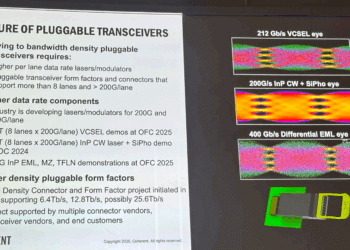
• Ramp to 1.6T optics – The transition from 800G to 1.6T (200G per lane) is now in sampling and expected to exceed 800G volumes by 2027. Early results from Arista’s lab show clean performance with Linear Pluggable Optics (LPO)at 1.6T, although package reflections at the BGA interface will require improved flyover cables or direct package connections.
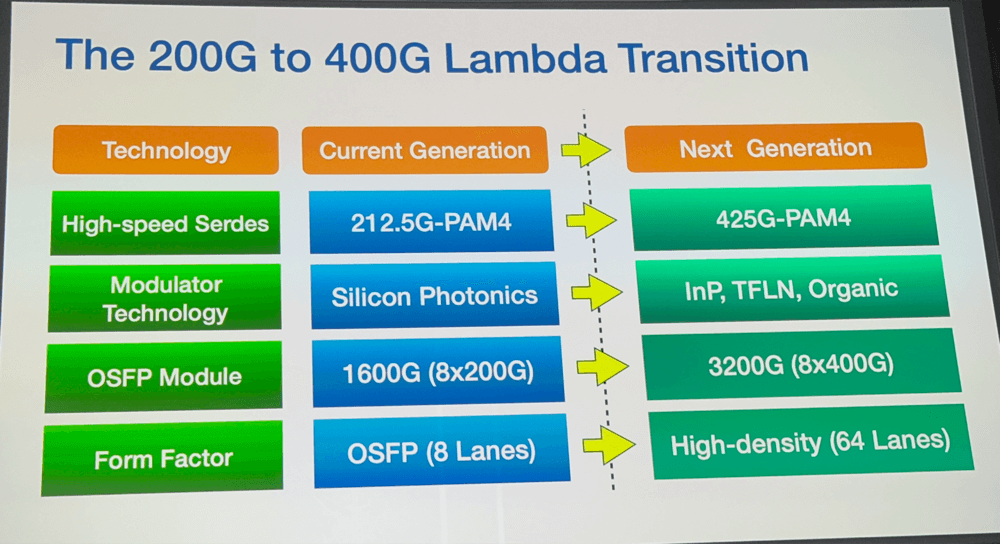
• Toward 3.2T (400G per lane) – Early research modules using InP and thin-film lithium niobate modulators demonstrate feasibility, but new connectors and form factors will be essential to handle the higher frequencies and power densities.
• Power efficiency gains – The shift from DSP-based optics to Linear-Receive-Only (LRO) and LPO modules reduces optical power by 30–65% compared to traditional retimed designs. Combining this with switch ASIC power reductions from 5 nm to 3 nm process nodes yields significant system-level savings.
• Technology diversification inside modules – A major trend toward silicon photonics continues for manufacturability and cost, but Bechtolsheim expects InP, VCSEL, and emerging organic/EOM technologies to play key roles in low-power short-reach applications. “The beauty of pluggables,” he said, “is that they can host all of these technologies under one standard form factor.”
• Manufacturing scale – To meet exploding demand, optics manufacturers are building fully automated high-volume production lines, with capacity doubling by 2027. Automated assembly and test reduce human handling, improving yield and consistency.
• Connector and electrical channel evolution – Current OCP connector designs are insufficient for 400G-per-lane signaling; new high-density connectors are under development to support PAM4 and future PAM6 signaling across shorter electrical reaches.
Bechtolsheim also presented new simulation results from Arista’s signal integrity labs, showing that 1.2-meter co-packaged copper cables using 31AWG wire can achieve 40–41 dB insertion loss and maintain an ACOM >3, confirming that advanced copper interconnects remain viable up to 425 Gb/s per lane. “Copper still has legs,” he noted. “It’s far cheaper than optics for short reaches — and with better packaging, we can extend it another generation.”
On power and reliability, Bechtolsheim projected that liquid-cooled switches will further enhance module lifespan. “The difference between operating optics at 75°C versus 45°C can be an order of magnitude in lifetime,” he said, predicting that next-generation liquid-cooled systems will improve both energy efficiency and optical reliability.
While acknowledging that co-packaged optics will eventually find its place, Bechtolsheim concluded that pluggables will remain dominant well into the next decade, supported by the ecosystem’s maturity, flexibility, and economies of scale. “CPO is exciting,” he said, “but practical systems depend on power, cost, and volume — and that’s still the world of pluggables.”


🌐 We’re tracking the latest advances in AI photonics and optical interconnects at https://convergedigest.com/category/photonics