AST SpaceMobile signed a definitive commercial agreement with Verizon to deliver space-based cellular broadband service across the continental United States beginning in 2026. The deal expands the companies’ strategic partnership announced in May 2024 and marks a key milestone in bringing direct-to-device connectivity to Verizon customers using standard smartphones.
The agreement combines Verizon’s terrestrial mobile network and 850 MHz low-band spectrum with AST SpaceMobile’s low Earth orbit (LEO) satellite network. This hybrid approach aims to extend service coverage beyond traditional terrestrial boundaries—providing connectivity to users in remote and underserved areas without requiring specialized satellite phones. AST SpaceMobile’s constellation features the largest commercial communications arrays ever deployed in LEO, capable of operating across its licensed L-band and S-band spectrum and up to 1,150 MHz of partner spectrum globally.
Earlier trials demonstrated successful voice, video, and RCS messaging between unmodified Verizon smartphones and AST’s BlueBird satellite, including a VoLTE call from Texas to New Jersey. The companies said the tests validated direct satellite-to-smartphone communications over Verizon’s commercial network and will serve as the foundation for commercial deployment.
• AST SpaceMobile’s network to connect directly to everyday smartphones without specialized hardware
• Verizon to leverage 850 MHz spectrum for nationwide hybrid terrestrial-satellite coverage
• Commercial service expected to launch in 2026
• Successful live tests validated VoLTE and data sessions between Verizon users over satellite
• AST SpaceMobile’s LEO network to support both commercial and government applications
“Through our definitive commercial agreement with Verizon, we are working to deliver space-based cellular broadband coverage from space across the continental United States,” said Abel Avellan, Founder, Chairman and CEO of AST SpaceMobile.
🌐 Analysis:
This agreement solidifies Verizon’s strategy to enhance coverage through non-terrestrial networks, complementing its fixed wireless and fiber deployments. It also positions Verizon competitively against AT&T’s collaboration with AST and T-Mobile’s partnership with SpaceX for direct-to-cell services. For AST SpaceMobile, the Verizon deal provides a major anchor customer in the U.S. market ahead of commercial service activation, reinforcing investor confidence in its hybrid satellite-cellular approach.
AST SpaceMobile: Company Backgrounder
AST SpaceMobile, Inc. (NASDAQ: ASTS) is developing what it calls the first space-based cellular broadband network designed to connect directly with everyday smartphones. Its low Earth orbit (LEO) satellites communicate on standard mobile network operator (MNO) spectrum, allowing 4G and 5G service without specialized satellite hardware. The company’s mission is to bridge coverage gaps across rural, remote, and maritime regions while complementing terrestrial networks through partnerships with AT&T, Verizon, Vodafone, Rakuten, and others. AST SpaceMobile remains in its pre-commercial phase as of October 2025, targeting beta service by late 2025 and full consumer rollout in 2026.
Headquartered in Midland, Texas, AST operates out of a purpose-built 85,000-square-foot facility within the Midland International Air and Space Port—the first U.S. commercial airport with an FAA spaceport license. This site supports large-scale satellite assembly and testing. Founder and CEO Abel Avellan, a Costa Rican-born telecom entrepreneur who previously built and sold Emerging Markets Communications (EMC) for $550 million, established AST & Science in 2017 and led it through a 2021 SPAC merger that raised $462 million. Avellan continues to drive the company’s technical roadmap and global operator alliances.
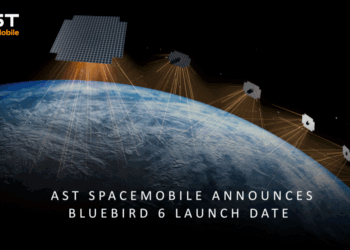
AST SpaceMobile’s core innovation is its SpaceMobile constellation—massive phased-array satellites capable of connecting directly to unmodified phones. The 693-square-foot (64.3 m²) BlueWalker-3 test satellite validated this concept in 2023 with the first two-way voice and 5G data calls from space. The company’s BlueBird production satellites are larger and more capable, built at its Midland site with vertically integrated manufacturing. The system operates across AST’s licensed L- and S-band frequencies and up to 1,150 MHz of partner low- and mid-band spectrum worldwide.
AST SpaceMobile’s published satellite roadmap outlines a clear progression toward scaled commercial service through successive generations of its BlueBird platform. The company’s current Block 1 BlueBirds—five launched in early 2025 with 693 sq ft (64.3 m²) antennas—will deliver foundational, non-continuous connectivity starting late 2025, offering roughly ten times the throughput of the BlueWalker-3 prototype. The immediate focus is Block 2, a next-generation design featuring 2,400 sq ft (223 m²) phased-array antennas—three times larger than Block 1—and custom AST 5000 ASICs for improved power efficiency and signal processing. Each Block 2 unit supports peak data rates up to 120 Mbps per beam and a seven-year design life.
The first Block 2 launched in July 2025 aboard India’s GSLV, with production ramping to six satellites per month and five missions planned through early 2026 using SpaceX Falcon 9 and Blue Origin New Glenn vehicles. AST targets 60 operational satellites by end-2026 to enable U.S. beta services with AT&T and Verizon, expanding to 90 Block 2 units by 2027 for global non-continuous coverage and 243 by 2028 per FCC filings. While per-unit manufacturing costs have edged up to $21–23 million due to tariffs, AST’s vertically integrated Midland facility supports high-volume scalability. Future post-Block 2 iterations will emphasize even higher throughput—potentially 100× BlueWalker 3 performance—and advanced interference management to support an addressable base exceeding 2.8 billion MNO subscribers worldwide.
AST SpaceMobile — Key Milestones (as of 08-October-2025)
| Date | Milestone | Details / Significance |
|---|---|---|
| May 2017 | Company founded | Abel Avellan establishes AST & Science LLC in Miami to develop direct-to-device (D2D) satellite connectivity. |
| Mar 2018 | Acquires NanoAvionics stake | Secures small-satellite manufacturing capability (Lithuania) for early prototyping and LEO design validation. |
| Nov 2018 | Midland HQ announced | 85 000 sq ft manufacturing facility at Midland International Air & Space Port; $30 million investment. |
| Mar 2019 | First orbital test (“Micron” satellite) | Launched on Rocket Lab Electron; validated antenna deployment and initial D2D signal capture from orbit. |
| Apr 2019 | FCC experimental authorization | Receives first U.S. license for prototype testing and spectrum coordination in low-band frequencies. |
| Mar 2020 | Series B funding ($110 M) | Vodafone and Rakuten lead investment; Samsung Next and American Tower join as strategic partners. |
| Apr 2021 | SPAC merger and Nasdaq listing | AST merges with New Providence Acquisition Corp., raising $462 M; trades as ASTS on Nasdaq. |
| Jul 2021 | Gateway development begins | Establishes U.S. and European gateway sites for backhaul and integration with MNO cores. |
| Sept 2022 | BlueWalker-3 launch (SpaceX Falcon 9) | 693 sq ft (64.3 m²) phased-array antenna successfully deployed — largest commercial array in LEO to date. |
| Apr 2023 | First space-to-phone voice call | Two-way VoLTE call between Texas and Japan via BlueWalker-3 and Vodafone network; proof of D2D concept. |
| May 2023 | RCS messaging and data tests | Demonstrates two-way RCS texting and data sessions over AT&T spectrum on unmodified phones. |
| Sept 2023 | First 5G connectivity from space | Achieves ~14 Mbps download to standard smartphone — first 5G signal direct from LEO satellite. |
| Jan 2024 | $110 M convertible funding round | AT&T, Google and Vodafone invest; AT&T and Vodafone add $45 M in prepaid service commitments. |
| Apr 2024 | FCC experimental license renewal | Renews authority for next BlueBird missions and expanded gateway tests in Texas and Hawaii. |
| May 2024 | Verizon partnership announced | Strategic deal to integrate AST service with Verizon network; value reported around $100 M. |
| Sept 12 2024 | First five Block 1 BlueBirds launched (SpaceX Falcon 9) | Initial operational fleet; establishes foundational coverage for U.S. and Latin America test markets. |
| Oct 2024 | U.S. Government contract award | Wins federal engineering support deal for satellite cellular resilience and emergency response applications. |
| Jun 2025 | Block 2 BlueBird manufacturing initiated | First next-gen satellites enter assembly at Midland facility; ramp toward six units per month target. |
| Jul 2025 | First Block 2 BlueBird launch (GSLV India) | Debut of 2 400 sq ft (223 m²) array with AST 5000 ASICs; 10× capacity over Block 1, 120 Mbps peak rate. |
| Nov 2025 (planned) | Second Block 2 batch launch (SpaceX Falcon 9) | Adds 5–6 satellites to support U.S. beta service for AT&T and Verizon customers. |
| Sept 2025 | Partnership expands to Latin America | Signs agreements with América Móvil and Telefónica for regional integration tests and coverage trials. |
| Oct 8 2025 | Definitive commercial agreement with Verizon | Formal U.S. deployment contract for 2026 service using 850 MHz spectrum and LEO backhaul integration. |
🌐 We’re tracking the latest developments in satellite-to-cell and hybrid space-terrestrial networks. Follow our ongoing coverage at: https://convergedigest.com/category/satellite/