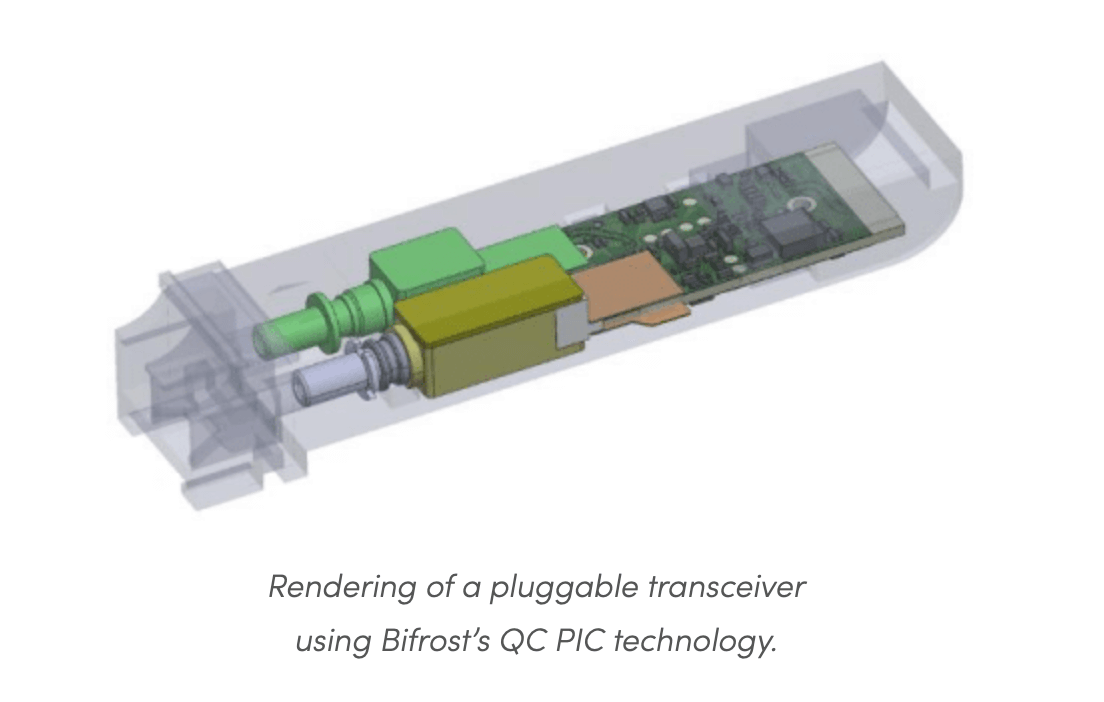
Bifrost has introduced a DSP-free 25 Gbps quasi-coherent (QC) transceiver capable of 40 km reach, developed in collaboration with Semtech. The solution uses Bifrost’s photonic integrated circuit (PIC) technology and Semtech’s GN2146 clock and data recovery (CDR) device to deliver longer reach and near-zero latency without relying on digital signal processing. The company will showcase the transceiver at ECOC 2025 in Copenhagen, hosted at the Danish Pavilion.
The QC transceiver is designed for seamless upgrades from 10 Gbps to 25 Gbps in DWDM networks and supports filterless operation with a wavelength-selective receiver. Key advantages include lower cost, reduced power consumption, and compact SFP28/56 compatibility. Bifrost emphasized the European design and production footprint, with R&D based in Denmark and manufacturing carried out in Belgium. A 50 Gbps PAM4-based version with 20 km reach, targeting 6G fronthaul requirements set by the Mobile Optical Pluggables Alliance (MOPA), is expected to follow.
Bifrost’s roadmap also includes DSP-free 25 Gbps solutions with 80 km reach, 50 Gbps with 40 km reach, and 100 Gbps with 20 km reach. The company announced a production partnership with ESTEL Optical Transceiver Production Company in Belgium, which it says operates the only fully European transceiver manufacturing line.
• 25 Gbps QC transceiver supports 40 km reach using Semtech’s GN2146 CDR
• Compact, DSP-free, PIC-based design with near-zero latency and lower power
• Upgrade path from 10 Gbps to 25 Gbps in DWDM deployments
• 50 Gbps PAM4 version in development for 6G fronthaul, targeting 20 km reach
• Roadmap includes 25G 80 km, 50G 40 km, and 100G 20 km QC solutions
• European R&D in Denmark, production via ESTEL in Belgium
“Our QC technology, in combination with Semtech’s CDR, enables efficient 25 Gbps transmission over 40 km in the C-band,” said Jesper Bevensee Jensen, CTO of Bifrost Communication.
🌐 Analysis: Bifrost’s push into DSP-free transceivers highlights a growing trend toward lowering cost, latency, and power consumption in optical modules. The collaboration with Semtech positions the solution within the broader ecosystem of fronthaul and metro access deployments, where efficient 25–50 Gbps optics are in high demand. The European manufacturing angle also adds a strategic dimension, aligning with regional efforts to localize semiconductor and optical supply chains. Competitors such as Inphi (Marvell), Broadcom, and Acacia (Cisco) have focused heavily on DSP-based coherent solutions, making Bifrost’s analog dispersion-compensated approach a notable differentiation.
🌐 We’re tracking the latest developments at ECOC25 in Copenhagen. Follow our ongoing coverage at https://convergedigest.com/tag/ecoc25/