While SpaceX is planning to encircle the planet with thousands of satellites for delivering broadband Internet access, another venture, known as Ligado Networks, has come up with a plan to salvage the power of the largest commercial satellite ever launched to deliver connectivity over North America for the growing Internet of Things (IoT) sector, and possibly as a boost for 5G networks.
Ligado Networks is a privately-backed company based in Reston, Virginia, with investors including Centerbridge Partners, Fortress Investment Group and JPMorgan Chase & Co. From the big hitting industry execs on the leadership team it is clear the company is serious. Ivan Seidenberg, a former chairman of Verizon Communications, serves as chairman. Also on the board of directors is Timothy Donahue, former executive chairman of Sprint Nextel and former president and CEO of Nextel Communications, and Reed Hundt, the former Federal Communications Commission. Doug Smith serves as Ligado’s president and CEO; he is known for his work in engineering and launching nationwide networks for GTE, Nextel, Sprint Nextel and Clearwire.
Picking up the pieces from LightSquared, SkyTerra and Mobile Satellite Ventures
Ligado Networks, previously known as LightSquared, emerged from bankruptcy reorganisation in 2016 with a new plan, or rather a new version of an old plan. The company controls 40 MHz of nationwide spectrum licenses in the L-Band (1500 to 1700 MHz), which it acquired in 2010 through its purchase of SkyTerra, another bold start-up that envisioned transforming the U.S. mobile scene with satellite communications.
Prior to 2008, SkyTerra was known as Mobile Satellite Ventures and had successfully operated the MSAT-1 and MSAT-2 satellites for over a decade. As 4G LTE technologies neared, the company set its sights and going big. The business plan evolved from pure mobile satellite to a hybrid design where the satellite connectivity would be used to augment terrestrial mobile communications. This would mean using the same spectrum bands from ground based base station as well as from the satellite. The company changed its name to SkyTerra and was acquired by Philip Falcone’s Harbinger Capital Partners acquired SkyTerra in March 2010. Harbinger invested about $2.9 billion in assets and soon raised more than $2.3 billion in debt and equity financing.
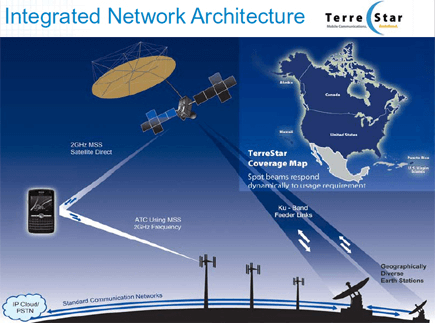
SkyTerra soon became known for its massive SkyTerra 1 satellite, which weighed a record 6,910 kg. The satellite was built at Space Systems/Loral’s Palo Alto, California facility. It operates in two 10 MHz blocks of contiguous MSS spectrum in the 2 GHz band throughout the U.S. and Canada. Notably, the satellite uniquely features an 18-metre reflector and an S-band feed array with 500 spot beams. In November 2010, SkyTerra 1 was successfully launched from the Baikonur Cosmodrome in Kazakhstan.
SkyTerra changed its name to LightSquared and in January 2011 was granted a conditional waiver by the FCC to test its network if it could be shown that the service would not interfere with GPS signals. This alarmed many GPS advocates, who argued that the L-band spectrum was simply too close to its own and that even a little interference could have serious consequences for the military, aviation, agriculture and other vertical sectors that rely on precise navigation.
In February 2012, the company received its greatest setback when the FCC withdrew its conditional approval for LightSquared network due to the potential interference concerns with GPS receivers. In June 2012, the U.S. Securities and Exchange Commission filed securities fraud charges against Philip Falcone and Harbinger Capital Partners; the case was settled in June 2013. For LightSquared, the game was over and it was soon forced into the bankruptcy courts. In addition to the technical, legal and financial challenges, LighSquared also faced allegations of political favouritism. Nevertheless, it still had the spectrum licenses and a fully functional Skyterra1 satellite parked in geostationary orbit.
Ligado Network is the new entity that in December 2015 emerged from this decade-long mess. Significantly, the company reached a settlement with the GPS industry on a technical plan to avoid interference issues by reducing the transmission power. It is not clear why a similar compromise could not have been reached in 2012. Ligado is now awaiting clearance from the FCC.
Ligado looks for its market
So back to square one, and Ligado Networks is now moving ahead with the plan to combine Skyterra1 satellite coverage with a ground-based network should FCC approval come. The goal is a ubiquitous national network whose footprint requires far fewer ground-based towers than would otherwise be required for universal coverage. The company says its mid-band spectrum is well suited for things that move, such as planes, trains and automobiles.

In its original iteration, LightSquared aimed to either compete with or partner with 4G LTE mobile services. At least one mobile handset model was developed that incorporated specialised silicon for tuning in the L-band frequency in addition to standard cellular bands. It seemed that a distribution partnership with AT&T was also in the works. For consumers, this would have meant being able to use the AT&T LTE network where available and then seamlessly roam onto the SkyTerra1 satellite service when that signal was stronger. Unfortunately, this handset was based on an old Nokia design and was not an iPhone or Android device. Even without the legal and financial issues, this business plan was not going to work.
Meanwhile, as the number of autonomous vehicles on the road rises, the strain on the mobile infrastructure will rise. Mobile operators are working to ‘densify’ their networks in preparation for 5G. This might mean more of the capex is focused on the cities and less on rural places. Satellite coverage could really help here, although the issue of latency may prove problematic for fast moving vehicles needing to connect to a geostationary bird. In addition, there is the issue of creating end-point devices tuned for the L-band spectrum. Perhaps Ligado will introduce specialised solutions for the types of vehicles it is targeting. A further issue to consider is the aging Skyterra1 satellite. It has now been in orbit for six and a half years, and most satellites are designed for a 15-year life. By the time the Ligado Network is up and running it may be approaching mid-life status and time to start planning a new one.