by Matt Williams, Field CTO, Cornelis Networks
Federal agencies are turning to AI and high-performance computing (HPC) to accelerate everything from climate models and grid planning to real-time defense simulations and fraud detection. Yet GAO notes that agencies still typically spend about 80% of their IT dollars operating and maintaining existing systems, leaving modernization chronically underfunded relative to mission demand. To close that gap, agencies need a practical blueprint that aligns system design, interconnect strategy, and procurement, so AI/HPC programs scale predictably instead of stalling at pilot stage.
Design for simulation-grade AI and HPC (not just automation)
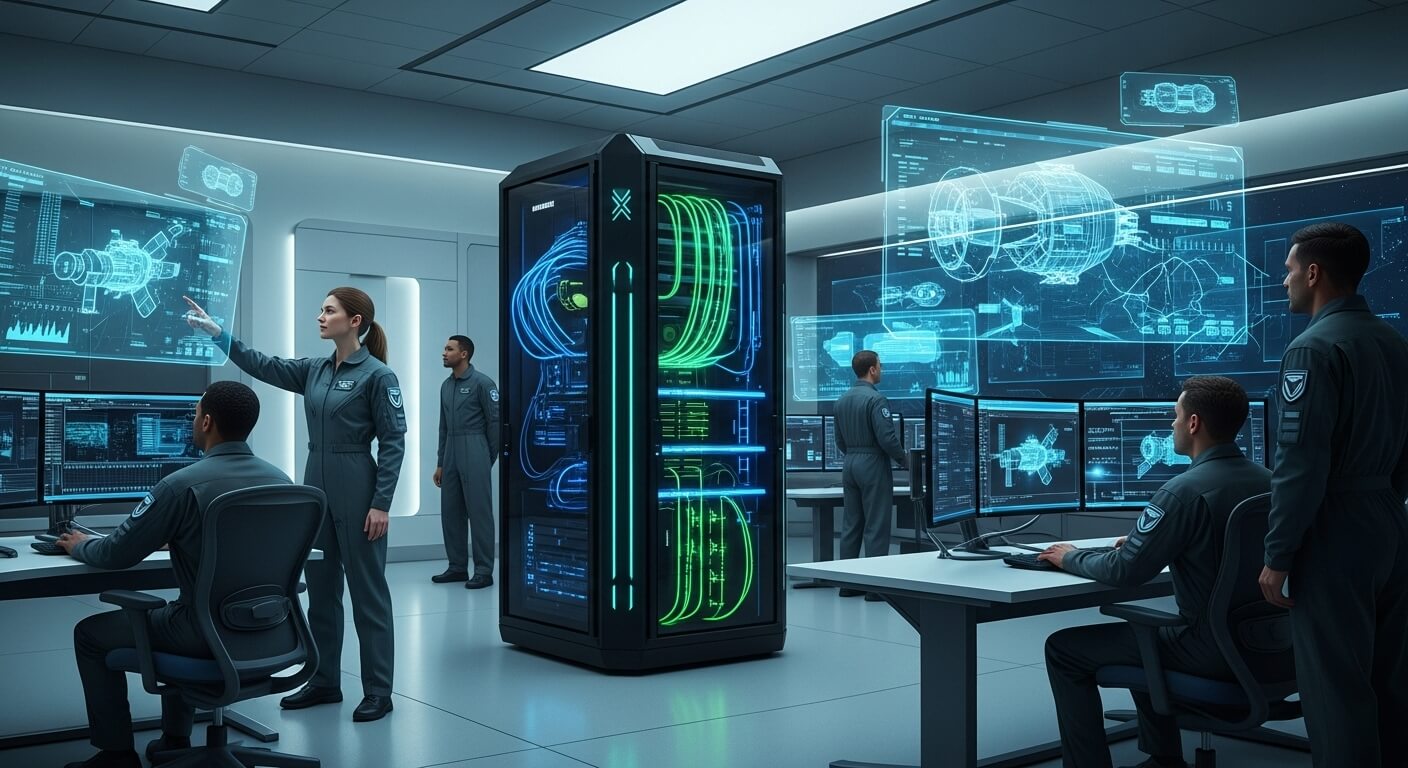
AI is changing how government operates: document triage, case prioritization, and pattern recognition are speeding service delivery and audits. But the real leap in mission impact comes when AI and HPC are combined to simulate complex, high-risk, or cost-prohibitive scenarios entirely in the digital domain. Weather and wildfire models, grid resilience planning, and force readiness simulations can be iterated far faster than physical trials, exploring more parameters at lower cost. The bar for infrastructure therefore rises from “automate a workflow” to “drive at-scale modeling and inference with tight time-to-insight requirements.”
Most agency workloads won’t require the very latest accelerator generation or hyperscale “AI factories.” Many mission use cases center on inference and light fine-tuning, where right-sized clusters, high utilization, and predictable job completion matter more than marquee silicon. Plan around measurable outcomes and keep architectural flexibility so you can slot in new accelerators as they become available, without re-architecting the stack.
Design guidance
- Co-design compute and data paths; avoid hot-path serialization and profile tail latency, not just averages, because AI collectives are latency-sensitive across the entire spectrum of responses and message sizes.
- Right-size memory and storage tiers. AI/HPC pipelines are memory- and I/O-sensitive; ensure datasets flow through DRAM, HBMs, and storage in a way that doesn’t starve the network during collectives.
- Treat observability as a first-class feature for AI: expose queue depth, packet drops, and flow completion times to the scheduler so jobs land on healthy topologies.
- Design for failure as a constant. At meaningful AI scale, network link and node faults are routine; use checkpointing policies and intelligent network infrastructure that protects against common failure scenarios (e.g. bit errors and optical module failures) and automatically reroutes and recovers so jobs keep progressing.
Make the network a co-equal to compute
Scaling modern AI/HPC is ultimately a communications problem: hundreds, thousands or even tens of thousands of nodes exchanging massive volumes of small and large messages with strict latency budgets and bandwidth requirements. Training/fine-tuning speed and simulation fidelity depend on the performance of collectives (e.g., all-reduce, all-to-all) and the network’s ability to avoid head-of-line blocking and congestion collapse.
The market is responding. Hyperion’s 2025 update projects on-prem HPC/AI server spend to exceed $47–$48B by 2029, and notes a 36.7% upward revision to market size as AI workloads proliferate. If the interconnect can’t keep up, that capital is under-utilized.
Why legacy networking approaches stumble for AI/HPC
General-purpose Ethernet and legacy InfiniBand were not designed for today’s AI/HPC scales and job mixes. Teams routinely encounter packet loss during collectives, uneven multipathing, slow or manual failure recovery, and built-in scaling limits, each of which wastes accelerator cycles. Purpose-built, open fabrics that deliver truly lossless behavior under load, topology-aware routing, and automatic congestion/failure remediation translate directly into faster time-to-solution and higher utilization.
Network blueprint for Scalable AI/HPC
- Zero-loss at scale for AI collectives. Favor fabrics/configurations that are provably lossless under load rather than relying only on deep buffers or reactive loss control.
- Latency where it matters (tail, not mean). High message rates and microbursts dominate sync steps.
- Topology-aware scheduling that reads live fabric telemetry to place jobs for locality and avoid hot links.
- Standards and interoperability. Adopt open middleware/APIs (e.g., MPI/UCX, libfabric) and emerging Ultra Ethernet approaches to avoid walled gardens.
- Self-healing operations. Prefer fabrics that auto-reroute around congestion, gracefully handle partial optical module failures, and protect from link failures, so humans aren’t hand-holding the network at AI scale.
Procure for performance and resilience (not just price)
Modernization isn’t purely technical—it’s a procurement challenge. The fastest AI/HPC systems are built in open, competitive ecosystems where multiple vendors can prove performance, scalability, and TCO against the same benchmarks and workloads.
Avoid AI/HPC vendor lock-in. Lead times, supply constraints, and rapid model/simulation churn make 12–18-month bets on a single, closed ecosystem risky. Specify interoperability so you can mix accelerator generations and vendors over time, add new device classes, and keep program optionality.
Procurement playbook
- Benchmark what you’ll actually run (AI + HPC): mission datasets, real collectives, real scaling factors. Reward sustained performance and predictable latency.
- Mandate multi-vendor interoperability: open standards, portable software stacks, and published APIs to prevent future dead-ends.
- Score for operability: time-to-deploy, observability, and automated remediation.
- Total cost over lifecycle: utilization targets, energy efficiency, cooling, and staff time, because idle accelerators and congested links are hidden costs.
- Domestic supply chain and R&D. Favor solutions that strengthen U.S. innovation while meeting performance goals.
A reference architecture for federal AI/HPC pods
While each mission is unique, agencies can accelerate time-to-value by standardizing a pod-based reference that composes cleanly into larger systems:
- Compute: Mix of CPUs and accelerators sized to workload (training vs. inference; CFD vs. graph analytics), with sufficient HBM/DRAM to keep links saturated without thrashing.
- Interconnect: A lossless, low-latency network designed to maintain application performance at scale and handle common operational failure scenarios.
- Storage & data: Parallel file system for checkpoints and results; fast object tier; policy-driven data placement near compute.
- Software: Containerized toolchains; MPI/collectives libraries; observability agents that export flow and performance metrics to the job scheduler.
- Operations: Automated deployment, job-aware capacity planning, SLOs for queue time and job completion, and a change-control process tuned for high-utilization environments.
Pods let agencies pilot quickly, then scale horizontally as funding arrives without re-architecting.
From pilots to production: what “good” looks like
Leading federal agencies and national labs are already operating large-scale AI/HPC environments with advanced networking interconnects and open software stacks, demonstrating that multi-vendor, interoperable solutions can meet mission-critical requirements. Hallmarks of healthy programs include:
- >70–80% sustained accelerator utilization on representative jobs
- Predictable time-to-train / time-to-solution as clusters scale
- Clear migration paths for future standards and hardware generations
- Measurable TCO improvements through right-sized power, cooling, and staffing
One AI metric pair to watch: Track both utilization (how busy accelerators are when scheduled) and usage (how often accelerators are assigned). Many environments show high idle time from data stalls, scheduler blind spots, or fabric congestion, fixing interconnect behavior and job placement often yields the fastest ROI.
The bottom line
Federal AI/HPC programs don’t fail for lack of compute, they stall when data can’t move fast enough, when telemetry is opaque, or when procurement locks systems into brittle or proprietary stacks. By designing explicitly for AI simulation and inference, treating the network as a co-equal to compute, and insisting on open, interoperable ecosystems, agencies can modernize faster, spend smarter, and deliver better mission outcomes today and over the long lifecycle of federal systems.
 | Converge Digest and NextGenInfra.io are bringing together the leaders shaping AI-driven data center networks—from optics and fabrics to silicon and orchestration.
Explore how the industry is re-architecting the network for the AI era through exclusive video interviews,
expert reports, and collaboration opportunities. |