by Anand Gonuguntla, co-founder & CEO of Centina Systems
Network virtualization techniques, such as SDN and NFV, are revolutionizing the telecom business. But the speed and dynamism of these virtual paradigms represent a severe challenge to current service assurance systems.
Here’s the problem: operators are saddled with service assurance systems that are costly to maintain, slow to upgrade, and poor at isolating network problems that affect customers. So unless operators deploy a more efficient and responsive service assurance platform, many of the key benefits of SDN/NFV cannot be achieved.
In this article, I’m going to discuss why service assurance is a strategic enabler for virtual networks. I’ll first explain how network virtualization changes network and business models. Then I’ll walk through the difficulties that current service assurance systems face, and point out how a modern, strategic assurance system can satisfy SDN/NFV requirements.
The Purpose of Network Virtualization
The purpose of network virtualization is to drive the greater reuse and coordination of network-resident devices and software. The idea is to transform stacks of technology- and vendor-specific networks into a more open and adaptable infrastructure.
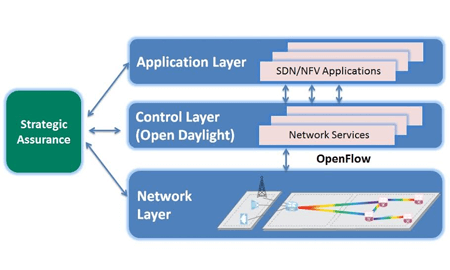
For example, with SDN, the applications that ask the network to perform a certain service – such as streaming a video from Los Angeles to Shanghai – can be totally ignorant about networking or video streaming. They simply delegate that work to an SDN control layer whose job is to orchestrate the service into a chain of services supplied by various network devices, servers and software components that perform their individual tasks.
NFV merely takes SDN to the next level, allowing the operator to park multiple network functions (or services) on formerly single-purpose devices, and even allowing those services to be consolidated on higher-level network devices.
How NFV and SDN Change the Stakes of Telecom Competition
So what are the new business models and efficiencies that SDN/NFV creates? Well, one of the key ones is allowing an operator to differentiate its services like an airliner does with first class, business and economy class service on its planes.
Enabling the network to differentiate services is the key to allowing operators to earn the most money for the value customers receive. But, because networks are very region-specific and single-purpose today, it’s hard to deliver differentiated service over them, and this is why SDN/NFV’s flexibility represents a key breakthrough.
Virtual networks will also enable a more optimal delivery of the different traffic types – email, video, data, cloud, voice, SMS, etc. Software will define what network functions, routing, and QoS belong to each traffic class.
Why Service Assurance is Essential to the New Network Virtualization
 So the competitive stakes of SDN/NFV are fairly obvious: an operator who is savvy in NFV/SDN can potentially leapfrog its rivals through differentiation and gain market share. This is why it’s a major risk for an operator to merely sit on the sidelines and not invest in SDN/NFV.
And yet, SDN/NFV puts some pretty steep demands on service assurance. The three major challenges as I see them are these:
1. The Diversity and Complexity of Networks Goes Way Up
SDN won’t replace legacy networks overnight. So, for the foreseeable future, networks will be a mix of new virtual networks and legacy network infrastructure. Virtual and non-virtual networks will need to work side by side.
And NFV/SDN architectures introduce entirely new control processes that need to be monitored. For instance, virtual networks weave service chains that are constantly being re-provisioned and reconfigured by the SDN controller. Plus, a highly complex software environment with virtual machines and hypervisor is deployed. There are many complications here. For example, the connections between service chain components could be on a single virtual server or could be distributed across many servers.
Old service assurance systems are challenged to keep up with all this new complexity. Even under today’s non-virtual assurance world, these hard-coded custom systems are slow to adapt. As NFV/SDN comes on-line, this problem will become more acute.
2. Maintaining Service Topologies and Layers Gets Harder
Traditional networks are simpler because the physical hardware and network functions go together. Virtual architectures, however, move functionality wherever it’s needed, meaning it will be harder to monitor and correlate performance to determine service impact.
One of the biggest concerns here is maintaining up-to-date service topology. The service chaining in virtual networks will be hard to maintain unless you can modify and update service models in real-time.
Here too, the cumbersome manual effort required by traditional service assurance makes it hard to keep service definitions accurate. The slowdown often causes operators to abandon complex rule writing and maintenance required for alarm correlation and root-cause analysis. Yet another problem: the service provider is responsible for the time-consuming job of maintaining its own library of device adapters for monitoring the network.
3. There’s a Huge Emphasis on Accurate & Near Real-Time Monitoring of the Network State
Virtual networks will require constant monitoring in near real-time. That’s because the prices you offer and the services you push greatly depend on the network’s availability and current state, which can change rapidly. In other words, maintaining a deep understanding of the network’s current state and performance is essential.
So, this is yet another mismatch: current service assurance systems require too much time and too many human resources to deploy, administer and maintain the network. Even if you build virtual networks, they won’t deliver the efficiencies they promise because a flexible and real-time service assurance system is not supporting them.
Virtual Networks Require a Strategic Service Assurance Platform
A modern, strategic service assurance system is critical to making virtual network investments pay off. Three essential strategic assurance capabilities are:
1. Configured Out-of-the-Box Software, not Customized Frameworks
Service assurance needs to shift from a highly customized system to a true and modular software environment. To lighten the operator’s programming load, the vendor should supply device and network function libraries that keep up with the latest versions and capabilities.
2. Intuitive, Configurable Functionality without Programming and Real-time Service Visualization
Increasing staffing levels in the NOC and network operations support is not necessary if the design of the system facilitates adding a new device in matter of minutes. Wherever possible, point and click configuration should replace manual programming. In that way, service topology and hierarchy can be kept up-to-date so users can quickly identify the root-cause and service impact of problems that impact customers.
3. Dynamic Interaction between Service Assurance and Service Orchestration
Finally, for virtual networks to deliver their efficiency and differentiated services benefits, the assurance system must dynamically interact with the Service Orchestration. For the true power of virtualization to be realized, networks will have to adapt in real-time to network conditions and service modification requests. As network performance is impacted, the Service Assurance system must be able to communicate to the Orchestration platform in real-time to adapt or re-distribute network services to maintain network performance. Similarly, if a customer requests a change to their services through an online customer portal or app, the Orchestration platform needs to be able to update the Service Assurance system in real-time so that end-to-end service monitoring begins as soon as the service is available to the customer.
Virtual networks are a strategic investment for the future. They will take the telecom business to the next level of network efficiency and differentiated services. But operators also need to recognize the strategic importance of a modern service assurance solution that can monitor and keep pace with that virtual network.
About the Author
 Anand Gonuguntla is the Co-Founder & Chief Executive Officer of Centina Systems. Previously, Anand was the Director of Systems and Software Engineering at Xtera. Anand also held management positions in software and program management at Fujitsu where he worked on FLM and FLASHWAVE product lines.
Anand holds a master’s degree in Electrical Engineering from the University of North Dakota and a bachelor’s degree in Electronics and Communications Engineering from Jawaharlal Nehru Technological University, India. He has published in Proceedings of ACM and holds patent in network management.
About Centina Systems
Centina Systems is the global leader in strategic service assurance and innovative network performance solutions. The company focuses on helping operators and enterprises worldwide support both established and emerging services and business models, through unparalleled end-to-end visibility into the operational performance of their infrastructure.
 Centina’s NetOmnia family of assurance and management solutions have redefined the market approach to assurance, incorporating features like enhanced SLA management, real-time, visual data analytics, customizable reports and dashboards for dynamic network views, and an integrated, plug-and-play architecture that provides actionable intelligence across hundreds of device-types and multiple types of networks. The company is based in Plano, Texas.

Got an idea for a Blueprint column? We welcome your ideas on next gen network architecture.
See our guidelines.