by Ildiko Vancsa
In today’s technology landscape, the prevalence of open source software is undeniable, with estimates suggesting that Free and Open Source Software (FOSS) constitutes 70-90% of modern software. Gartner says that over 95% of the IT enterprises across the globe use open source software for their mission-critical IT workloads, whether they are aware of it or not. Even governments are recognizing the importance of open source: the EU Commission, for example, embraces open source strategies to encourage sharing, contribute to the knowledge society, and build world-class public services.
So, what exactly is Open Infrastructure? It’s IT infrastructure built with open source components. The popular LOKI (Linux, OpenStack, Kubernetes Infrastructure) stack is an example of Open Infrastructure.
Another standout example of Open Infrastructure is StarlingX — a deployment-ready, scalable, and highly reliable edge infrastructure platform.
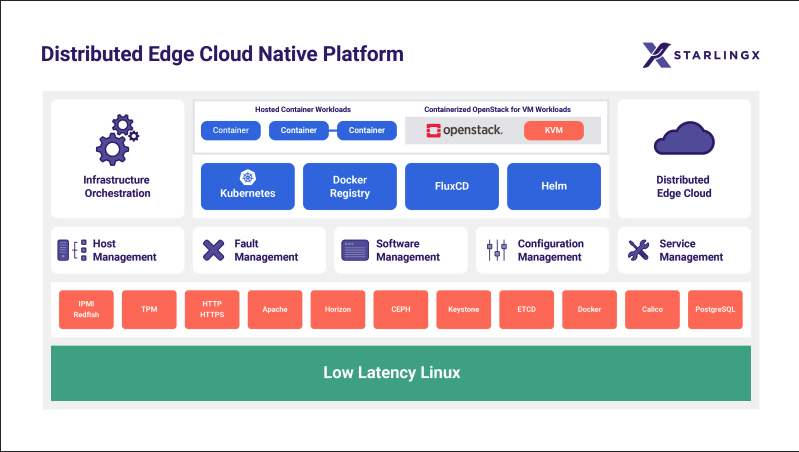
Open Infrastructure in Action: StarlingX Overview of StarlingX’s Open Source Components The creators of StarlingX set out to reconfigure proven cloud technologies, including OpenStack, Kubernetes, Ceph, and QEMU/KVM, for large-scale deployments, whether local or geographically distributed. The result is a distributed cloud platform that is simple to deploy, operate and manage, while capable of running bare metal, VM and container workloads alike.
What Makes StarlingX Special
Modern software infrastructure stacks are often deployed on a large scale, with an increasing number of components distributed among sites in different geographies, which makes these environments inevitably complex. Deploying and managing these systems is no small task, with automation being the only path towards simplification.
The StarlingX platform has been designed and developed to provide the missing pieces to today’s software infrastructure components, to take them outside of the walls of large data centers without compromising on manageability or performance.
The project provides a fully integrated stack, which includes the Debian operating system with a real-time kernel. StarlingX utilizes container technologies on the platform level to package the infrastructure services, which makes the platform much more flexible and robust. By using Kubernetes for container orchestration, the ability to manage infrastructure services as well as run containerized applications is available out of the box. At the same time, users have access to well-known APIs, whether they are running containers or orchestrating virtualized workloads through OpenStack.
StarlingX implements a distributed cloud architecture model, which means that users can deploy the platform in a geographically distributed configuration. In this scenario, operators are able to access and manage the end-to-end deployment from a central cloud, while having autonomous sites remotely, including at the network edge. This setup makes the platform much less sensitive to unreliable network connection between sites. At the same time, the ability to remotely manage and operate sites, with high levels of automation, simplifies infrastructure maintenance and brings the associated costs down.
The StarlingX project is designed and developed with high security standards, which includes periodic CVE scans, vulnerability management and a ever-growing number of related security features.
Beyond taking care of the infrastructure, the platform also provides features for mission-critical and high-performance applications, which makes it a prime candidate for a wide range of use cases. StarlingX is already highly utilized by the telecom sector in their backbone infrastructure to provide connectivity. These successful, large scale deployments help pave the way for more advanced use cases.
Unique Features of StarlingX
Here’s a quick recap of the features of StarlingX which demonstrate the power of this Open Infrastructure platform:
- Engineered for Scale and Performance : StarlingX is tailored for distributed cloud and high-performance applications, providing deterministic low latency and a small footprint at the edge without compromising security.
- Comprehensive Orchestration : The platform focuses on easy deployment, low-touch manageability, rapid response to events and fast recovery, ensuring efficiency in managing multiple sites in geographically dispersed regions.
- Automated Operations : StarlingX enables fully automated certificate management and can scale operational support, making it ideal for applications in transportation, manufacturing, video, healthcare, energy, retail, smart cities and drones.
- Telecom Integration : StarlingX is already deployed by telecom companies supporting 5G use cases. With telco-related features like Preciasion Time Protocol (PTP) support and O-RAN O2 interfaces, it excels in deploying thousands of subclouds using Zero-Touch Provisioning.
Why Open Infrastructure Should Matter to You
Open Infrastructure, exemplified by StarlingX, offers several advantages over closed source alternatives:
- Flexibility vs Vendor Lock-in : Open Infrastructure provides flexibility, allowing organizations to avoid vendor lock-in and choose solutions that best fit their needs.
- Open Code vs Hidden Source : With open source, code transparency ensures trust and enables collaboration, fostering innovation.
- Community Support vs Help Desk and Sales Calls : Open Infrastructure benefits from community support, encouraging collaborative problem-solving rather than relying on traditional help desk channels and increasing collective knowledge through information sharing.
- Innovating Faster vs Reinventing the Wheel : Open source allows for faster innovation by building upon existing solutions rather than reinventing the wheel with proprietary alternatives.
- Shared Burden on Common Dependencies vs High Maintenance Costs : Open Infrastructure shares the burden on common dependencies, reducing maintenance costs compared to closed source alternatives.
Conclusion: Join the Open Infrastructure Community
Open Infrastructure is the most effective way to develop technology globally and empower applications to fulfill their designed purposes. StarlingX serves as a compelling case study, showcasing the transformative potential of Open Infrastructure in diverse use cases. If you’re passionate about making a difference, the Open Infrastructure community invites you to participate. Learn more at openinfra.dev and embrace the power of Open Infrastructure—it’s what runs the world!
About the Author
Ildikó Vancsa is Director of Community at the Open Infrastructure Foundation. As part of her role, she is the Community Manager for the StarlingX open source distributed cloud project and a co-leader of the OpenInfra Edge Computing Group. Ildikó has been contributing to projects like OpenStack, Anuket and State of the Edge for over 10 years with focus areas of Edge Computing, Telecommunications and NFV. She is an open source evangelist and is using her experience to help individuals, companies and organizations to learn and get more involved and active in open source communities.