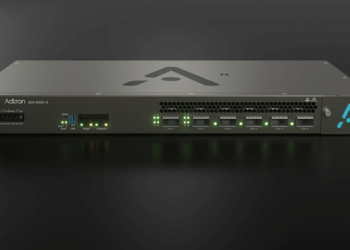
The Broadband Forum hosted its latest Passive Optical Network (PON) interoperability Plugfest at AT&T Labs in Plano, Texas, marking the first-ever multi-vendor testing of 50G-PON (High-Speed PON) and the second round of testing for 25GS-PON. The event, held in collaboration with LANPARK, brought together leading optical access vendors to validate interoperability between next-generation PON technologies and test environments, accelerating readiness for future fiber deployments.
Participating vendors included Adtran, Broadcom, Calix, CIG, Cortina Access, Gemtek, Lambda Networks, MT2, Nokia, Sagemcom, and Vantiva. They tested the compatibility of their Optical Line Terminals (OLTs), Optical Network Units (ONUs), chipsets, software stacks, and residential gateways using emulated broadband environments. Key layers tested included the 25GS-PON TC-PMD and OMCI layers, and—critically for the first time—50G-PON TC-PMD. These efforts support multi-vendor broadband ecosystems as service providers prepare to roll out faster, more efficient access networks.
Broadband Forum emphasized the growing importance of collaboration, coexistence, and open standards in enabling seamless evolution across broadband infrastructures. The organization will host upcoming Plugfests in Tours, France (July 7–10, 2025) and at the University of New Hampshire InterOperability Lab (October 6–10, 2025), continuing its multi-year program to advance PON interoperability.
- First-ever multi-vendor Plugfest testing for 50G-PON TC-PMD; second for 25GS-PON
- Held at AT&T Labs in Plano, Texas, in partnership with LANPARK
- Vendors tested OLTs, ONUs, chipsets, and software for interoperability across next-gen PON layers
- Participating vendors included Nokia, Broadcom, Adtran, Calix, Sagemcom, and others
- Upcoming PON Plugfests scheduled for France (July 2025) and UNH-IOL (October 2025)
- Testing reinforces support for multi-vendor ecosystems and prepares for mass fiber rollouts
“Following the success of the previous Plugfest, it was great to see the industry come together again to advance both 25GS and 50G-PON technologies thanks to the participation of the vendors and involvement of LANPARK and AT&T Labs,” said Craig Thomas, CEO of Broadband Forum.
Advanced Passive Optical Network (PON) technologies such as XGS-PON, 25GS-PON, and 50G-PON are designed to meet rising bandwidth demands while enabling scalable, future-proof fiber access for residential, enterprise, and mobile backhaul use cases.
XGS-PON (10G Symmetrical PON)
- Standardized: ITU-T G.9807.1 in 2016
- Speeds: 10 Gbps downstream / 10 Gbps upstream
- Modulation: NRZ
- Max Split Ratio: Up to 1:128
- Reach: Up to 20 km
- Compatibility: Coexists with GPON on same ODN using WDM
- Use Cases: Residential broadband, enterprise access, small cell backhaul
25GS-PON (25G Symmetrical PON)
- Standardized: Developed by 25GS-PON MSA; initial specs published in 2021
- Speeds: 25 Gbps downstream / 25 Gbps upstream
- Modulation: PAM4
- Max Split Ratio: Up to 1:64 (typical), with potential for 1:128 in future
- Reach: 20 km
- Compatibility: Backward-compatible with XGS-PON and GPON on same ODN
- Use Cases: 5G fronthaul, premium enterprise connectivity, low-latency apps
50G-PON (Higher Speed PON or HS-PON)
- Standardized: ITU-T G.9804 series (G.9804.1–G.9804.4), finalized in 2021–2023
- Speeds: 50 Gbps downstream / up to 25 Gbps upstream (symmetrical future versions under study)
- Modulation: PAM4 (downstream), NRZ or PAM4 (upstream, depending on implementation)
- Max Split Ratio: Up to 1:64
- Reach: Up to 20 km
- Compatibility: Designed for co-existence with GPON/XGS-PON
- Use Cases: Metro fiber aggregation, cloud-edge connectivity, 5G/6G transport