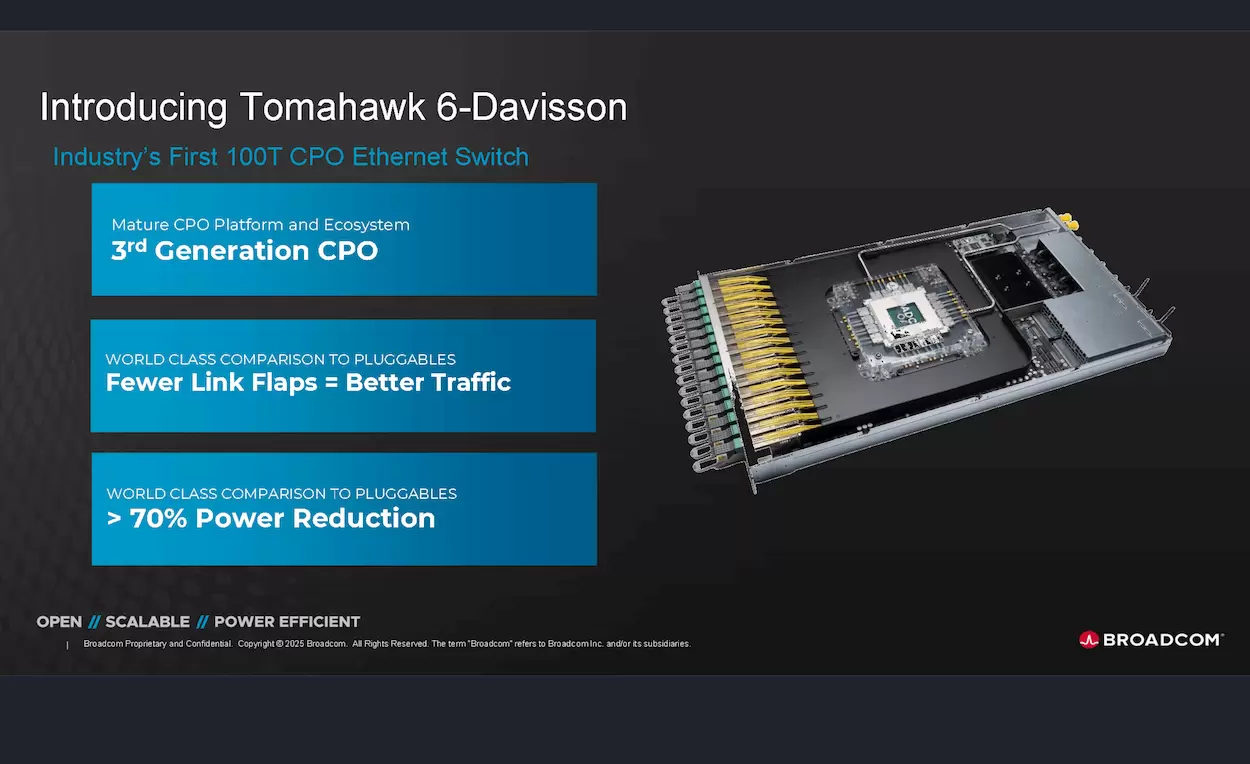
Broadcom introduced its third-generation co-packaged optics (CPO) switch, the Tomahawk 6 – Davisson (TH6-Davisson), delivering 102.4 Tbps of optically enabled Ethernet switching capacity for next-generation AI networks. The new platform doubles the bandwidth of Broadcom’s previous CPO generation and integrates 16 optical engines operating at 200 Gbps per channel, setting a new performance benchmark for AI cluster scale-out.
The announcement builds on Broadcom’s reliability milestone confirmed by Meta—one million cumulative 400G CPO port-device hours with zero link flaps—demonstrating the optical stability needed for hyperscale AI workloads. TH6-Davisson also introduces field-replaceable ELSFP laser modules, separating the light source from the high-heat switch package to improve serviceability and thermal efficiency. Broadcom said this design eliminates manufacturing variability typical in pluggables, reducing link flap occurrences and improving job reliability at cluster scale.
Architected with TSMC’s Compact Universal Photonic Engine (COUPE) and Broadcom’s advanced multi-chip packaging, TH6-Davisson achieves a 70% reduction in optical interconnect power compared with pluggable solutions—3.5× lower overall power draw. It interoperates with both DR-based transceivers and 200 Gbps CPO/NPO links and supports AI cluster configurations of up to 512 XPUs in a single tier and 100,000+ XPUs across two tiers at 200 Gbps per link. Broadcom’s roadmap includes a fourth-generation CPO platform targeting 400 Gbps per channel and further power savings.
“TH6-Davisson, our 3rd generation CPO Ethernet switch, represents a significant advancement for AI infrastructure,” said Near Margalit, Vice President and General Manager, Optical Systems Division, Broadcom. “By enhancing link stability and energy efficiency, we’re enabling smoother, more cost-effective AI model training. We designed this platform to scale large AI clusters by delivering on the three imperatives for optical interconnect—higher model FLOPs utilization, reduced job interruptions, and improved cluster reliability.”
• Bandwidth and architecture: 102.4 Tbps switching capacity; 16 × 6.4 Tbps optical engines; 200 Gbps per link bandwidth
• Power efficiency: >70% reduction in optics power vs pluggables; 3.5× lower overall interconnect power
• Reliability: One million flap-free port-device hours validated by Meta; >120,000 hours of CPO stress testing across 70 systems
• Serviceability: Field-replaceable ELSFP laser modules; improved thermal isolation for high-density AI fabrics
• Roadmap: 400 Gbps/lane Gen-4 CPO under development for future AI and cloud clusters
Tomahawk 6: The Silicon Foundation for Davisson
Broadcom’s Tomahawk 6 silicon, introduced earlier this year, forms the switching core of the Davisson CPO platform. Fabricated in advanced 5nm process technology, Tomahawk 6 delivers 102.4 Tbps of switching bandwidth in a single monolithic device—doubling the capacity of its predecessor, Tomahawk 5. It is designed for AI-scale Ethernet fabrics that require the ability to connect tens of thousands of GPUs and XPUs with minimal latency and near-linear scalability.
The Tomahawk 6 ASIC supports 256 400G ports, 128 800G ports, or 64 1.6T optical connections, depending on system design, enabling operators to flexibly scale clusters from 512 XPUs in a single tier to over 100,000 XPUs in large multi-tier networks. It also introduces a fully scheduled switch architecture, optimized for AI workloads that depend on stable flow completion and minimal packet drops. The architecture aligns with Broadcom’s “cluster-aware” Ethernet roadmap, supporting Ultra Ethernet Consortium standards for congestion control, RDMA, and precision timing.
To meet sustainability goals, Broadcom engineered Tomahawk 6 for industry-leading energy efficiency of under 0.1 nJ/bit, which represents a 40% improvement compared with previous-generation silicon. Power savings are achieved through integrated SerDes with 200 Gbps-per-lane signaling, fine-grained power gating, and adaptive voltage scaling. Combined with Davisson’s co-packaged optics, the complete switch platform delivers a system-level power reduction exceeding 70% versus retimed pluggable architectures, paving the way for AI data centers that can scale compute density without exceeding thermal envelopes.

🌐 Analysis: Broadcom’s TH6-Davisson marks a pivotal point in the CPO adoption curve—combining 200 Gbps lanes, optical co-packaging maturity, and real-world reliability data from Meta to support AI cluster scaling. Competing 200G and 400G CPO programs from Marvell, Intel, and NVIDIA are likely to accelerate, with ecosystem focus shifting toward interoperability, serviceable laser modules, and optical interconnect sustainability.
🌐 We’re tracking the latest developments in networking silicon. Follow our ongoing coverage at: https://convergedigest.com/category/semiconductors/
 | Converge Digest and NextGenInfra.io are bringing together the leaders shaping AI-driven data center networks—from optics and fabrics to silicon and orchestration.
Explore how the industry is re-architecting the network for the AI era through exclusive video interviews,
expert reports, and collaboration opportunities. |