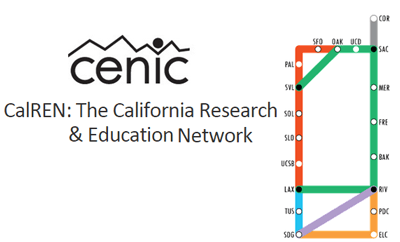
The California Research and Education Network (CalREN) is now able to provide high-capacity services, from 100G to 400G and beyond, on its coastal path between Los Angeles and Sunnyvale. The 460-mile upgraded optical route includes nodes in Santa Barbara, San Luis Obispo, and Soledad.
 The upgrades leverages flex-grid spectrum Reconfigurable Optical Add-Drop Multiplexers (ROADMs). Flex grid optimizes the amount of spectrum used per wavelength, enabling more data capacity to be provisioned over fiber spans.
CalREN, which is operated by CENIC, serves the vast majority of K-20 students, educators, researchers, and individuals at other vital public-serving institutions. CalREN operates over 8,000 miles of fiber optic cable and serves more than 20 million users.
In 2019, CENIC upgraded the southern path of its network between Los Angeles and Riverside, including nodes in Tustin, Oceanside, San Diego, Escondido, and Sun City. Work will start in the fall on upgrades to the final inland path, which completes the network ring from Sunnyvale back to Los Angeles and includes nodes in Oakland, Sacramento, Fergus, Fresno, and Bakersfield.
“Next-generation infrastructure ensures CENIC can easily meet today’s networking demands while remaining flexible to meet the needs of tomorrow,” said CENIC President and CEO Louis Fox. “These upgrades provide CENIC’s members a more robust and efficient network on which to conduct data-intensive research, support teaching and learning, provide cutting-edge medical care, and enhance community engagement.”
CENIC is also supporting the Pacific Research Platform (PRP), a partnership of more than 50 institutions, led by researchers at UC San Diego and UC Berkeley, with support from the National Science Foundation. PRP builds on the optical backbone of Pacific Wave, a project of CENIC and Pacific Northwest Gigapop, to create a high-speed freeway for large scientific data sets by connecting campus networks and supercomputing centers on a regional scale, with Science DMZs at each site.
Developed by the US Department of Energy’s Energy Science Network (ESnet) engineers, the Science DMZ model addresses common network performance bottlenecks encountered at research institutions by creating an environment that is tailored to the needs of high-performance science applications, including high-volume bulk data transfer, remote experiment control, and data visualization. PRP’s design supports university researcher data analysis for projects such as the Large Hadron Collider (LHC), the NSF’s South Pole Neutrino Detector (IceCube), and the Laser Interferometer Gravitational-Wave Observatory (LIGO).
CENIC deploys first 400G circuit in Los Angeles
CENIC, the organization that provides global connectivity for education and research institutions in California, has deployed a 400 Gbps single-carrier optical circuit between Los Angeles and Riverside. This marks one of the first-ever 400G superchannels to be deployed by a US regional research and education network. Construction included upgrading nodes in Los Angeles, Tustin, Oceanside, San Diego (home to the San Diego Supercomputer Center), Escondido, Sun City, and Riverside to 400G capabilities.
CENIC upgraded network infrastructure to flex spectrum Reconfigurable Optical Add-Drop Multiplexers (ROADMs) and the NCS 1004 transponder platform. CENIC used Cisco-loaned equipment for the validation in production and is now implementing the permanent infrastructure.
“This is an important networking milestone for CENIC,” said President and CEO Louis Fox. “With increasing demands for 100G services among our community, from research scientists working with big data sets to educators leveraging technology to transform the classroom, network capacity should not limit the work or ambitions of our researchers, teachers, or students.”
CENIC plans to expand its 400G provisioning capabilities along its coastal fiber path from Los Angeles to Sunnyvale by mid-2020.
CENIC’s network traffic continues to grow by roughly 60% each year. Between May 2018 and May 2019, the network moved an exabyte of data.