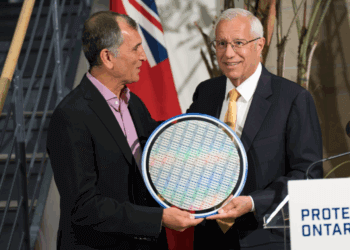
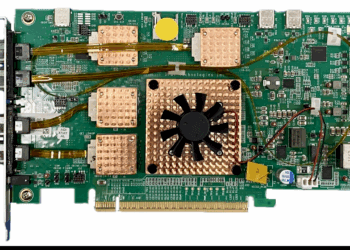
Cerebras Systems has secured a new contract from DARPA to develop a next-generation real-time compute platform combining its wafer-scale engine with Ranovus’ co-packaged optics. The system is designed to deliver significantly higher performance for AI and high-performance computing (HPC) workloads, addressing longstanding bottlenecks in memory and interconnect bandwidth while reducing power consumption.
The platform will integrate Cerebras’ Wafer-Scale Engine—which offers 7,000 times more memory bandwidth than GPUs—with Ranovus’ wafer-scale photonic interconnects to overcome communication constraints that hinder conventional systems. This architecture targets real-time simulations and AI inference tasks at a scale and speed not previously possible. It builds upon Cerebras’ experience with DARPA’s Digital RF Battlespace Emulator (DRBE) and introduces a new class of compute optimized for energy efficiency and latency-sensitive environments.
Beyond defense applications, the Cerebras-Ranovus system has dual-use potential for commercial sectors such as robotics, real-time sensor analytics, and complex digital twin simulations. The joint solution is expected to outperform today’s supercomputing clusters while consuming only a fraction of the power, setting a new bar for AI infrastructure across both public and private sectors.
• DARPA selected Cerebras to build a real-time AI/HPC platform using wafer-scale compute and co-packaged optics.
• Cerebras’ Wafer-Scale Engine delivers 7,000x GPU memory bandwidth, enabling extreme-scale inference and simulation.
• Ranovus’ co-packaged optics interconnect offers a 100x improvement in data capacity over current solutions.
• Integrated system reduces power draw compared to traditional GPU clusters using discrete switches and optics.
• Applications include real-time battlefield simulations, AI sensor processing, and advanced commercial robotics.
“By solving these fundamental problems of compute bandwidth, communication IO and power per unit compute through Cerebras’ wafer scale technology plus optical integration with Ranovus, we will unlock solutions to some of the most complex problems in the realm of real-time AI and physical simulations,” said Andrew Feldman, co-founder and CEO of Cerebras.