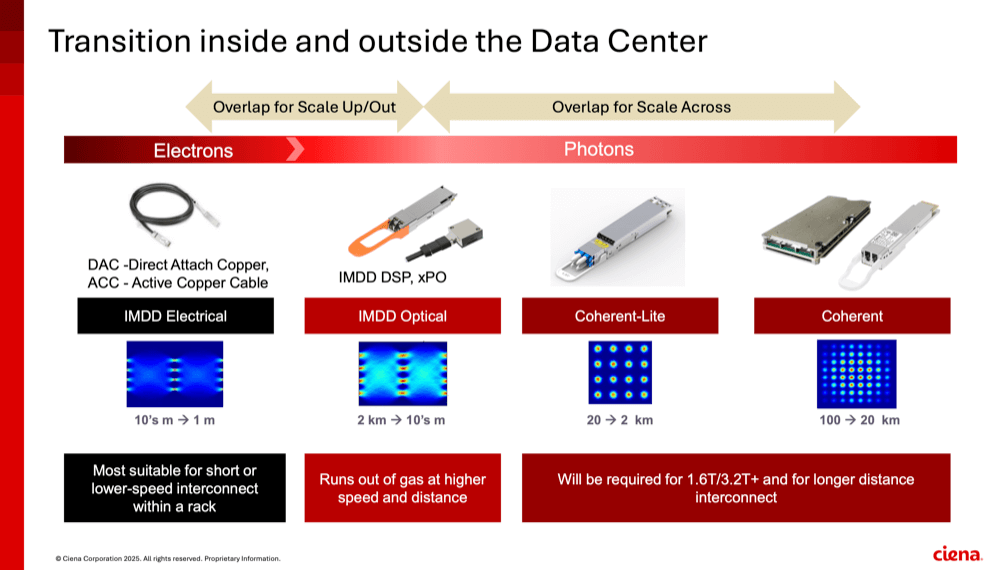
At last week’s Optica Photonic-Enabled Cloud Computing (PECC) Summit, Bilal Riaz, Senior Director of Product Line Management at Ciena, presented the company’s vision for building energy-efficient AI infrastructure through advanced interconnect technologies. Riaz outlined a three-tier scaling strategy—Scale-Up, Scale-Out, and Scale-Across—that unites electronics and photonics across the data-center fabric. He emphasized that no single architecture can meet every AI workload’s bandwidth, reach, and power requirements, saying that “the right technology must be chosen for the right distance and use case.”

Riaz noted that AI clusters are driving exponential growth in data-center traffic. Ciena’s roadmap spans from 224 G to 448 G SerDes and toward 3.2 Tb/s modules, combining near-package optics (NPO) and co-packaged optics (CPO)for scale-up connections, and coherent fabrics for scale-across deployments. The company’s research and demonstrations—including a 3.2 T link over 2 km and a driverless 448 G PAM4 optical transmission—illustrate how the ecosystem is evolving to support 100 GHz+ bandwidths with reduced energy per bit.
Key technology highlights from the presentation:
• 448 G ecosystem: Ciena’s 3 nm CMOS DSPs, thin-film LiNbO₃ (TFLN) modulators, and InP EMLs form the foundation for 448 G PAM4 links. The move from 100 → 200 → 400 G per lane reduces energy by roughly 30 % per generation and doubles per-port bandwidth.
• Energy efficiency and packaging: 448 G architecture halves waste by reducing lanes and components, enabling denser switch ASICs and next-generation 3.2 T optical modules.
• Ecosystem coordination: Riaz stressed that connector design, modulation formats, and packaging techniques must evolve together. Collaboration across the OIF CEI-448G, IEEE 802.3, and Ultra Ethernet Consortium initiatives will determine commercial readiness.
• Liquid-cooling innovation: With air cooling reaching its limits, Ciena is developing direct-to-plug and integrated cold-plate solutions that eliminate external heatsinks and dry contacts. The goal is to enable pluggables and xPO form factors to operate at full capacity under AI-class power densities.
Riaz concluded that optical and electrical domains are converging both inside and outside the rack. “The gap between coherent and IMDD, and between copper and optics, is closing,” he said. “Future AI networks will rely on hybrid fabrics that balance reach, power, and scalability.”
Ciena continues to invest in energy-efficient interconnect platforms—spanning coherent optics, pluggable and co-packaged solutions, and advanced liquid-cooled packaging—to support hyperscale and AI workloads across scale-up, scale-out, and scale-across domains.


www.ciena.com