+Cisco unveiled its flagship Network Convergence System (NCS) core routing fabric designed to bring scalability, open programmability, and IP/Optical integration to power the Internet of Everything.
The Cisco NCS family serves as network fabric and orchestration system uniting the Cisco Carrier Routing System (CRS) and Aggregation Services Router (ASR) product lines. It can be deployed as part of the Cisco ONE Service Provider Architecture, which embraces and extends SDN/NFV. The NCS family leverages several innovations:
 Programmable Silicon: The NCS features the recently announced Cisco nPower X1 integrated network processor, which is also used in the CRS-X. The nPower X1 packs 336 cores and 4 billion transistors on a single chip. It also features new memory technology , the nPower X1 implementation achieves
unprecedented levels of performance, functionality, programmability and scale for a network processor.
Intelligent Convergence for Optimization and Simplification: The Cisco NCS converges IP and optical networks and is designed to seamlessly integrate with the Cisco Unified Computing System (Cisco UCS) and the Dynamic Fabric Automation capabilities supported by Cisco’s data center innovations. This convergence capability enables the NCS to act as a flexible foundational network fabric for an evolved programmable network, able to shift and redirect data center, core, edge and optical resources spontaneously and in real time, allowing service providers to accelerate service velocity while reducing overall complexity and operating costs.
Advanced Virtualization Capabilities: The NCS’s element, system and architectural virtualization capabilities converge to enable the system to orchestrate services and resources across disparate physical, virtual and geographical elements as if they are part of a single unified system using Cisco Prime and Cisco Quantum solutions. The system’s advanced virtualization features enable service providers to elastically scale up and down both network and compute resources, utilizing scalable multichassis configurations that can be managed as a single entity. If system scale is exceeded in one part of the network, the NCS moves control plane functions onto UCS servers in the data center, creating virtually unlimited control plane scale by capitalizing on the blade servers’ processing.

The Cisco NCS family consists of three key components that can be managed as a single integrated system for business agility and simplified operations:
NCS 6000 — the flagship router boasts the ability to transport up to 5 Tbps per slot and 1.2 Pbps per system. By using its 100 Gbps,CMOS-based CPAK transceivers Cisco is delivering the first 1 Tbps line card. Each line card runs up to 1 Tbps throughput, using a mix of 10, 40, or 100 Gbps interfaces per card. Significantly, the NCS 6000 will run virtualized IOS-XR instances while supporting hardware-enabled true zero-packet, zero-topology loss (ZPL/ZTL) In Service Software Upgrade (ISSU). This will enable lossless software image updates. Thanks to the CMOS silicon photonics and new network processor, Cisco said the NCS 6000 will achieve the lowest carbon footprint in service provider routing . The NCS 6000 is currently shipping.
NCS 4000 — bridges the gap between the IP and optical layers with time division multiplexing (TDM), packet switching, and integrated DWDM functionality. It will support 400 Gbps per slot and 6.4 Terabits per system and be available in single, back-to-back, and multi-chassis configurations. It will offer full optical channel data unit (ODU-0) level switching, with ports supporting SONET/SDH, Ethernet, and channelized OTN Full IP, MPLS, MPLS-Transport Profile (TP), and Carrier Ethernet switching, supporting 10 Gb, 40 Gb, and 100 Gb Ethernet interfaces with the option of OTN encapsulation. The NCS 4000 will be available in the first half of 2014.
 NCS 2000 — a DWDM transport platform that evolves the Cisco ROADM portfolio by introducing 96-channel nLight ROADM technology. It offers touchless re-configurability through colorless, omni-directional, and contention-less add/drop, networks. The NCS 2000 introduces hybrid Raman-EDFA amplifiers known as erbium doped Raman amplifiers (EDRA). The NCS 2000 is currently shipping.
The three platforms are designed to work as a single, integrated system.
“The Cisco NCS was engineered with the programmability, intelligence and scalability to meet the demands of today and tomorrow. The NCS delivers an evolved programmable network that will enable service providers to generate new revenue streams and business models, while delivering exciting new experiences to their customers,” stated Surya Panditi, SVP and GM, Cisco’s Service Provider Networking Group.
Cisco named three early adopters for NCS: BSkyB (Sky), KDDI and Telstra.
http://newsroom.cisco.com/press-release-content?type=webcontent&articleId=1268183
Earlier this month, +Cisco unveiled its nPower X1 integrated network processor — the first generation of a new line of custom-developed silicon designed for programmatically handling high volumes of transactions at high data rates.
Cisco said its nPower X1 is purpose-built for software-defined networking (SDN), enabling on-the-fly reprogramming for new levels of service agility and simplified network operation.

Key features include:
- 400 Gigabits-per-second (Gbps) throughput to enable multi-terabit network performance. All packet processing, traffic management and input/output functions are integrated on a single nPower X1 and operate at high performance and scale.
- Highest-performing programmable control designed to seamlessly handle hundreds of millions of unique transactions per second. The nPower’s industry-leading processing architecture is purpose built for machine-driven events and ultra-high-definition video applications.
- 4 billion transistors on a single chip for performance, functionality, programmability, and scale.
- Enables solutions with eight times the throughput and one quarter the power per bit compared with Cisco’s previous industry-leading network processor.
In March 2013, Cisco introduced its 100 Gbps, CMOS-based transceiver technology — describing it as a breakthrough for the rollout of 100G services.

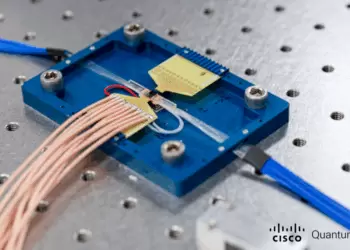
By integrating advanced optics in complementary metal oxide semiconductor (CMOS) technology, Cisco is able to significantly increase face-plate density for 100G pluggable optics.
The Cisco “CPAK” transceiver reduces space and power requirements by over 70 percent compared with alternative transceiver form factors, such as CFP. Future routing and switching line cards will also incorporate CPAK technology.