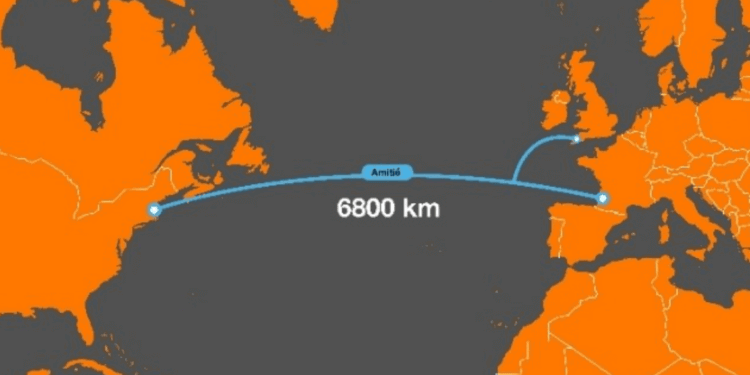
Cisco transmitted 800Gbps on the Amitié transatlantic communications cable, which runs 6,234 kilometers from Boston, Massachusetts to Bordeaux, France, and which now supportsMicrosoft’s global network.
The Amitié submarine cable incorporates Space Division Multiplexing (SDM) technology, utilizing 16 fiber pairs, which is higher than what is typically found in underwater cables. This design allows for the distribution of repeater power among the fiber pairs, resulting in the maximum capacity for the cable.
Cisco said the field trial carried an 800G wavelength in a 150GHz channel spacing, equivalent to a spectrum efficiency of 5.33bit/s/Hz and a maximum spectral efficiency of 5.6bit/s/Hz. In addition, 600G was transmitted over 12,469 kilometers for a trans-Atlantic loopback configuration. This is the first time a 140Gbaud single carrier signal was demonstrated live, and is the longest distance ever reported at single carrier 600G DWDM transmission on an SDM cable. The trial was performed with the Cisco NCS 1014 platform enabled by Acacia’s Coherent Interconnect Module 8 (CIM 8), which is powered by its Jannu digital signal processor and advanced silicon photonics. Both products are available today and actively deployed in multiple networks.
“In the era of AI, reliable and fast network connections are more important than ever,” said Bill Gartner, SVP Optical Systems and Optics, Cisco. “Working with Microsoft on the Amitié cable to demonstrate the potential for improved overall network capacity with 800G at these distances is a significant milestone for an SDM cable, and we’re proud to drive the innovations that pave the way for ever increasing network capacity needs.”
“The transmission of 800G over 6,234 kilometers is a milestone that demonstrates SDM cables can deliver increased capacity over traditional subsea cables,” said Jamie Gaudette, GM of Cloud Network Engineering, Microsoft. “This field trial demonstrates what is now a commercial technology for subsea routes, and we can improve the network capacity to help drive digital transformation for people, organizations, and industries around the world.”

- In July 2023, Aqua Comms, Meta, Microsoft, and Vodafone announced the commissioning of the Amitié subsea cable system, a 6,783 km (4,215 miles) trans-Atlantic system connecting North America and Europe and boasting 16 fiber pairs and up to 400 Tbps capacity — the highest to date.
- The Amitié cable, which was built by Alcatel Submarine Networks, has landings in Lynn, Massachusetts; Widemouth Bay, England; and Le Por ge, France. The design of the system brings all users additional connectivity options in the United States, the UK, and in France. Boston will have direct connec tion all the way to London and a new Carrier Neutral Data Center constructed in Bordeaux. This delivers improved reliability in terms of protected capacity on multiple diverse routes.
- The system includes an innovative branching unit 860 km from France and 650 km from the UK. This device allows the owners to switch either i ndividual optical wavelengths between different landings or the full fiber capacity via two different types of switching technologies.
- Space Division Multiplexing (SDM) is a technology used in optical fiber communication to increase the amount of data that can be transmitted over a single fiber. It involves the use of multiple spatial channels within a single fiber optic cable to carry separate data streams. This is achieved by either using multiple cores within a single fiber (multi-core fiber) or by exploiting different modes in a single core fiber (few-mode fiber).
- In traditional fiber optic communication, the capacity of a fiber is mainly increased by using techniques like Wavelength Division Multiplexing (WDM), where different wavelengths (colors) of light carry different data streams. However, as the demand for data capacity grows, WDM alone may not suffice due to physical and technical limitations.
- SDM offers a way to further expand the data-carrying capacity by multiplying the number of available channels. This is done by creating physical or modal separations within the fiber, allowing for parallel data transmission paths that can significantly increase overall throughput.
- The application of SDM in submarine cables, like the Amitié mentioned previously, represents a significant advancement in undersea communication infrastructure. By using SDM, these cables can handle more data simultaneously, making them more efficient and capable of supporting the growing demand for internet bandwidth and connectivity across continents.