Unlocking manufacturing bottlenecks for optical transceivers may be key in the race to 400G
Nearly two dozen companies announced 400G capabilities of some sort at the recent OFC 2018 conference, including transceivers in various formats, active optical cables, backplane interconnects, interface cards, optical module drivers, test equipment, and even full-blown switches.
A few months ago, Broadcom announced commercial shipments of its StrataXGS Tomahawk 3 Ethernet switch silicon, boasting 12.8 Terabits/sec in a single device – enough to drive 32 x 400GbE ports. It has since followed up with the commercial shipment of a 400G gearbox device for hyperscale data centre and cloud applications – the BCM81724. This device is an 8×56-Gbps PAM-4 to 16×25-Gbps NRZ forward and reverse gearbox designed to enable next-generation high-performance switches with PAM-4 I/Os to connect to the large existing ecosystem of switches and plug-in modules with NRZ interface. We should see data centre switches with 400G ports on the market soon.
Put all of these together and we have a 400G ecosystem that is primed for rapid growth. Hyperscale data centres say their networks are besieged with a flood of east-west data flows. They are ready to deploy 400G backbones.

However, volume production of 400G transceivers may be a gating factor that holds back mass deployment of 400G data centre backbones for much of 2018 and into next year. Simply put, the market may remain supply constrained until transceiver manufacturers bring more manufacturing capacity online. This is difficult to do because building the highest performance optical transceivers requires skilled labor and specialised equipment to precisely align light sources, lenses and fibre in a repeatable fashion. The manufacturing, especially when we are talking about the multiple lanes required to achieve 400G, is hard to do.
Adolite, a privately-held start-up with its head office in Santa Clara, California and its manufacturing base in Taiwan’s Hsinchu Science Park, was founded earlier this year with a vision to solve this problem. The company has developed a breakthrough optical interconnect solution that simplifies the manufacturing of optical transceivers and on-board optics in high volume.
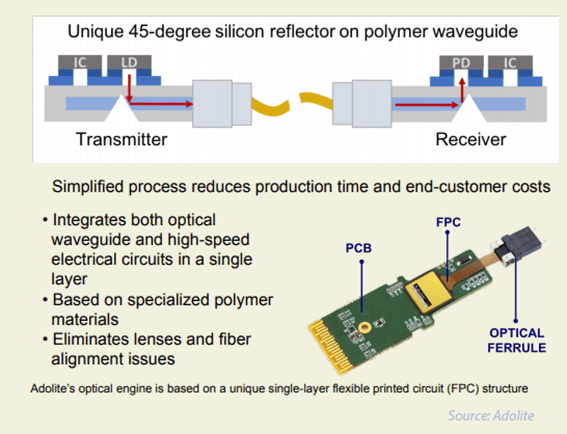
Adolite’s key innovation is to embed optical waveguides and electrical circuits into a single layer of flexible polymer circuit (FPC). The process directly integrates lasers and photo diodes onto the FPC using flip chip bonding techniques, eliminating the need for lenses and difficult fibre alignment and bonding, which is time consuming. Conventionally, microscopes were needed for the difficult and imprecise fibre alignment step and this led to low-yields and high costs in transceiver manufacturing.
By directly embedding the optical waveguides and electrical circuits into the FPC, the manufacturing process is greatly simplified and yields should go up, leading to faster production and lower costs.
While other companies are using FPC technology, their implementations have been electric-only FPC bonded to optical layers, still requiring lenses and complex alignment during manufacturing.
Much of Adolite’s innovation is centred on the process of integrating optical reflectors and polymer waveguides on a single FPC layer. Adolite says thermal management and material science techniques enable its FPC to handle 400G data rates and up. The polymer material is sourced from Japan. The company says its design also uses significantly less power – perhaps as little as 10 percent of its competitors – which would also be a strategic advantage in dense data centres. Patents are pending. The company is also on track to receive ISO 9001: 2015 certification in the 2nd half of 2018 for its manufacturing operations in Taiwan. Patent filings are underway.
Adolite is using its technology to build its own line of optical transceivers and on-board optic solutions for 25G, 100G, 200G, 400G and upwards. It product plans extend from 25 SFP28 AOCs to 400G QSFP DD PAM4 (FR4) transceivers. Adolite expects to have volume production of its 400G solutions by Q1 2019.
For a start-up, ramping up from prototype to manufacturing in only twelve months is a challenge. In this case, there will be big rewards for companies that open up the 400G market. Adolite is headed by Abraham Jou (CEO), who worked five years on the R&D team at Apple and went on to found two start-ups, PayEase (payments and big data processing) and Silicon Valley Communications (optical communications). Its technical team includes Dr. David Chung, CTO, Dr. Paul Wu in the critical role of EVP of Production, and Dr. Kenny Young as Principle Engineer.. The company has not disclosed its investor or its funding level to date, but no doubt will attract the attention of the venture capital community as its transceivers based on its FPC technology are put to the test.
The Race to 400G
Adolite’s simplified production process could be especially useful to hyperscale data centres operators who find a constrained market for transceivers. Broadcom may already be shipping its 400G silicon to hyperscale data centre operators who are designing and building custom switches for their backbones. Clearly, a very large number of 400G ports will be needed in data centres hosting 100s of thousands of Xeon servers with 25G interfaces. Adolite’s flexible polymer circuit is a promising solution to ramp up manufacturing