Corintis, a start-up based in Switzerland, secured $24 million in Series A funding to scale its microfluidic chip cooling technology, targeting what it calls the next bottleneck in AI infrastructure: heat dissipation. The round, led by BlueYard Capital with participation from Founderful, Acequia Capital, Celsius Industries, and XTX Ventures, brings the startup’s total funding to $33.4 million. The company will expand with multiple U.S. offices and an engineering hub in Munich.
Earlier this week, Microsoft revealed that, in collaboration with Corintis, it achieved a three-fold improvement in chip cooling performance. Tests of the new in-chip microfluidic system showed it removed heat three times better than conventional liquid cooling approaches, marking a milestone as GPU and accelerator power requirements climb toward 4,000 watts per device.
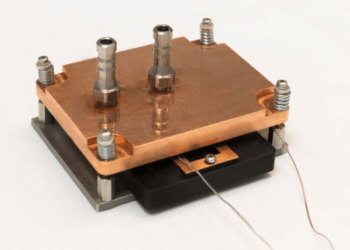
Corintis, founded out of EPFL in Lausanne by Remco van Erp, Sam Harrison, and Prof. Elison Matioli, has already shipped more than 10,000 cooling systems for advanced AI deployments. The company’s platform integrates simulation tools, copper microfluidic cold plate manufacturing, and the Therminator emulation environment for validating thermal solutions before production.
- $24M Series A led by BlueYard Capital; total raised $33.4M
- New U.S. offices plus Munich engineering hub
- Microsoft collaboration demonstrated 3x chip cooling efficiency
- Board additions include Lip-Bu Tan (Intel CEO, Walden International) and Geoff Lyon (CoolIT founder)
- Over 10,000 cooling systems already deployed in datacenters
- Technology portfolio: Glacierware simulation, copper microfluidic fabrication, Therminator validation platform
“Cooling is one of the biggest challenges for next-generation chips. Corintis is fast becoming the industry leader in advanced semiconductor cooling solutions to address the thermal bottleneck, as made evident by its growing customer list,” said Lip-Bu Tan, board director and investor.
🌐 Analysis: Corintis is emerging at the intersection of semiconductor design and advanced cooling, where demand from AI workloads is pushing power densities beyond the limits of conventional liquid systems. Microsoft’s validation adds credibility at hyperscale, placing Corintis alongside companies like CoolIT and other liquid-cooling innovators. With GPU power envelopes projected to rise tenfold compared to early AI training systems, solutions like microfluidic in-chip cooling will be critical for enabling the next generation of AI datacenters.