• Home
  • Events Calendar
  • Blueprint Guidelines
  • Privacy Policy
  • Subscribe to Daily Newsletter
  • NextGenInfra.io
No Result
View All Result
Converge Digest
Sunday, April 12, 2026
  • Home
  • Events Calendar
  • Blueprint Guidelines
  • Privacy Policy
  • Subscribe to Daily Newsletter
  • NextGenInfra.io
No Result
View All Result
Converge Digest
No Result
View All Result

Home » Cumulus targets web-scale networks for containers and microservices

Cumulus targets web-scale networks for containers and microservices

August 23, 2017
in All, Start-ups
A A

Cumulus Networks is introducing a suite of technologies to help enterprises to deploy and operate production-ready web-scale networks for containers and microservices.

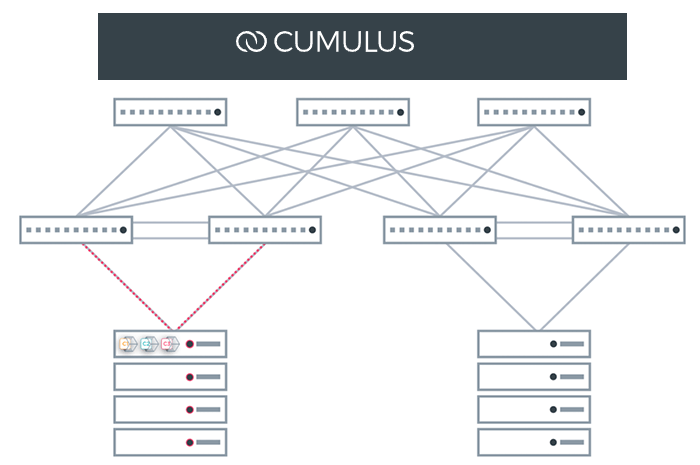
The company said its new “Cumulus Host Pack” enables a path to web-scale networking that supports containers and microservices by utilizing a common toolset of the Linux ecosystem. Because Cumulus Linux brings the host to the network, Host Pack gives application developers and network operators universal visibility and connectivity of the network. This visibility is needed because containers are constantly created and destroyed, and workloads are often moved to different physical machines or migrated to completely different data centers. The new Host Pack offering is the first of its kind to address the challenges network operators face in achieving end-to-end network visibility and connectivity of containerized applications.

Key capabilities and benefits of Host Pack include

  • Granular container visibility for faster debugging: Host Pack gives operational and development teams shared visibility of application availability through popular container orchestration tools such as Mesosphere, Kubernetes, and Docker Swarm. Enabled by NetQ running on the host, network operators can easily view the health of container services, keep track of container locations, track IP addresses and open ports, and have deep insights into where an issue resides, allowing for faster troubleshooting.
  • Simplified network connectivity for improved performance: With the use of routing protocols such as FRRouting and BGP unnumbered directly on the host and in a Layer 3 architecture, Cumulus’ network fabric is able to dynamically learn about containers and distribute these addresses throughout the network to ensure predictable performance between containers across host environments. This removes the complications of a Layer 2 overhead, provides rich and reliable multipathing, simplifies IP address management, and increases reliability.   
  • A common data center operating model, Linux, from network to containers: Cumulus Linux utilizes the same Linux networking model that is foundational to container systems. This enables the use of a common operational toolset, guarantees interoperability, and reduces complexity across the entire data center.

The Cumulus Host Pack suite will also be made available for trial through Cumulus in the Cloud, a low effort, zero cost way to explore these technologies before committing to a full deployment.

“As companies look at containers as a way of deploying revenue generating applications in faster, more agile ways, the supporting networking infrastructure needs to adapt and change,” said Josh Leslie, CEO, Cumulus Networks. “Until now, we’ve been missing a solution that gives customers a scalable end-to-end network architecture and pervasive view of how containers impact the network. Cumulus Host Pack allows customers to deliver on the promise of containers and microservices by removing operational barriers and enabling them to design a network of web-scale efficiency that is reliable, and simple to deploy.”


http://www.cumulusnetworks.com

Tags: #containers#OpenBlueprint columnsCumulusData CentersLinux
ShareTweetShare
Previous Post

ADTRAN Introduces Mosaic Software Tools

Next Post

Level 3 enables multiple VLANs on single Ethernet to AWS Direct Connect

Staff

Staff

Related Posts

Cisco and Nutanix Partner to Accelerate Hybrid Multicloud
Clouds and Carriers

Wind River Launches a new Linux Solution for Cloud-to-Edge

September 17, 2024
Juniper enhances AI-native networking for SD-WAN and SASE
Video

Tech Update: Benchmarking Networking-for-AI

June 6, 2024
TPG Real Estate acquires 80% stake in Digital Realty’s No Virginia data centers
All

TPG Real Estate acquires 80% stake in Digital Realty’s No Virginia data centers

July 30, 2023
Blueprint: Brazil looks to municipal Wi-Fi 6E
Blueprints

Blueprint: Brazil looks to municipal Wi-Fi 6E

February 21, 2023
Blueprint: Building wholesale networks with OTN
All

Blueprint: Building wholesale networks with OTN

December 20, 2022
Oracle opens cloud region in Chicago
All

Oracle opens cloud region in Chicago

December 20, 2022
Next Post
Level 3 enables multiple VLANs on single Ethernet to AWS Direct Connect

Level 3 enables multiple VLANs on single Ethernet to AWS Direct Connect

Please login to join discussion

Categories

  • 5G / 6G / Wi-Fi
  • AI Infrastructure
  • All
  • Automotive Networking
  • Blueprints
  • Clouds and Carriers
  • Data Centers
  • Enterprise
  • Explainer
  • Feature
  • Financials
  • Last Mile / Middle Mile
  • Legal / Regulatory
  • Optical
  • Quantum
  • Research
  • Security
  • Semiconductors
  • Space
  • Start-ups
  • Subsea
  • Sustainability
  • Video
  • Webinars

Archives

Tags

5G All AT&T Australia AWS Blueprint columns BroadbandWireless Broadcom China Ciena Cisco Data Centers Dell'Oro Ericsson FCC Financial Financials Huawei Infinera Intel Japan Juniper Last Mile Last Mille LTE Mergers and Acquisitions Mobile NFV Nokia Optical Packet Systems PacketVoice People Regulatory Satellite SDN Service Providers Silicon Silicon Valley StandardsWatch Storage TTP UK Verizon Wi-Fi
Converge Digest

A private dossier for networking and telecoms

Follow Us

  • Home
  • Events Calendar
  • Blueprint Guidelines
  • Privacy Policy
  • Subscribe to Daily Newsletter
  • NextGenInfra.io

© 2025 Converge Digest - A private dossier for networking and telecoms.

No Result
View All Result
  • Home
  • Events Calendar
  • Blueprint Guidelines
  • Privacy Policy
  • Subscribe to Daily Newsletter
  • NextGenInfra.io

© 2025 Converge Digest - A private dossier for networking and telecoms.

This website uses cookies. By continuing to use this website you are giving consent to cookies being used. Visit our Privacy and Cookie Policy.
Go to mobile version