TRUMPF Photonic Components has enhanced its datacom vertical-cavity surface-emitting lasers (VCSELs) with proprietary subwavelength surface grating technology, improving polarization stability and signal performance for high-speed data transmission. This innovation reduces sensitivity to optical feedback, minimizes relative intensity noise (RIN), and eliminates polarization flips, leading to better signal quality in optical links without altering the light current voltage (LIV) characteristics. The advanced technology applies to all wavelengths and helps data centers, AI, and high-performance computing systems manage bandwidth-intensive applications more effectively.
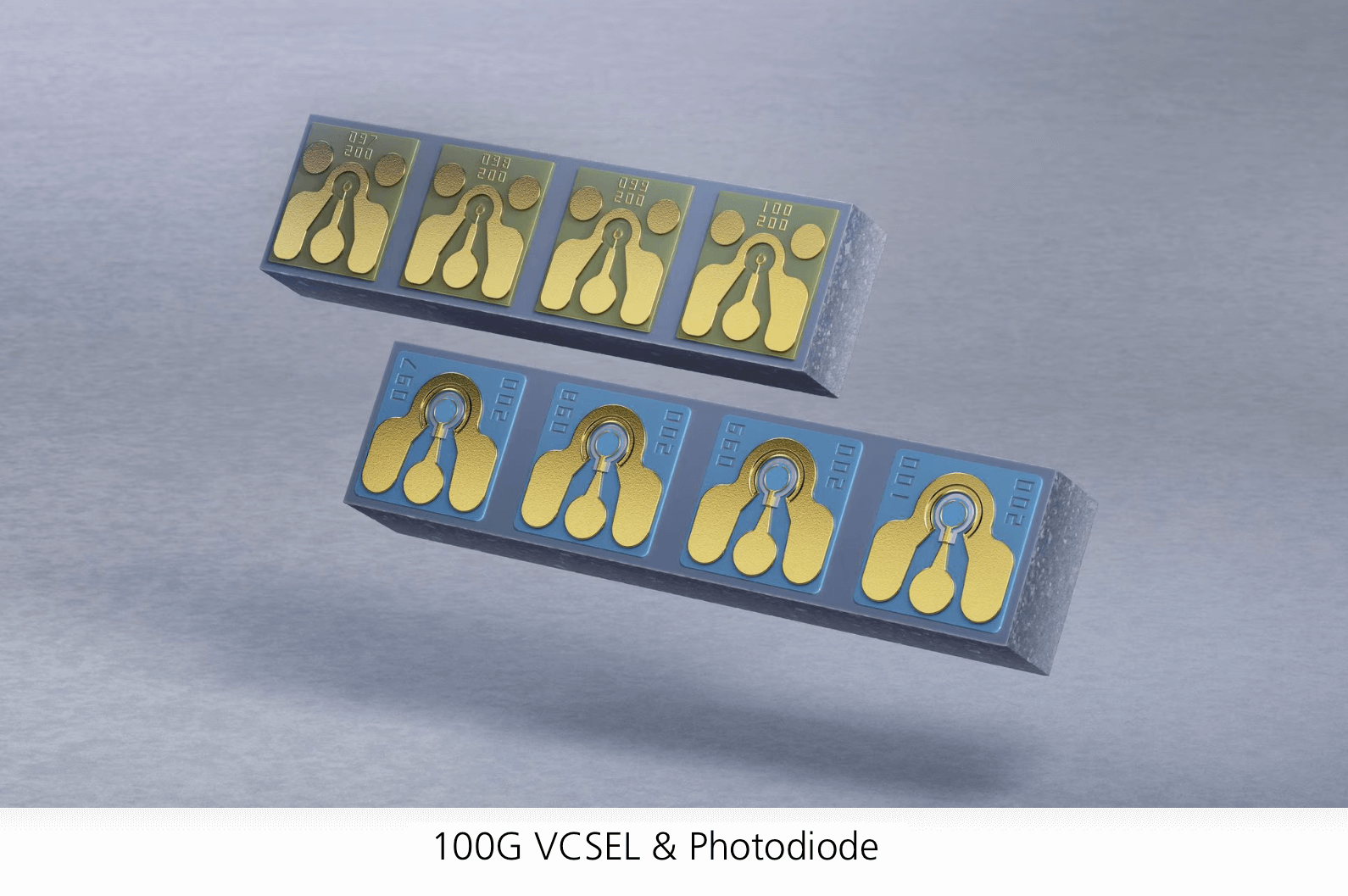
TRUMPF’s latest VCSELs, designed for 100G wavelength division multiplexing (WDM), emit at 850nm, 880nm, 910nm, and 940nm. They feature a ground-signal-ground (GSG) pad layout and are flip-chip bondable. These VCSELs, with a bandwidth of 25 GHz, offer full passivation and mechanical protection. TRUMPF also provides matched photodiodes, available in singlets and various array configurations, including 1×2, 1×4, 1×8, and 1×12, ensuring compatibility for high-speed, reliable data transmission.
• Product: VCSELs with subwavelength surface grating technology
• Wavelengths: 850nm, 880nm, 910nm, 940nm
• Bandwidth: 25 GHz
• Features: Ground-signal-ground pad layout, flip-chip bondable, fully passivated, mechanically protected
• Available configurations: Singlets, 1×2, 1×4, 1×8, 1×12 arrays
“Our proprietary, advanced subwavelength grating technology has been a proven, key feature in our VCSEL solutions for two decades now and has been employed in many millions of consumer devices,” said Ralph Gudde, VP of Marketing and Sales at TRUMPF. “We are pleased to see that this technology found its way into our datacom products and offers customers a performance that sets them apart.”