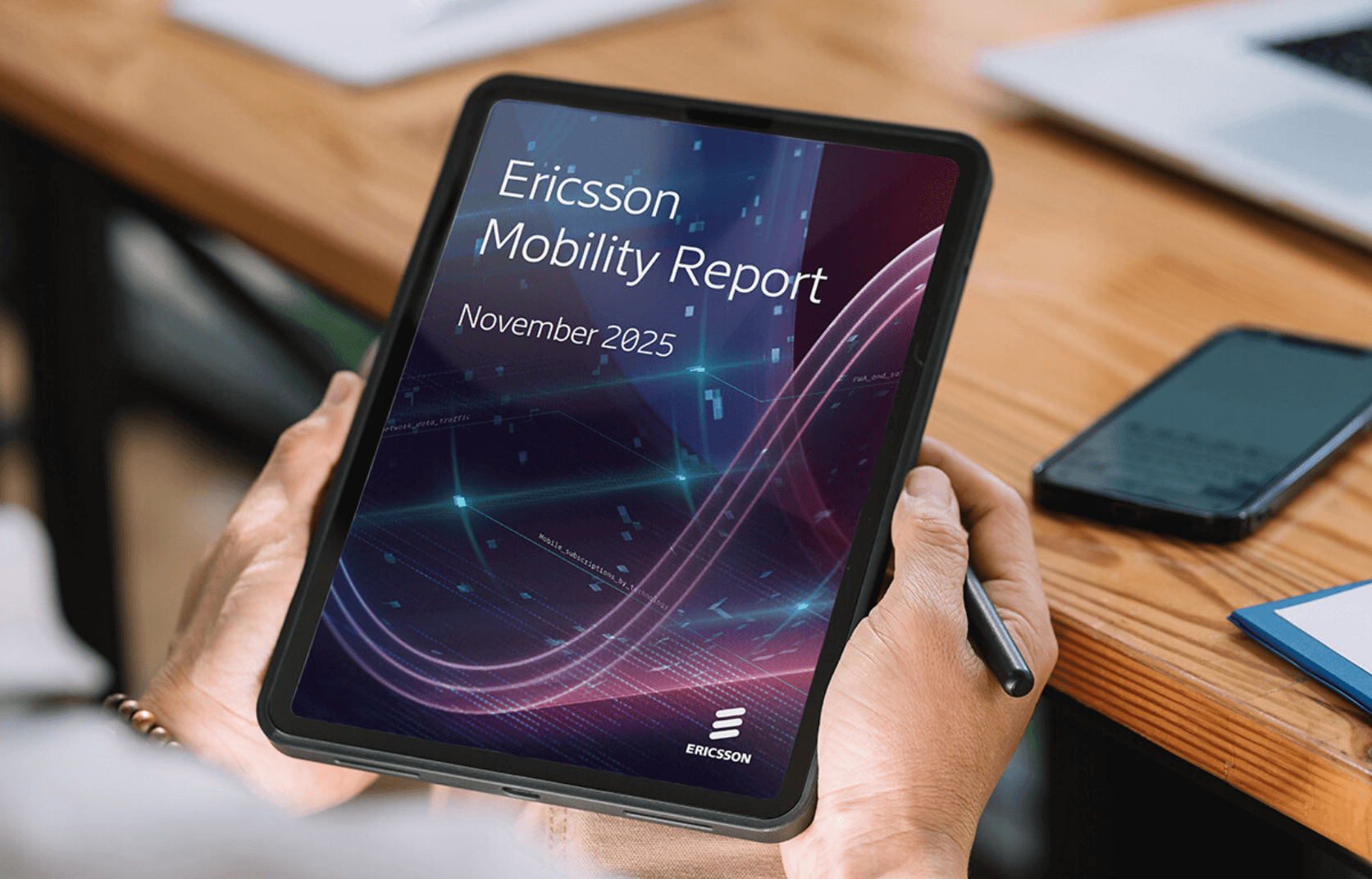
5G Standalone (5G SA) deployments gained significant momentum in 2025, as more than 90 communications service providers (CSPs) launched or soft-launched 5G SA networks—a year-over-year increase of about 30 operators. Ericsson’s November 2025 Mobility Report shows that 5G SA is now a foundational enabler of differentiated connectivity, with 118 documented network-slicing use cases across 56 CSPs and 65 of those already in commercial service. Twenty-one new slicing offers launched in 2025 alone.
The report extends Ericsson’s forecasting horizon through 2031, highlighting the first projected commercial 6G deployments in leading markets such as the U.S., Japan, South Korea, China, India and GCC countries. Global 6G subscriptions are expected to reach 180 million by 2031, with uptake possibly rising if early launches occur. Meanwhile, 5G subscription growth continues at pace: 5G will reach 2.9 billion subscriptions by the end of 2025—roughly one-third of all mobile subscriptions—and is projected to reach 6.4 billion by 2031, with 4.1 billion of these on 5G SA.
Mobile data usage continues to surge as well. Ericsson reports that mobile network traffic grew 20 percent year-over-year—slightly above expectations—driven by intensified use in India and mainland China and by an increase in video consumption, which is forecast to represent 76 percent of global mobile data traffic by year-end. 5G networks are expected to carry 43 percent of all mobile data by the close of 2025, rising to 83 percent in 2031. Fixed Wireless Access (FWA) also contributes meaningfully, with global FWA traffic projected to more than triple to 174 EB per month by 2031.
Expanded Highlights
• 5G SA adoption accelerates: 90+ CSPs have launched/soft-launched 5G Standalone—up ~30 year-over-year.
• Commercial network slicing scales: 118 slicing cases identified; 65 commercially launched across 33 CSPs; 21 launched in 2025 alone.
• Shift toward differentiated connectivity: Europe, Asia-Pacific and North America show strong momentum in latency-based, guaranteed-QoS and application-centric slicing models.
• 5G subscriptions hit 2.9B in 2025: Represents one-third of all mobile subscriptions; mid-band 5G covers 45% of the global population outside China.
• 2031 forecast: 6.4B 5G subscriptions, including 4.1B 5G SA connections; over two-thirds of all global mobile subscriptions.
• 6G outlook: First launches expected in the early 2030s; 180M 6G subscriptions forecast by 2031, excluding early AI-IoT devices.
• Mobile traffic surges 20% YoY: Driven by China and India; video reaches 76% of global mobile traffic; average smartphone usage is 21 GB/month worldwide.
• 5G to handle 43% of global mobile data in 2025: Rising to 83% by 2031, supported by widespread SA rollout and mid-band coverage expansion.
• FWA expansion: 159 operators now offer 5G FWA; 1.4B people expected to use FWA broadband by 2031, with 90% of connections on 5G.
• Network coverage milestones: 400M additional people gained 5G coverage in 2025; outside China, 5G population coverage to reach 50% this year and ~85% by 2031.
• Regional growth insights: Latin America, India, SEA/Oceania show strongest upside in 5G subscription CAGR toward 2031.
• Mobile traffic drivers:
– Short-form video dominates, with 70–80% of mobile video from social platforms (e.g., YouTube, TikTok, Instagram).
– Cloud storage & communications apps drive uplink load.
– Flagship devices deliver higher QoE and bitrates vs entry-level models.
• Traffic forecast: Total mobile network traffic to rise from 197 EB/month in 2025 to 482 EB/month in 2031 (CAGR 16%).
• AI/cloud/AR impact on uplink: On-device AI and AR glasses expected to sharply increase uplink requirements, potentially multiplying uplink traffic by several hundred percent depending on adoption rates.
Mobile Traffic Growth
The Ericsson report shows mobile traffic growth stabilizing yet remaining high, with a 20 percent year-over-year increase between Q3 2024 and Q3 2025—slightly exceeding expectations. India’s expanding 5G footprint and affordability dynamics, along with China’s intensified competition between operators, contributed heavily to rising per-user consumption.
Monthly global mobile data traffic reached 188 EB in Q3 2025. Crucially:
• Video now accounts for ~76% of all mobile data traffic, driven primarily by short-form content.
• Average traffic per smartphone reached 21 GB/month, with wide regional variations—from 5 GB in Sub-Saharan Africa to 36 GB in India.
• 5G networks increase traffic density, as higher throughput and better QoE encourage more streaming and cloud-connected applications.
• FWA continues to shift household traffic onto mobile networks, particularly in markets like the U.S. and India. FWA traffic alone is forecast to reach 174 EB/month by 2031, representing 36% of all mobile network traffic.
Looking ahead, the next wave of traffic growth will be driven not only by video but also by AI-enabled devices, AR/VR glasses, cloud-executed inference and autonomous systems, all of which will place increased demands on uplink performance. Ericsson’s modelling shows that widespread adoption of AI/AR glasses could increase uplink traffic by hundreds of percent, even under conservative assumptions.
“We see that service providers around the world are keen to embrace and deploy 5G SA to offer differentiated connectivity based on value services and not just data volume packages,” said Erik Ekudden, EMR publisher and CTO at Ericsson.
🌐 Analysis: Ericsson’s latest EMR reinforces that 5G SA is becoming a commercially relevant architecture, not just a technical milestone. The rise in slicing-based offers, the acceleration of FWA monetization and the imminent transition to 6G point to a cycle in which operators broaden revenue models beyond throughput. The strong traffic surge in India and China underscores the importance of mid-band spectrum and SA coverage—factors also shaping competitive responses from Huawei, Nokia and other RAN suppliers.