• Home
  • Events Calendar
  • Blueprint Guidelines
  • Privacy Policy
  • Subscribe to Daily Newsletter
  • NextGenInfra.io
No Result
View All Result
Converge Digest
Friday, April 10, 2026
  • Home
  • Events Calendar
  • Blueprint Guidelines
  • Privacy Policy
  • Subscribe to Daily Newsletter
  • NextGenInfra.io
No Result
View All Result
Converge Digest
No Result
View All Result

Home » Ericsson’s Minimalist Radio Dot System Aims to Open Small Cell Market

Ericsson’s Minimalist Radio Dot System Aims to Open Small Cell Market

September 26, 2013
in All
A A

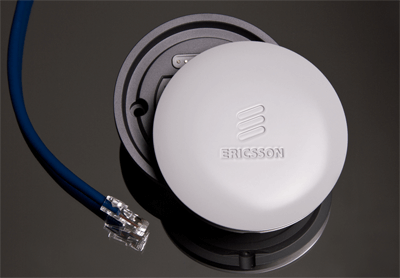
+Ericsson is looking to open up the small cell market with the introduction of  its Radio Dot System, a disk-shaped remote antenna element about the size of a hockey puck.

The Ericsson Radio Dot is connected via standard Category 5/6/7 Ethernet cabling to a indoor base station.  The Dot delivers 3G and 4G LTE for indoor users using 2X 100 milliwatt output power.  Up to 96 of the dots could be connected to a single base station.  The compact dots can be mounted to ceilings or walls and use Power-over-Ethernet.  As such, it serves as an alternative to distributed antenna systems (DAS) or single-element, broadband-connected femtocells.

Ericsson said its unique Radio Dot System leverages the same technology in its macro base stations, including cell coordination and self-organizing networking capabilities. The company believes that the unit’s small size and simplicity of installation will make it far easier and cheaper for carriers to deploy. The design incorporates 14 patents.

Ericsson Radio Dot System supports integration with Ericsson’s carrier Wi-Fi portfolio enabling features such as real-time traffic steering to ensure the best user experience across both Wi-Fi and 3GPP networks. Additional Wi-Fi capability, as well as multi-carrier / multi-frequency support are also planned.  FDD-LTE is initially supported with TD-LTE versions on the way.

Johan Wibergh, head of Ericsson Business Unit Networks, says: “With the Radio Dot System we lower the threshold to building indoor coverage. The dot is the most cost-effective, no-compromise solution to the indoor coverage challenges expressed by our customers. It is ultra-small but can scale to virtually unlimited capacity; it is easy to install, future proof and it is 100 percent integrated with existing mobile networks.”

Speaking at the Ericsson Analyst Forum in Santa Clara, California, Kris Rinne, Senior Vice President, Network and Product Planning, AT&T Services, said: “Small cells are a key component of AT&T’s Project VIP network enhancement program as we seek to constantly improve our customers’ mobile Internet experience. Delivering a great wireless experience indoors can present both technical and logistical challenges. A solution like the Ericsson Radio Dot System gives AT&T another tool to choose from in its next-generation toolkit.”

The product is expected to be commercially available in late 2014.

http://www.ericsson.com/news/1731153

Tags: Blueprint columnsEricssonLTESmall Cells
ShareTweetShare
Previous Post

Ericsson: Expect 5G Network-Society Technologies by 2020

Next Post

Fujitsu Boosts Energy Efficiency in Base Station Power Amplifier

Staff

Staff

Related Posts

Ericsson: Sharp Rise in 5G SA, Network Slicing, and Early 6G Momentum
5G / 6G / Wi-Fi

Ericsson: Sharp Rise in 5G SA, Network Slicing, and Early 6G Momentum

November 21, 2025
Nokia and Mavenir test Open RAN system performance
All

AT&T Pushes Open RAN with Ericsson and 1Finity

October 24, 2025
Nokia and Mavenir test Open RAN system performance
5G / 6G / Wi-Fi

HPE and Ericsson Launch 5G Core Validation Lab for Multi-Vendor Networks

October 16, 2025
Airbus Expands Private 5G Rollout with Ericsson
5G / 6G / Wi-Fi

Airbus Expands Private 5G Rollout with Ericsson

October 6, 2025
Video: AI Automation for Real-Time, Multi-Vendor Networks
Video

Video: AI-Native Networks – From Predictive to Agentic AI – Director’s Cut

October 2, 2025
Ericsson completes first live 5G data call on Ericsson Cloud RAN
5G / 6G / Wi-Fi

Ericsson Wins $1.13B VodafoneThree Deal to Build UK 5G Standalone 

September 22, 2025
Next Post
Fujitsu Boosts Energy Efficiency in Base Station Power Amplifier

Fujitsu Boosts Energy Efficiency in Base Station Power Amplifier

Please login to join discussion

Categories

  • 5G / 6G / Wi-Fi
  • AI Infrastructure
  • All
  • Automotive Networking
  • Blueprints
  • Clouds and Carriers
  • Data Centers
  • Enterprise
  • Explainer
  • Feature
  • Financials
  • Last Mile / Middle Mile
  • Legal / Regulatory
  • Optical
  • Quantum
  • Research
  • Security
  • Semiconductors
  • Space
  • Start-ups
  • Subsea
  • Sustainability
  • Video
  • Webinars

Archives

Tags

5G All AT&T Australia AWS Blueprint columns BroadbandWireless Broadcom China Ciena Cisco Data Centers Dell'Oro Ericsson FCC Financial Financials Huawei Infinera Intel Japan Juniper Last Mile Last Mille LTE Mergers and Acquisitions Mobile NFV Nokia Optical Packet Systems PacketVoice People Regulatory Satellite SDN Service Providers Silicon Silicon Valley StandardsWatch Storage TTP UK Verizon Wi-Fi
Converge Digest

A private dossier for networking and telecoms

Follow Us

  • Home
  • Events Calendar
  • Blueprint Guidelines
  • Privacy Policy
  • Subscribe to Daily Newsletter
  • NextGenInfra.io

© 2025 Converge Digest - A private dossier for networking and telecoms.

No Result
View All Result
  • Home
  • Events Calendar
  • Blueprint Guidelines
  • Privacy Policy
  • Subscribe to Daily Newsletter
  • NextGenInfra.io

© 2025 Converge Digest - A private dossier for networking and telecoms.

This website uses cookies. By continuing to use this website you are giving consent to cookies being used. Visit our Privacy and Cookie Policy.
Go to mobile version