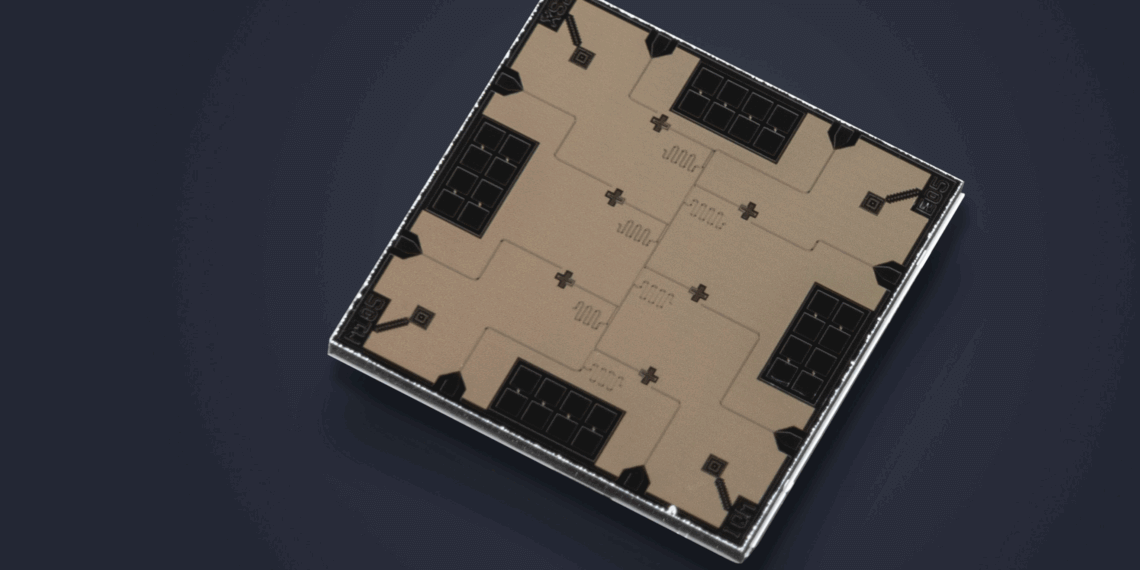
The European Union selected the SUPREME consortium to scale up production of superconducting chips for quantum systems. VTT coordinates the group of 23 partners from eight member states in a six-year effort to create stable fabrication processes with better repeatability and yield. The initiative targets superconducting quantum chips for computing, sensing, and communication applications.
SUPREME focuses on technologies like angle evaporated and etched Josephson junctions, 3D integration methods, and hybrid quantum processes. Partners validate these through pilot line demonstrators, including 3D-integrated qubit assemblies for large-scale quantum processing units, travelling wave parametric amplifiers, and superconducting nanowire single photon detectors. Pilot lines bridge the gap to industrial foundries by enabling technology transfer and supporting market growth.
The Chips Joint Undertaking approved the framework partnership agreement, paving the way for execution in two phases starting early 2026. First technologies become available to external users in 2027 via process design kits that allow academia, SMEs, and large enterprises to design their own devices. SUPREME collaborates with design platforms and chip centers to build a robust European ecosystem.
The consortium includes research organizations such as VTT (Finland), TNO (Netherlands), Delft University of Technology (Netherlands), Technical University of Munich (Germany), Fraunhofer Gesellschaft (Germany), Max-Planck-Gesellschaft (Germany), Leibniz Institute of Photonic Technology (Germany), CEA (France), University of Naples Federico II (Italy), Fondazione Bruno Kessler (Italy), IFAE (Spain), and Silicon Austria Labs (Austria).
Large enterprises join with Infineon Technologies AG (Germany) and IQM Finland Oy (Finland).
SMEs contribute through Arctic Instruments Oy (Finland), Alice & Bob (France), QuantWare BV (Netherlands), Single Quantum BV (Netherlands), QphoX BV (Netherlands), Peak Quantum GmbH (Germany), Silent Waves (France), Amires (Czech Republic), and Qilimanjaro Quantum Tech S.L. (Spain).
“By establishing comprehensive PDKs and stable processing capability around these approaches, we are providing European quantum companies with reliable building blocks to focus on innovation rather than reinventing fabrication processes,” says Pekka Pursula, VTT’s Director for Microeconomics and Quantum Research and coordinator of the consortium.
- A Josephson junction consists of two superconductors separated by a thin insulating barrier, enabling a supercurrent to flow across it via quantum tunneling of electron pairs even without applied voltage. Physicist Brian Josephson predicted this effect in 1962, and it forms the basis for nonlinear electrical behavior in superconducting circuits. Engineers use these junctions in quantum computing for qubits, as well as in precise sensors and metrology devices.