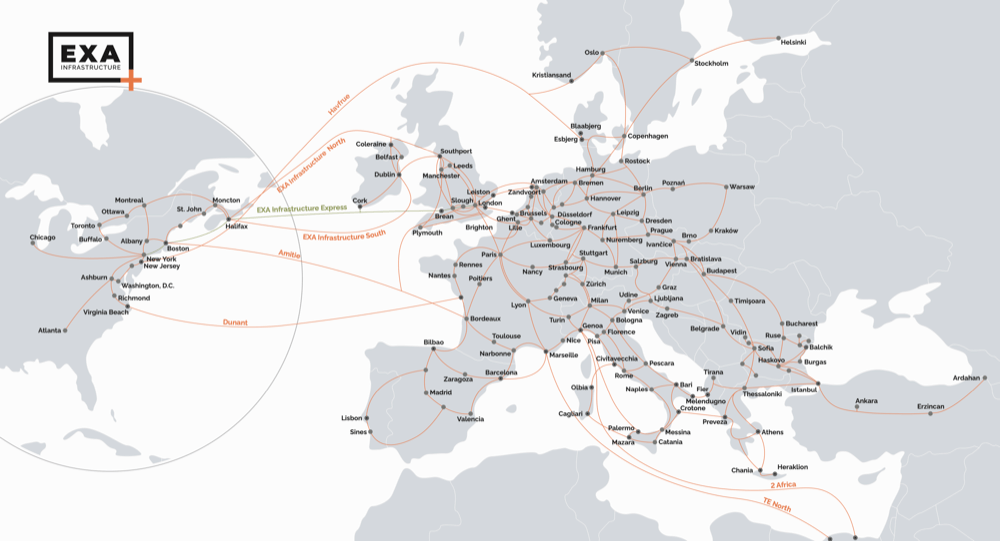
EXA Infrastructure has completed a major upgrade of the Marseille–Paris corridor, eliminating one of Europe’s most persistent connectivity constraints and significantly improving data flow between southern Europe, North Africa, and the rest of the continent. The investment introduces new fiber capacity and a fully diverse route through Dijon, bolstering resilience for carriers, hyperscalers, and AI infrastructure operators.
The company, which first deployed new low-loss G.652D fiber on the Paris–Marseille path in 2024, is now increasing fiber count to accommodate surging demand driven by subsea cable connectivity and data-intensive workloads. The new geographically diverse Paris–Dijon–Marseille route complements the existing one to create two fully diversified, low-latency pathways designed for scalability and reliability.
The announcement follows EXA’s €1.3 billion refinancing round earlier this year, which strengthened its balance sheet and accelerated network investment plans across Europe. EXA’s long-term strategy focuses on removing historic chokepoints and expanding digital capacity to support the region’s growing AI and HPC ecosystems.
• Two fully diverse Marseille–Paris routes now available: direct and Paris–Dijon–Marseille
• Deployment of new low-loss G.652D fiber optimized for subsea and backbone integration
• Supports AI, HPC, and hyperscaler traffic between southern and western Europe
• Backed by €1.3 billion refinancing to accelerate network upgrades and capacity expansion
• Part of EXA’s plan to enhance resilience across 155,000 km of pan-European fiber
“Enhancing network diversity and removing long-standing constraints like the Marseille–Paris corridor is central to our mission of delivering a more resilient and scalable digital infrastructure for Europe,” said Steve Roberts, SVP Network Investments and Products at EXA Infrastructure.
🌐 Analysis: EXA’s expansion underscores a growing trend among European backbone operators to address inland bottlenecks that limit the value of new subsea investments landing in Marseille. The project complements recent capacity initiatives by peers such as Zayo, Colt, and Arelion, all of whom are expanding terrestrial backbones to support rising AI and cloud demand.
🌐 We’re tracking the latest developments in subsea cable infrastructure, policy, and deployments. Follow our ongoing coverage at: https://convergedigest.com/category/subsea/