Unlocking Programmable Telecommunications Networks
For decades, mobile networks have been treated as “dumb pipes”—transporting data without exposing their deeper capabilities to developers. But this model is changing. Network APIs (Application Programming Interfaces) allow developers to programmatically access advanced network features such as quality of service (QoS), location, device identity, fraud prevention, and security.
This represents a fundamental shift for operators, transforming networks into programmable platforms. Instead of being limited to selling connectivity, carriers can expose and monetize network capabilities, while developers gain new tools to create applications that are richer, more secure, and more responsive.
The mission of Network APIs is to unlock the value embedded in telecom networks and democratize access for developers. Historically, many of the most useful network capabilities—guaranteed QoS, precise location data, advanced identity checks—were hidden within proprietary systems.
Network APIs change that by exposing these features through standardized, easy-to-use interfaces.
Key principles underpinning the effort:
- Simplification: APIs abstract away telecom complexity so developers don’t need to be experts in 3GPP or OSS/BSS systems.
- Standardization: APIs must work across different networks worldwide to avoid fragmentation and ensure applications can scale globally.
- Monetization: Carriers gain new business models to earn returns on their multibillion-dollar investments in 5G.
- Security: Strong authentication and authorization mechanisms (OAuth, zero-trust models) protect user data.
- Interoperability: APIs must integrate with existing carrier IT systems and be consumable by third-party developers.
The roots of network APIs stretch back to 4G networks, when operators first exposed basic capabilities such as messaging and billing. With the arrival of 5G Service-Based Architectures (SBA) in the late 2010s, the Network Exposure Function (NEF) provided a secure gateway to expose network functions externally.
The GSMA’s Open Gateway initiative (2023) and the Linux Foundation’s CAMARA project (2022) became turning points. Together with vendors like Ericsson and Nokia, and standards bodies like TM Forum, they have laid the foundation for an interoperable global API ecosystem.
Key Industry Initiatives
Ericsson and the Global Telco JV (Aduna)
In 2024, Ericsson and twelve major carriers—including AT&T, Deutsche Telekom, Verizon, Vodafone, Telefónica, Reliance Jio, Bharti Airtel, Singtel, T-Mobile, Telstra, and América Móvil—created a joint venture often referred to as Aduna. Its role is to act as a global aggregator of network APIs.
Instead of developers needing to integrate separately with each carrier, Aduna provides a single point of access. Early APIs include SIM Swap (fraud detection), Number Verification, and Quality on Demand. Ericsson provides the technology and integration, while carriers contribute their network reach.
Nokia’s Network as Code Platform
Nokia has launched Network as Code, a platform combining a developer portal, SDKs, and pre-packaged APIs such as QoS on Demand and Number Verification. These are distributed via cloud marketplaces (AWS, Azure, Google Cloud), allowing developers to integrate network capabilities as easily as they do with cloud services.
Network as Code also supports GSMA Open Gateway and TM Forum APIs, positioning Nokia as both a vendor and ecosystem enabler.
GSMA Open Gateway
The GSMA Open Gateway initiative is the industry’s overarching framework for Network APIs. Its mission is to standardize APIs across global operators so that applications can be built once and deployed everywhere.
As of 2025, more than 70 operator groups, representing over 80% of global mobile connections, are participating. Open Gateway defines APIs for capabilities such as:
- SIM Swap and Number Verification (fraud prevention)
- Quality on Demand (QoS for gaming, streaming, conferencing)
- Location Verification
- Device Status and Security
Linux Foundation CAMARA
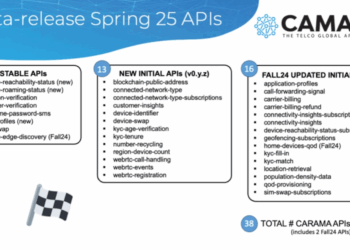
The CAMARA project provides the technical backbone for GSMA Open Gateway. CAMARA develops open-source API definitions and reference implementations, ensuring that APIs are standardized, transparent, and developer-friendly.
Its releases are published under open-source licenses, with YAML/JSON schemas and SDKs for easy adoption. CAMARA collaborates directly with GSMA and TM Forum to align specifications and avoid fragmentation.
TM Forum
TM Forum has long defined APIs for telecom operations (billing, order management, service assurance). Its Open APIs (now over 60 in production) form the operational glue that connects external-facing network APIs into carrier back-end systems.
In 2025, TM Forum and GSMA launched a unified certification program, ensuring that TM Forum Operate APIs and CAMARA-defined service APIs align with Open Gateway standards. Telefónica was the first operator to certify its APIs under this program.
mPlify (formerly MEF)
mPlify, rebranded from the MEF Forum in 2025, is focusing on Network-as-a-Service (NaaS) and enterprise-oriented APIs. Its work includes:
- Quality on Demand: Real-time API for enterprises needing temporary performance boosts.
- Incident Notifications: Standardized APIs for enterprises to receive automated outage or maintenance alerts.
- Lifecycle Service Orchestration (LSO): End-to-end APIs for automating services across SD-WAN, cloud fabrics, and carrier networks.
mPlify complements GSMA and TM Forum by tailoring APIs for enterprise adoption.
The Role of the Carriers
Ultimately, the success of network APIs depends on operator adoption. Carriers are motivated by:
- Generating new revenue streams from API-based services.
- Creating partnerships with cloud providers and developers.
- Remaining relevant in a digital economy dominated by hyperscalers.
Examples of participation:
- AT&T, Verizon, T-Mobile, and Telefónica are early adopters of GSMA Open Gateway APIs.
- Deutsche Telekom, Vodafone, Orange, Jio, Airtel contribute through Aduna and CAMARA.
- Orange demonstrated its LiveNet API portfolio at MWC 2025, targeting developers with live-use portals.
Through these programs, operators are moving from connectivity providers to digital service enablers.
Example Use Cases
- Fraud Prevention: Financial services use SIM Swap and Number Verification APIs to block account takeovers.
- Optimized Gaming: Game developers request low-latency, high-bandwidth sessions via QoS APIs.
- Enhanced Logistics: Location Verification APIs confirm driver positions for deliveries or secure transactions.
- Immersive Media: Streaming platforms use APIs to guarantee bandwidth during live events.
- Connected Vehicles: APIs reserve network slices for ultra-reliable vehicle-to-everything (V2X) communications.
- Healthcare: APIs ensure telemedicine sessions receive prioritized bandwidth for video consultations.
These examples illustrate how network APIs extend telecom services into industries like finance, logistics, entertainment, and health.
Standards Development and Interoperability
Network APIs are advancing through multiple layers of standardization:
- GSMA Open Gateway: Defines global frameworks and initial API families.
- CAMARA: Provides open-source specifications and developer tooling.
- TM Forum Open APIs: Ensures operational alignment with carriers’ IT systems.
- mPlify LSO APIs: Brings in enterprise connectivity and automation focus.
The unification of GSMA, CAMARA, and TM Forum certification in 2025 is a milestone, creating a globally trusted baseline.
Governments have supported network API development as part of broader 5G and digital sovereignty strategies:
- United States: NTIA programs fund API pilots; the CHIPS Act supports 5G core and semiconductor innovation.
- European Union: Digital Decade and Horizon Europe initiatives emphasize API-enabled data sharing and sovereignty.
- Asia-Pacific: India and China are backing API pilots with national R&D support.
- Public-private collaborations: GSMA Open Gateway is used in e-governance and public-safety initiatives.
These programs recognize APIs as a way to foster innovation, secure critical infrastructure, and ensure competitive telecom industries.
Despite strong momentum, several challenges remain:
- Fragmentation: Without continued alignment, APIs could diverge across regions or vendors.
- Legacy Integration: Carriers must upgrade OSS/BSS and NEFs to support API exposure.
- Developer Awareness: Many developers still associate “APIs” only with cloud, not with networks.
- Security Concerns: API exposure increases the attack surface and requires robust zero-trust security.
- Competition from CPaaS providers: Hyperscalers and CPaaS platforms could capture much of the value.
Market forecasts suggest revenue will grow steadily but modestly in the early years—$284 million in 2025—before accelerating to an estimated $34 billion by 2030.
Current Implementations (2025)
As of 2025, real deployments are gaining traction:
- Ericsson’s Aduna JV aggregates APIs across multiple carriers for developers worldwide.
- Nokia’s Network as Code signs up 20 partners and offers APIs through hyperscaler cloud marketplaces.
- Orange LiveNet showcases live API demonstrations at industry events.
- AT&T, Verizon, and T-Mobile launch GSMA Open Gateway APIs for fraud prevention and verification.
- Axiata and BT adopt TM Forum APIs for operational integration.
- mPlify’s NaaS APIs are used for AI-driven enterprise connectivity.
These implementations show that APIs are moving beyond pilots into production-scale services.
In short, it would be fair to conclude that the trajectory for network APIs looks promising:
- AI Integration: APIs will increasingly include AI-driven predictive capabilities for dynamic resource allocation.
- Edge Expansion: APIs will orchestrate services at the network edge, supporting IoT and low-latency apps.
- 6G Readiness: Early 6G frameworks are expected to embed APIs for quantum security and adaptive slicing.
- Ecosystem Growth: With GSMA, TM Forum, and CAMARA alignment, APIs are likely to reach mass adoption by 2030.
- Developer Engagement: Carrier platforms and marketplaces will prioritize developer experience, including SDKs, sandboxes, and global distribution channels.
Will network APIs represent a pivotal evolution for telecom operators? We’ve been disappointed by the technical implementations of new carrier paradigms many times before. But by exposing programmable interfaces, operators could transform their networks into platforms that developers can build on—unlocking new revenue streams, enabling innovative services, and staying relevant in a software-driven economy.
Recent reporting suggest that he initiatives of Ericsson, Nokia, GSMA, TM Forum, CAMARA, mPlify, and global carriers are gaining traction. But will they gain critical momentum, or will other forces drive telecom infrastructure in a different direction?