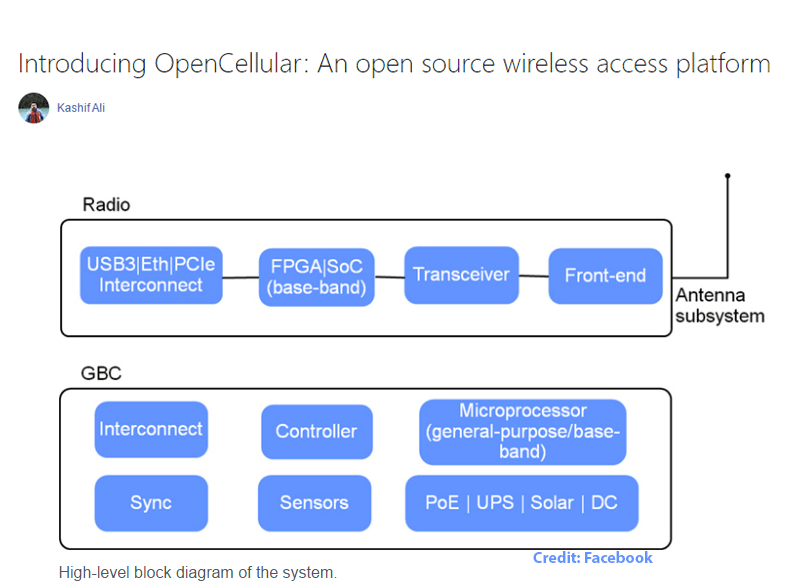
Facebook introduced OpenCellular, its open source, wireless access platform designed for remote areas of the world not served by traditional networks. Facebook said it seeks to encourage telecom operators, entrepreneurs, OEMs, and researchers to locally build, implement, deploy, and operate wireless infrastructure based on this platform.

Facebook plans to open-source the hardware design, along with necessary firmware and control software.
OpenCellular consists of two main subsystems: general-purpose and base-band computing (GBC) with integrated power and housekeeping system, and radio frequency (RF) with integrated analog front-end.
Facebook’s Telecom Infra Project Gets Organized
The Telecom Infra Project (TIP), which was kicked off by Facebook earlier this year with a mission to take the principles of the Open Compute Project (OCP) model and apply them to software systems and components involved in access, backhaul, and core networks, has expanded its membership and formed the first set of technical project groups.
New TIP members include Axiata Digital, Indosat, MTN Group, Telefonica, Vodafone, Acacia, ADVA, BlueStream, Broadcom, Coriant, Deloitte, Juniper Networks, and Lumentum. TIP launch partners included Intel, Nokia, Deutsche Telekom and SK Telecom.
The new Project Groups include:
Access
System integration and site optimization – Chaired by SK Telecom
 New integration via innovative, cost-effective and efficient end-to-end solutions that address rural and urban regions difficult to serve profitably.
Unbundled solutions – Co-chaired by SK Telecom and Nokia
Taking a fresh look at access, specifically through a cost-effective approach for low-power, low-maintenance solutions.
Media-friendly solutions – Chaired by Intel
Focusing on methods to increase effective throughput and further enhance the mobile user experience by bringing compute and storage capacity closer to the network edge.
Backhaul
High-frequency autonomic access – Chaired by Facebook
Defining thin and extensible software stack to autonomously coordinate routing, addressing and security related functions in packet-switched IPv6 networks.
Open optical packet transport – Co-chaired by Facebook and Equinix
Defining Dense Wavelength Division Multiplexing (DWDM) open packet transport architecture that triggers new pace of technology innovation and flexibility, and avoids implementation lock-ins.
Core and Management
Core network optimization – Chaired by Intel
New innovation through disaggregation of traditional telecom core network via deconstructing traditionally bundled components.
Greenfield telecom networks – Co-chaired by Nokia, Facebook and Deutsche Telekom
Accelerating operator-friendly evolution towards a pure and efficient IT-based network architecture via greenfield solutions designed from the ground up.
https://telecominfraproject.com/news/updates-to-the-tip-foundation/
Facebook’s Terragraph Accelerates WiGig for City Access
Facebook took the wraps off of two terrestrial connectivity technologies for fast wireless access.
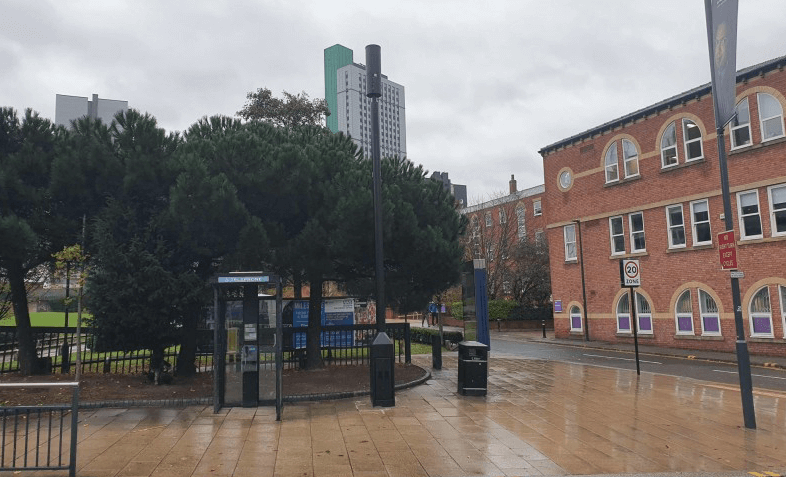
Terragraph is a 60 GHz, multi-node wireless system for dense urban areas and that uses radios based on the WiGig standard. Facebook said Terragraph will deliver gigabits of data capacity. IPv6-only Terragraph nodes will be placed at 200m intervals. Terragraph will incorporate commercial off-the-shelf components and aim for high-volume, low-cost production. Facebook noted that up to 7 GHz of bandwidth is available in the unlicensed 60 GHz band in many countries. U.S. regulators are considering expanding this to a total of 14 GHz.

Facebook Terragraph will also leverage an SDN-like cloud compute controller and a new modular routing protocol that Facebook optimized for fast route convergence and failure detection. The architecture also tweaks the MAC layer to solve shortcomings of TCP/IP over a wireless link. The company says the TDMA-TDD MAC layers delivers up to 6x improvement in network efficiency while being more predictable than the existing Wi-Fi/WiGig standard.
Terragraph is already in operation at the Facebook campus in Menlo Park, California, where it delivers 1.05 Gbps bidirectional (2.1 Gbps total throughput per distribution node) in P2P mode, up to 250 meters away. A wider trial is planned for San Jose, California.
Facebook also released details on Project ARIES, a transmission technology that is a) spectrally efficient and allows for higher throughput in even the smallest bandwidths, and b) energy efficient, allowing for extended coverage range.
The proof-of-concept system features a base station with 96 antennas and can support 24 streams simultaneously over the same radio spectrum. Researchers have demonstrated 71 bps/Hz of spectral efficiency. The target is aiming for an unprecedented 100+ bps/Hz of spectral efficiency. Facebook said ARIES is an embodiment of Massive MIMO — by using “spatial multiplexing,” the antenna array at the base station can serve a multiplicity of autonomous user terminals on the same time-frequency resource. This opens up possibilities such as resource sharing as an alternative not only to the need for spectrum licensing.
Facebook already has an ARIES testbed delivering 10x spectral and energy efficiency gains in point to multi-point deployments.