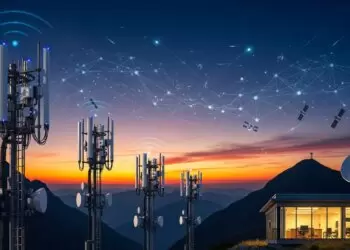
The Federal Communications Commission has set two major spectrum items for its April 28, 2025, open meeting. The first proposal would modernize spectrum sharing rules between geostationary (GSO) and non-geostationary (NGSO) satellite systems. The second item would finalize a licensing framework for the 37–37.6 GHz band, also known as the Lower 37 GHz band, which is currently the only millimeter wave band not yet allocated for exclusive, licensed use.
The satellite item centers on updating power limits originally set in the 1990s to reflect the rapid evolution of NGSO constellations, such as those used by satellite broadband providers. The proposed Notice of Proposed Rulemaking (NPRM) seeks to allow more dynamic coexistence between GSO and NGSO systems, potentially opening the door to higher throughput and better coverage across overlapping orbital networks.
Meanwhile, the proposed Report and Order for the Lower 37 GHz band would establish a shared licensing model. This would enable coordinated access among commercial users and federal agencies for high-capacity services like 5G, wireless backhaul, and advanced fixed wireless. The decision could unlock hundreds of MHz of spectrum for dense urban deployments and AI data center interconnects, especially as demand surges for Tbps-scale wireless infrastructure.
Key points:
• Modernizing satellite spectrum sharing (SB Docket No. 25-157):
• Revisits legacy power limits between GSO and NGSO systems.
• Promotes more efficient orbital spectrum use for satellite broadband.
• Targets better coexistence of constellations to expand consumer services.
• Lower 37 GHz band licensing framework (WT Docket No. 24-243; GN Docket No. 14-177):
• Establishes licensing rules for the 37–37.6 GHz band.
• Encourages co-primary access between federal and commercial users.
• Supports use cases requiring ultra-high bandwidth and low-latency wireless.