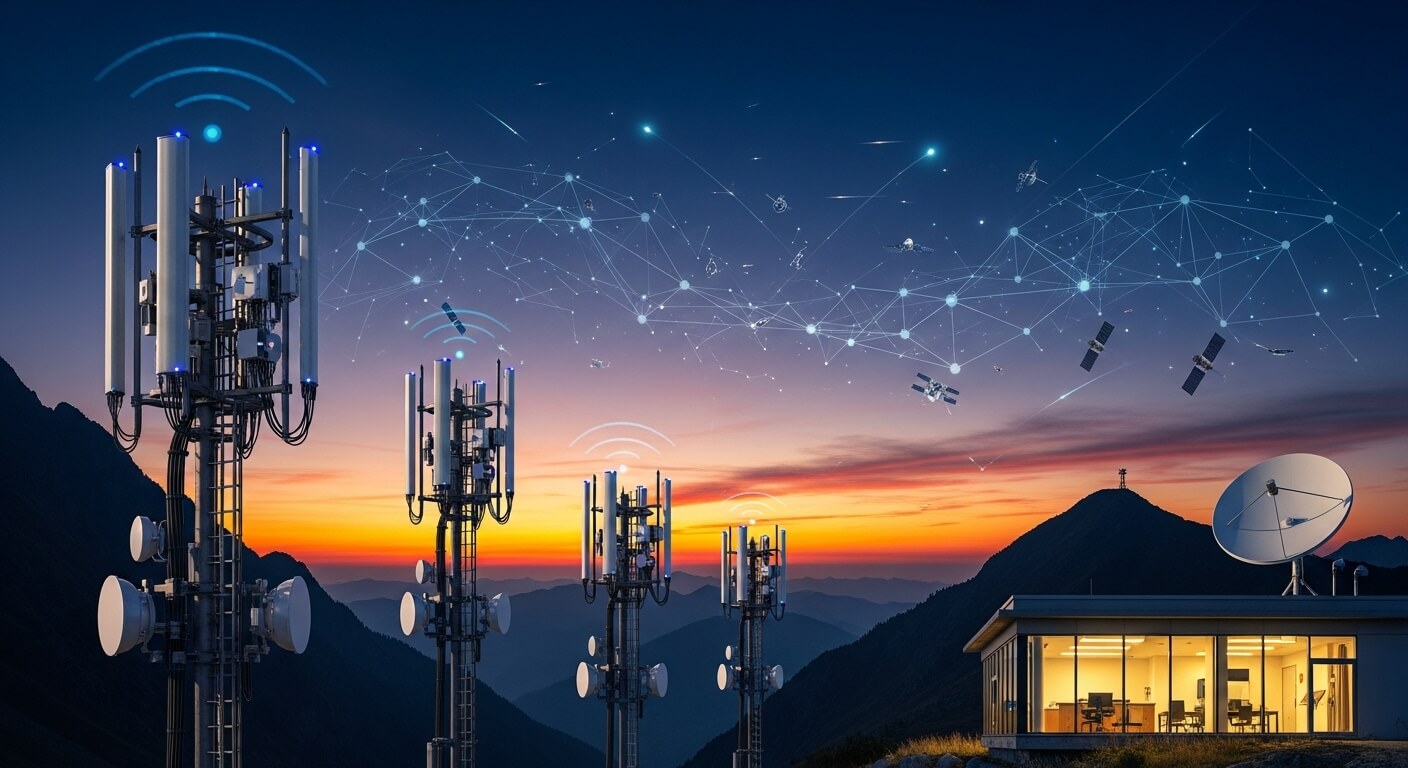
The Federal Communications Commission (FCC) will consider a major proposal at its November 20, 2025, open meeting to reallocate part of the Upper C-band (3.98–4.2 GHz) for terrestrial wireless use. The Notice of Proposed Rulemaking (NPRM), GN Docket No. 25-59, fulfills Congress’s directive in the One Big Beautiful Bill Act (OBBB Act), which mandates auctioning at least 100 MHz of this spectrum by mid-2027. The proposal could open as much as 180 MHz, creating a contiguous mid-band block spanning 3.7–4.16 GHz for 5G and emerging 6G applications.
The FCC plans to apply the existing 3.7 GHz Service rules—used in the 2020 Lower C-band auction—to any new Upper C-band licenses . Reconfiguration options under review range from 100 MHz (3.98–4.08 GHz) to 180 MHz (3.98–4.16 GHz), with a guard band of no more than 20 MHz to protect remaining Fixed Satellite Service (FSS)operations and adjacent radio altimeters operating in 4.2–4.4 GHz . The FCC seeks comment on technical coexistence, relocation procedures, reimbursement mechanisms, and bidding rules, signaling that future auctions will likely mirror prior C-band practices such as small-business credits and flexible-use licensing .
Key points from the NPRM include:
- Up to 180 MHz of spectrum could be cleared for 5G/6G terrestrial use.
- Remaining FSS operations (Eutelsat, SES, Telesat) would be repacked, supported by transition payments and possibly a new Clearinghouse .
- A guard band of ≤ 20 MHz would protect aviation systems.
- Competitive bidding will follow Part 1 Subpart Q rules, with provisions for rural and small providers.
- The new allocation would add a primary non-federal mobile service designation to portions of 4.0–4.2 GHz .
“Making this mid-band spectrum available for flexible use will help meet growing demand for advanced wireless services while ensuring aviation safety and continuity for satellite users,” the FCC stated.
“Restoring America’s leadership position is important. After all, freeing up spectrum drives down prices for consumers, creates jobs, and increases competition. It also plays a vital role in promoting our national security and geopolitical interests. We’ve seen how the Lower C-band powers in-homeand high-speed mobile broadband across the country.
“We have no time to spare. The One Big Beautiful Bill requires us to complete an Upper C-band auction by July 2027. So it is now time to start making important decisions on how best to unleash new wireless services quickly in the band.” – Brendan Carr, FCC Chairman
🌐 Analysis:
Winners: National mobile carriers—Verizon, AT&T, and T-Mobile—stand to gain additional mid-band spectrum contiguous with their existing 3.7 GHz holdings, simplifying network engineering and boosting capacity for AI-era workloads such as edge inference, vehicle connectivity, and real-time XR. Cable operators (Comcast, Charter) may also enter bidding to support offload capacity for MVNO traffic. Network infrastructure vendors (Ericsson, Nokia, Samsung, Mavenir) and tower operators (Crown Castle, SBA Communications, American Tower) will benefit from the densification cycle this triggers.
Losers:
- Fixed Satellite Service (FSS) operators—notably SES, Eutelsat OneWeb, Intelsat, and Telesat—still depend on the 4.0–4.2 GHz range for broadcast and data links. They face costly repacking, earth-station retuning, and potential interference risks.
- Uplink providers and national broadcasters that rely on C-band contribution feeds (major networks and sports channels) could face migration costs as feeds move to Ku/Ka-band.
- Aviation manufacturers and airlines must validate radio-altimeter performance near 4.2 GHz to avoid another interference dispute like the 2021–2022 5G rollout episode.
- Rural wireless ISPs operating under experimental or shared access in 3.98–4.2 GHz could lose secondary rights once commercial mobile licensing begins.
Potential spectrum-sharing winners:
If the FCC opts for a shared-access or dynamic coordination model—similar to the CBRS (3.5 GHz) framework—then spectrum management platform providers such as Federated Wireless, Google SLASS, CommScope, Sony, and Amdocs could gain new opportunities. Such a hybrid approach could accelerate deployment in rural areas and support enterprise private 5G systems without waiting for full clearing. The NPRM leaves the door open to testing this model in portions of the band where satellite incumbents remain.
Institutional context:
The proceeding unfolds as the FCC operates with only three sitting commissioners, following delays in confirming replacements for open Democratic and Republican seats. This limited roster may slow decision-making or temper the ambition of large-scale reallocations until the Commission regains a full quorum. Industry observers note that while Chair Brendan Carr has prioritized spectrum expansion, final auction policy—including timing, block size, and repacking incentives—will likely depend on how quickly the Senate confirms new commissioners in early 2026.