• Home
  • Events Calendar
  • Blueprint Guidelines
  • Privacy Policy
  • Subscribe to Daily Newsletter
  • NextGenInfra.io
No Result
View All Result
Converge Digest
Monday, April 20, 2026
  • Home
  • Events Calendar
  • Blueprint Guidelines
  • Privacy Policy
  • Subscribe to Daily Newsletter
  • NextGenInfra.io
No Result
View All Result
Converge Digest
No Result
View All Result

Home » FCC Updates Rules for 57-64 GHz Unlicensed Spectrum

FCC Updates Rules for 57-64 GHz Unlicensed Spectrum

August 13, 2013
in All
A A

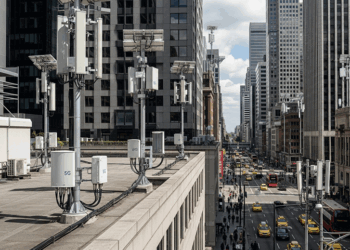
The Federal Communications Commission updated rules governing unlicensed communication equipment in the 57-64 GHz band, saying the changes support using the spectrum for relatively low-cost, high-capacity short-range backhaul alternative to connect wireless broadband networks and for other wireless applications.

The FCC said the spectrum could provide wireless broadband network connectivity over distances up to a mile at data rates of 7 Gbps, potentially relieving the need and expense of wiring facilities or using existing facilities with less capability.

At the same time the rules for equipment located indoors will remain unchanged, providing regulatory certainty for an emerging family of products that can provide data rates of 7 Gbps for applications such as wireless docking of digital devices and distribution of uncompressed video to TV receivers and video displays.

In the 1990s, the Commission adopted rules for unlicensed operations over a 7-gigahertz wide bandwidth, in the 57-64 GHz band. Because of the wide bandwidth, this spectrum is very desirable for high-capacity uses, both in point-to-point fixed operations outdoors (extending the reach of fiber optic networks by providing broadband access to adjacent structures in commercial facilities), and as networking equipment indoors (enabling users to send data between entertainment equipment such as high-definition televisions and video players within the same room, eliminating the need for complex wiring).

Under the new rules, new limits are set for the power permitted for outdoor operations between fixed points using highly directional antennas. This maximum power permitted is tied to the precision of the antenna beam which determines its potential for causing interference to other users, including to indoor low-power networks. This rule change would permit outdoor devices to deliver high-capacity communication links over longer distances, enhancing the utility of the unlicensed 57-64 GHz band as a vehicle for broadband. It will also facilitate the use of this unlicensed spectrum as a backhaul alternative in densely-populated areas where 4G and other wireless services are experiencing an ever-increasing need for additional spectrum.

The Commission also took additional actions to reduce the regulatory burden on these operations by eliminating a station identification rule that has become unnecessary, and by modifying the measurement units to promote uniformity and consistency.

http://www.fcc.gov/document/fcc-modifies-part-15-rules-unlicensed-operation-57-64-ghz-band

Tags: Blueprint columnsFCCSpectrumWi-Fi
ShareTweetShare
Previous Post

Telstra and Ericsson Complete LTE-A Call on 1800MHz and 900MHz

Next Post

NeoPhotonics and Inphi Begin Shipping High Dynamic Range ICR (HD-ICR) for 100G Colorless Coherent

Staff

Staff

Related Posts

FCC Targets Upper C-Band for 5G and 6G Expansion — Winners and Losers
5G / 6G / Wi-Fi

FCC Targets Upper C-Band for 5G and 6G Expansion — Winners and Losers

November 1, 2025
FCC issues 2.5 GHz licenses from Auction 108
Clouds and Carriers

FCC Moves to Expel Hong Kong Telecom from U.S.

October 20, 2025
FCC Targets Faster Satellite Approvals and Expanded Spectrum
Space

FCC Targets Faster Satellite Approvals and Expanded Spectrum

October 6, 2025
FCC adds $791 million in RDOF funding for broadband
Legal / Regulatory

FCC Targets Chinese-Controlled “Bad Labs” in First Enforcement Action

September 9, 2025
MetTel Extends SD-WAN Services Globally as Starlink Reseller
5G / 6G / Wi-Fi

SpaceX Gains 50 MHz S-band, Paving Way for Satellite-Grade 5G

September 8, 2025
AT&T to Buy EchoStar Spectrum for $23B; Boost Mobile Shifts to Hybrid MNO
5G / 6G / Wi-Fi

AT&T to Buy EchoStar Spectrum for $23B; Boost Mobile Shifts to Hybrid MNO

August 26, 2025
Next Post
NeoPhotonics and Inphi Begin Shipping High Dynamic Range ICR (HD-ICR) for 100G Colorless Coherent

NeoPhotonics and Inphi Begin Shipping High Dynamic Range ICR (HD-ICR) for 100G Colorless Coherent

Please login to join discussion

Categories

  • 5G / 6G / Wi-Fi
  • AI Infrastructure
  • All
  • Automotive Networking
  • Blueprints
  • Clouds and Carriers
  • Data Centers
  • Enterprise
  • Explainer
  • Feature
  • Financials
  • Last Mile / Middle Mile
  • Legal / Regulatory
  • Optical
  • Quantum
  • Research
  • Security
  • Semiconductors
  • Space
  • Start-ups
  • Subsea
  • Sustainability
  • Video
  • Webinars

Archives

Tags

5G All AT&T Australia AWS Blueprint columns BroadbandWireless Broadcom China Ciena Cisco Data Centers Dell'Oro Ericsson FCC Financial Financials Huawei Infinera Intel Japan Juniper Last Mile Last Mille LTE Mergers and Acquisitions Mobile NFV Nokia Optical Packet Systems PacketVoice People Regulatory Satellite SDN Service Providers Silicon Silicon Valley StandardsWatch Storage TTP UK Verizon Wi-Fi
Converge Digest

A private dossier for networking and telecoms

Follow Us

  • Home
  • Events Calendar
  • Blueprint Guidelines
  • Privacy Policy
  • Subscribe to Daily Newsletter
  • NextGenInfra.io

© 2025 Converge Digest - A private dossier for networking and telecoms.

No Result
View All Result
  • Home
  • Events Calendar
  • Blueprint Guidelines
  • Privacy Policy
  • Subscribe to Daily Newsletter
  • NextGenInfra.io

© 2025 Converge Digest - A private dossier for networking and telecoms.

This website uses cookies. By continuing to use this website you are giving consent to cookies being used. Visit our Privacy and Cookie Policy.
Go to mobile version