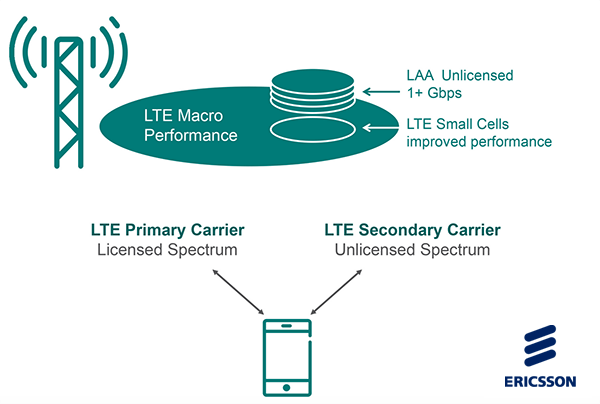
Ericsson, Vodafone and Qualcomm have conducted the first live testing of advanced LTE Carrier Aggregation (CA) of LTE in licensed and unlicensed bands on a commercial mobile network.
The Vodafone LTE trials with unlicensed spectrum are being conducted over Vodafone’s network in the Netherlands. The latest over the air results were achieved by aggregating 20 MHz of Vodafone spectrum in Band 3 (1800 MHz) with 20 MHz of the unlicensed 5 GHz band U-NII-1 band. The testing validated LTE performance in the unlicensed band and fair co-existence with other technologies like Wi-Fi within the unlicensed 5 GHz band. The Ericsson RBS 6402 Indoor Picocell includes a 5GHz LTE enabled radio in addition to multiple LTE radio variants and optional 2.4 GHz Wi-Fi module – all in a sleek, compact package with a tablet-sized footprint. The user equipment utilized in this trial is a test device powered by the Qualcomm Snapdragon X12 LTE modem. The Snapdragon X12 LTE modem is a product of Qualcomm Technologies.
Matthias Sauder, chief network officer, Vodafone Netherlands: “Our intent in deploying small cells is always to deliver the best customer experience, and we see the potential for LTE aggregation with unlicensed bands on small cells as one way to make that customer experience even better. We are already using Ericsson’s RBS 6402 indoor picocell in our own shops in the Netherlands, so it’s great to see that it will also support advanced LTE CA capabilities with unlicensed spectrum on our network.”
Valter D’Avino, Head of Ericsson’s Region Western and Central Europe, says: “Vodafone has taken a leadership position in small cells and our LTE trials on unlicensed spectrum with them, together with Qualcomm Technologies, really underscore their continued commitment to improving the performance of indoor networks to ensure better app coverage for their customers. The unlicensed 5 GHz band is a shared resource and, as we have seen, it can be aggregated with LTE bands to provide a speed boost for users to improve app coverage, when spectrum is available – of course, the user also maintains their connection to Vodafone’s highly reliable LTE network, so they have a great connection no matter what.”
Ericsson Achieves 450 Mbps with LTE-U
Ericsson now has License Assisted Access (LAA), sometimes referred to as LTE-U, running live its labs. The tests support the aggregation of licensed and unlicensed spectrum for peak rates up to 450 Mbps and enabling fair sharing of spectrum between mobile and Wi-Fi devices. The lab trials of both LAA fair sharing and licensed-unlicensed aggregation – 20 MHz on licensed band and 40 MHz on unlicensed 5 GHz band – were demonstrated from the Ericsson radio development units in Ottawa, Canada and Stockholm, Sweden.

LAA, or LTE-U, extends the benefits of LTE to unlicensed spectrum, providing reliable and predictable performance. The licensed band provides an anchor to ensure a seamless user experience with full mobility while the unlicensed band provides incremental capacity and enables faster data speeds.
The technology milestone has been achieved in cooperation with Qualcomm Technologies. The companies also confirmed that Verizon, SK Telecom and T-Mobile US are already investigating the performance benefits that LAA can offer to mobile customers on their networks.
Starting in the fourth quarter 2015, Ericsson is adding LAA to its indoor small cell portfolio, including the Ericsson RBS 6402 Indoor Picocell (targeted at smaller buildings under 50,000 square feet) followed by the Ericsson Radio Dot System (for medium and large buildings).