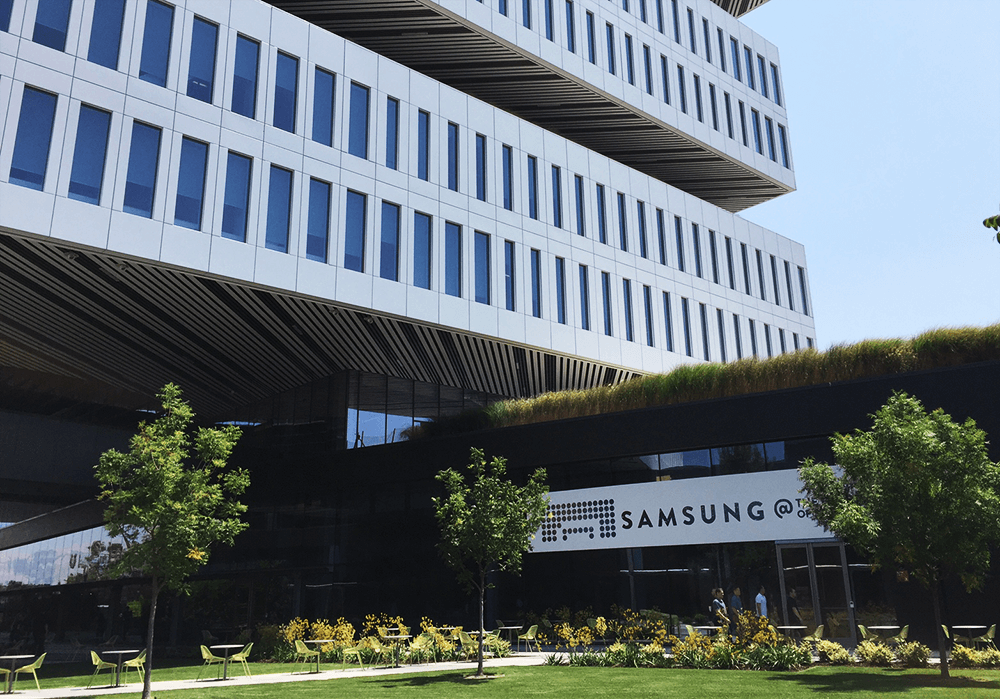
Can you imagine a 128 TB SAS SSD? It is coming soon from Samsung in the familiar 2.5” disk drive package and destined for the next generation of cloud data centres. Leading companies and start-ups from across the storage industry met at this week’s Flash Memory Summit in Santa Clara, California. A key takeaway from the event is that solid state storage continues to improve at a rate much faster than networking technologies. Solid state drives surpassed spinning disks in total capacity some time ago – Samsung announced a 16 TB SDD in August 2015 and currently offers a 32 TB SSD, but prices remain high.

The market is driven by unrelenting demand for flash drives in laptops, desktops and servers, especially in cloud data centres where there has been an uptick in spending over the last few quarters. NAND prices on a $/GB are significantly higher than they were 12 months. According to data from Objective Analysis, contract prices for NAND averaged $0.30 per gigabyte on July 2nd, compared to $0.20 per gigabyte a year ago. Looking at Amazon.com, the street price of a 500 GB SSD is about the same in mid-2017 as last summer. Meanwhile, with higher prices and relentless demand in the current market, the leading manufacturers of 3D NAND are doing quite well. For Samsung Electronics, this translated into very strong revenue and earnings for its June financial report, which predicted that a tight market for DRAM and 3D NAND will continue for the rest of the calendar year.
 In a presentation at Flash Memory Summit, Jim Handy of Objective Analysis predicted that NAND prices will remain stable at these rates through mid-2018, but will then suddenly collapse due to a saturation of new supply entering the market. His argument goes that all vendors have begun to ship 3D NAND but only in limited volume due to the complexity of mastering 3D NAND manufacturing. Over time, these complexities are being ironed out, manufacturers will move to add additional layers of stacking and the cost per GB will become cheaper for 3D NAND than for 2D planar NAND. Objective Analysis expects a steep oversupply of 3D NAND by late 2018, even before significant new manufacturing facilities in China come online.
Disruption at Flash Memory Summit
This year’s Flash Memory Summit was disrupted on opening day by a fire in the exhibition area, apparently an electrical issue at one of the vendor stands. Thankfully no one was hurt, but the exhibits were cancelled for the remainder of the event. Conferences and keynotes were the forum for technological disruptions, of which there are plenty in this rapidly evolving segment.
Firstly, Samsung made several important announcements and previewed that massive 128 TB SSD. At a fundamental level, Samsung said its 3D NAND roadmap is progressing on schedule. Last year, Samsung introduced its 4th generation, 64-layer triple-level-cell V-NAND flash memory. This has now gone into production and is being used for products such as the 32TB SSD. Drive capacity and performance are expected to scale up with the upcoming v5 generation of 3D NAND. Samsung has already started work on v6 and v7, with an assumed 18-month interval between each generation. Samsung executives seemed confident they will be able to squeeze at least ten generations out of 3D NAND technology, which provide another decade of continuous improvement if Flash SSD. Beyond that, other non-volatile memory technologies will need to be developed.

Samsung’s 1 TB V-NAND chip
Samsung also announced a 1 TB V-NAND chip, slated for commercial production next year, that will enable 2 TB of memory in a single V-NAND package. This is achieved by stacking 16 x 1 TB dies – an advancement the company considers ‘one of the most important memory advances of the past decade’.
Samsung is introducing a 16 TB NGSFF (next generation small form factor) SSD that is designed for use in 1U rack servers. Measuring 30.5 x 110 x 4.38 mm, the Samsung NGSFF SSD aims for improved space utilisation and scaling. The company showcased a 1U sample design, codenamed Mission Peak, that pack 36 of the units for a total capacity of 576 TB in the 1 RU appliance. Samsung is looking for partners on this new drive form factor.
In addition, for extreme SSD read/write performance, Samsung introduced its first Z-SSD product, boasting 15 microseconds of read latency time, which is approximately a seventh of the read latency of an NVMe SSD. At the application level, the company estimates its Z-SSDs can reduce system response time by up to 12 fold compared to using NVMe SSDs.
Samsung is also introducing a technology it calls Key Value SSD. Whereas today’s SSDs convert object data of widely ranging sizes into data fragments of a specific size called ‘blocks’, the new Key Value SSD technology allows SSDs to process data without converting it into blocks. Samsung said its Key Value instead assigns a ‘key’, or specific location, to each value, or piece of object data, regardless of its size. The key enables direct addressing of a data location, which in turn enables the storage to be scaled.