Hyperconverged platforms, such as those offered by Nutanix, have proven to be extremely successful in the market because they integrate compute, networking and storage in a single, scale-out box. They are a new way of looking at the old problem of how best to connect these three resources. In a similar fashion, the Open Compute Project, which was launched by Facebook six years ago, set out to rethink how compute, storage and networking could be optimised at the rack level to build hyperscale data centres.
 What we’re seeing now, as evidenced by the 2017 Flash Memory Summit in Silicon Valley, is that non-volatile memory is advancing at a faster pace than other storage technologies, and at faster pace than compute (CPUs and GPUs), or networking. Ethernet has continued to progress in either 10X or 4X steps, but recently, these have taken time. In data centres, 10G backbones are common. Carrier backbones typically run utilise 100G links.
These statements were true a year ago – or even two years ago. We see some 400G pluggable transceiver apparently ready for market this year. But will 400G be rapidly adopted in either data centres or carrier networks? For a variety of network engineering reasons, implementing 400G in a network is not as easily done as deploying new SSDs with 4 times the capacity as last year’s model.
More importantly, Samsung Electronics has a ten-year roadmap showing how its 3D NANDs will evolve from 4th generation to 5th, 6th, 7th, 8th, 9th and 10th over the course of a decade.
The company says the physics of the last two generations in this progression have yet to be solved but so far look possible. At this point, it seems likely that this rapid evolution will deliver 2X or 3X capacity improvements every two years of less. On the networking side, we’ve seen the Ethernet Alliance publish an Ethernet Roadmap that envisions a proliferation of new interface speeds. This roadmap predicts terabit speed interfaces by 2020, scaling up to 10 terabits/second by 2030. Storage innovation may be winning this race.
Here are some other interesting observations on the storage market.
Western Digital pushes 3D NAND to 96 layers
Western Digital, which received the Flash Memory Summit ‘Best of Show’ award for its BiCS4 technology, has now pushed its 3D NAND technology to 96 layers of vertical storage capability. This marks several years of continuous improvement. In 2016, WD announced 64-layer 3D NAND after achieving 48-layer 3D NAND in 2015. Last month, the company also announced the development of its first four-bits-per-cell (X4) 3D NAND technology. More layers translate into more capacity.
Toshiba faces uncertainty but moves to 64-layer, triple-level Flash
Toshiba’s semiconductor division has been a state-of-turmoil due to restructuring and likely sale. Various suitors have been suggested and apparently rejected either by the company or the Japanese authorities. Most recently, Toshiba’s management appears to be nearing a deal to sell the business to a consortium led by Bain Capital, although this too may be at an impasse. The joint venture with SanDisk (a division of WD) focused on flash memory has become mired in legal disputes. Apparently, Toshiba will not ship its latest generation of 96-layer BiCS modules to SanDisk.
Nevertheless, at Flash Memory Summit, Toshiba America Electronic Components (TAEC) introduced its first enterprise SSDs utilizing the 64-layer,3-bit-per-cell TLC (triple-level cell) technology flash memory: the PM5 12Gbit/s SAS series and the CM5 NVM Express (NVMe) series. Toshiba’s PM5 series will be available in a 2.5-inch form factor in capacities from 400GB to 30.72TB], with endurance options of 1, 3, 5 and 10DWPD (drive writes per day). Toshiba also introduced its own consumer SSDs for PCs and laptops based on the same 64-layer technology. Capacity options include 256GB, 512GB, and 1024GB.
Toshiba is also introducing the first MultiLink SAS architecture, enabling up to 3350MB/s of sequential read and 2720MB/s of sequential write in MultiLink mode and 400,000 random read IOPS in narrow or MultiLink mode.
Mellanox looks to NVMe over Fabrics
Mellanox Technologies is pushing ahead with its BlueField System-on-Chip (SoC) for NVMe over a network fabric. BlueField integrates all the technologies needed to connect NVMe over Fabrics flash arrays. It provides 200 Gb/s of throughput and more than 10 million IOPS in a single SoC device. In addition, an on-board multicore ARM processor subsystem enables flexible programmability that allows vendors to differentiate their software-defined storage appliances with advanced capabilities. The BlueField chip can be used to control and connect All Flash Arrays and Just-a-Bunch-Of-Flash (JBOF) systems to InfiniBand and Ethernet Storage fabrics. The Mellanox SoC combines a programmable multicore CPU, networking, storage, security, and virtualization acceleration engines into a single, highly integrated device. Refence storage platforms are now ready.
“By tightly integrating high-speed networking, programmable ARM cores, PCIe switching, cache, memory management, and smart offload technology all in one chip; the result is improved performance, power consumption, and affordability for flash storage arrays. BlueField is a key part of our Ethernet Storage Fabric solution, which is the most efficient way to network and share high-performance storage,” stated Michael Kagan, CTO of Mellanox.
Seagate revs its Nytro Flash storage
Seagate Technology introduced enhanced versions of two flash technologies to boost performance and capacity for mixed data center workloads. The updated solid-state drives — including the 2 TB Nytro 5000 M.2 non-volatile memory express (NVMe) SSD and the Nytro 3000 Serial Attached SCSI (SAS) SSD — address different segments of the cloud and data center markets. The latest Nytro 3000 SAS SSD offers a dual-port SAS interface to maintain data integrity in the event of an unexpected communication channel loss. Capacity is 15TB, more than four times the capacity of the previous version.
Seagate also previewed plans to offer a 64-terabyte (TB) NVMe add-in card (AIC). This forthcoming product boasts a read speed of 13 gigabytes per second (GB/s) — the fastest and highest-capacity SSD ever demonstrated.
“Large-capacity SSDs are in high demand in hyperscale computing, a market that is growing faster than any other sector,” said Jim Handy, general director of research firm Objective Analysis. “Seagate’s new SSDs, with their high-performance interfaces and high capacities, should find ready acceptance in this market and other data center applications.”
WekaIO, a start-up based in San Jose, California with R&D in Israel, introduced a cloud-native scalable file system that scales to exabytes of data in a single namespace while delivering a big performance boost to applications, processing four times the workload compared to IBM Spectrum Scale measured on Standard Performance Evaluation Corp. (SPEC) SFS 2014. A key innovation is that WekaIO eliminates bottlenecks and storage silos by aggregating local SSDs inside the servers into one logical pool, which is then presented as a single namespace to the host applications. A transparent tiering layer offloads cold data to any S3 or Swift cloud object store for unlimited capacity scaling, under the same single namespace.
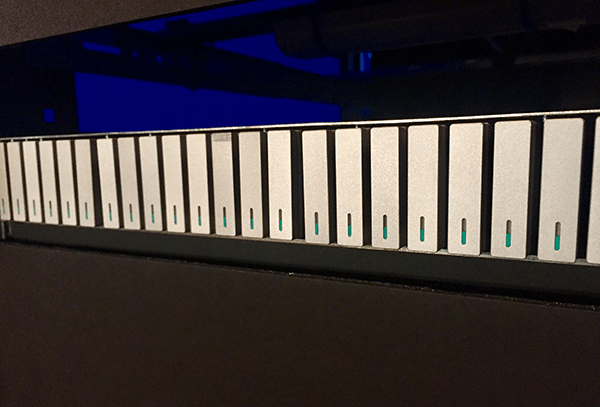
In partnership with Intel, WekaIO is now demonstrating a native NVMe-oF system using the new “ruler” form factor for Intel SSDs. The companies said this enables a storage capacity of beyond 1PB in 1U while delivering more than 3 million IOPS.