TeraWulf announced two transformative deals this week that significantly expand its role as a builder of high-performance computing (HPC) and AI-optimized infrastructure. The company secured a pair of 10-year hosting agreements with AI cloud platform Fluidstack, backed by Google, and closed an 80-year ground lease for its Cayuga site in upstate New York. Together, these developments boost TeraWulf’s contracted revenues into the billions, extend its platform capacity beyond 1 GW, and cement its position as one of the few operators marrying zero-carbon energy with hyperscale-ready compute campuses.
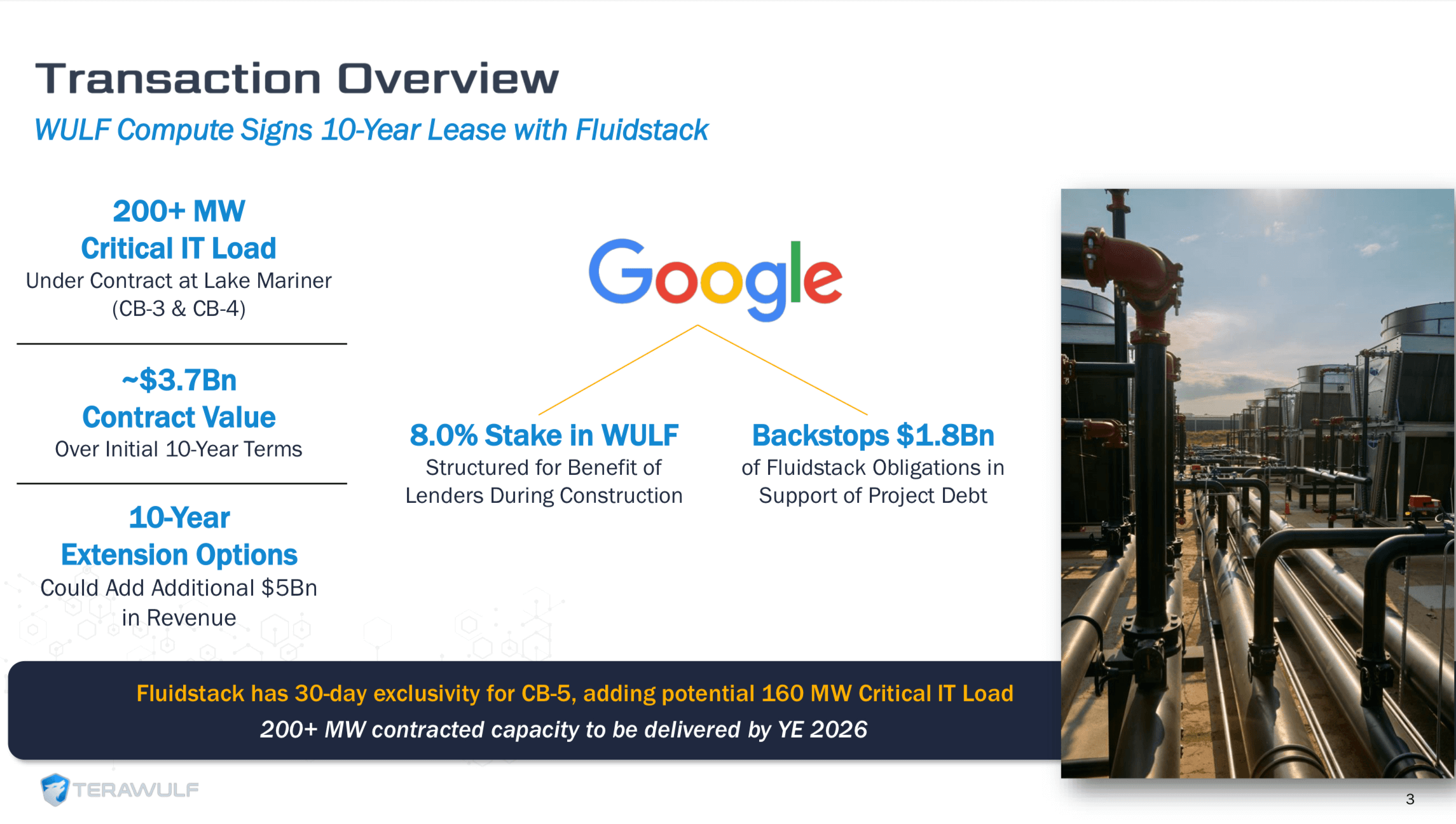
Under the Fluidstack agreements, TeraWulf will deliver more than 200 MW of critical IT load—about 250 MW of gross capacity—at its Lake Mariner campus in Western New York. The deals carry an initial value of $3.7 billion across their first 10 years, rising to $8.7 billion if extension options are exercised. Google is playing a pivotal role, providing $1.8 billion of lease backstops to strengthen project financing and receiving warrants equal to an ~8% equity stake in TeraWulf. Separately, the Cayuga ground lease secures up to 400 MW of future capacity on a 183-acre site with extensive existing electrical, water, and fiber infrastructure. With 138 MW expected in service by 2026, the site will rely on New York’s predominantly zero-carbon power mix and benefit from electricity costs averaging below $0.05/kWh.
On its Q2 2025 earnings call, TeraWulf reported revenues of $47.6 million, up 38% sequentially, with adjusted EBITDA turning positive at $14.5 million versus a $4.7 million loss in Q1. Management stressed that Google’s involvement materially improves its credit profile and lowers financing costs, giving the company greater flexibility as it ramps capacity at both Lake Mariner and Cayuga. CEO Paul Prager called the new contracts “a defining moment,” while CFO Patrick Fleury underscored that the transactions, together with progress on existing Core42 commitments, demonstrate the company’s ability to attract tier-one tenants while executing on time and on budget.
Founded in 2021, TeraWulf has differentiated itself by pursuing vertically integrated, sustainable data centers designed for both HPC hosting and bitcoin mining. Its assets are strategically located near abundant, low-cost zero-carbon energy in New York, with designs optimized for liquid cooling and high-density workloads. Unlike many peers, TeraWulf has leaned on its deep energy infrastructure background—its leadership previously built and operated large-scale power assets—to navigate site development, permitting, and grid interconnections. That approach has helped it control costs while aligning with hyperscaler sustainability priorities. The company has also focused on long-term revenue visibility through multi-year tenant agreements, positioning it to transition from bitcoin-heavy revenue streams toward a balanced mix of HPC and AI hosting.
• Signed 200+ MW, 10-year HPC hosting agreements with Fluidstack at Lake Mariner
• ~$3.7B contracted revenue; ~$8.7B possible with lease extensions
• Google: $1.8B lease backstop + ~8% equity stake via 41M warrants
• Fluidstack granted 30-day exclusivity for CB-5 (160 MW additional potential)
• Lake Mariner campus purpose-built for liquid cooling, dual 345kV lines, low-latency fiber
• Secured 80-year ground lease at Cayuga (183 acres, up to 400 MW capacity)
• 138 MW of Cayuga capacity expected online in 2026; plans for 67 MW solar + 800 MWh storage
• Q2 2025 results: $47.6M revenue (+38% QoQ); adjusted EBITDA $14.5M vs. -$4.7M Q1
• Cost of revenue down 10% QoQ; SG&A guidance raised to $50–55M reflecting HPC growth
• Bitcoin mining segment remains profitable, contributing cash flow during HPC ramp
• Corporate strategy: prioritize execution for Core42, secure new tenants, expand capacity base
• Evaluated 75+ potential expansion sites in 2025; maintaining disciplined site selection
“This is a defining moment for TeraWulf,” said CEO Paul Prager. “We are proud to unite world-class capital and compute partners to deliver the next generation of AI infrastructure, powered by low-cost, predominantly zero-carbon energy.”

🌐 Analysis: TeraWulf’s trajectory illustrates how bitcoin mining operators are pivoting into AI-era infrastructure, leveraging cheap energy and existing campuses to serve hyperscalers. Google’s equity-linked backstop mirrors Microsoft’s investment in CoreWeave and Amazon’s stake in Anthropic, signaling a new financing model for AI infrastructure expansion. With Lake Mariner and Cayuga, TeraWulf now sits in a small circle of firms capable of scaling 100–400 MW campuses purpose-built for liquid-cooled AI clusters. Execution speed, financing discipline, and power market conditions will determine if it can match the pace of competitors like CoreWeave and Crusoe Energy.
🌐 We’re tracking the latest developments in AI infrastructure and data centers. Follow our ongoing coverage at: https://convergedigest.com/category/data-centers/