• Home
  • Events Calendar
  • Blueprint Guidelines
  • Privacy Policy
  • Subscribe to Daily Newsletter
  • NextGenInfra.io
No Result
View All Result
Converge Digest
Friday, April 10, 2026
  • Home
  • Events Calendar
  • Blueprint Guidelines
  • Privacy Policy
  • Subscribe to Daily Newsletter
  • NextGenInfra.io
No Result
View All Result
Converge Digest
No Result
View All Result

Home » Germany’s updated security requirements avoid ban on Huawei

Germany’s updated security requirements avoid ban on Huawei

March 10, 2019
in All
A A

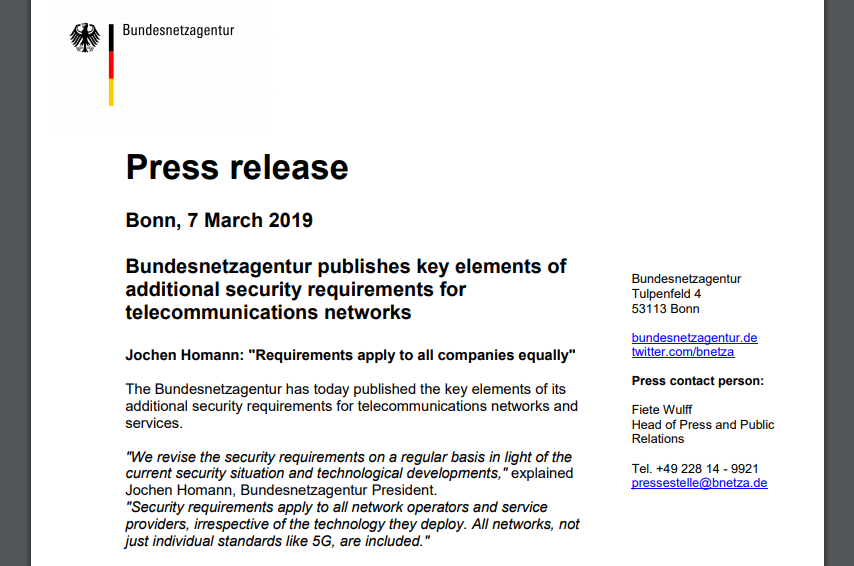
The Bundesnetzagentur, which is the German regulatory office in charge of telecommunications, published additional security requirements for telecommunications networks and services without banning Huawei or other Chinese vendors.

The key elements of the new security policy are:

  • Systems may only be sourced from trustworthy suppliers whose compliance with national security regulations and provisions for the secrecy of telecommunications and for data protection is assured.
  • Network traffic must be regularly and constantly monitored for any abnormality and, if there is any cause for concern, appropriate protection measures must be taken.
  • Security-related network and system components (critical key components) may only be used if they have have been certified by the Federal Office for Information Security (BSI) and undergone IT security checks by a BSI-approved testing body. Critical key components may only be sourced from trustworthy suppliers/manufacturers, ie those that can provide assurance of their trustworthiness.
  • Security-related network and system components (critical key components) may only be used following an appropriate acceptance test upon supply and must be subjected to regular and ongoing security tests. The components that are security-related (critical key components) will be defined by the BSI and Bundesnetzagentur by mutual agreement.
  • Only trained professionals may be employed in security-related areas.
  • Proof must be provided that the hardware tested for the selected, security-related components and the source code at the end of the supply chain are actually deployed in the products used.
  • When planning and building the network, “monocultures” must be avoided by using network and system components from different manufacturers.
  • Where system-related processes are outsourced, only professionally competent, reliable and trustworthy contractors may be selected.
  • Adequate redundancy must be available for critical, security-related network and system components (critical key components). 

“We revise the security requirements on a regular basis in light of the current security situation and technological developments,” explained Jochen Homann, Bundesnetzagentur President. “Security requirements apply to all network operators and service providers, irrespective of the technology they deploy. All networks, not just individual standards like 5G, are included.”

https://www.bundesnetzagentur.de/SharedDocs/Pressemitteilungen/EN/2019/20190307_SL.html?nn=404530


Tags: Blueprint columnsGermanyHuawei
ShareTweetShare
Previous Post

Austria completes 5G auction in 3.4 – 3.8 GHz band

Next Post

Aquantia intros 10 Gigabit Ethernet MAC Controller

Staff

Staff

Related Posts

BerryComm Expands Central Indiana Fiber with Nokia
5G / 6G / Wi-Fi

Telefónica Germany Awards Nokia a 5-Year RAN Modernization Deal

November 26, 2025
T-Systems signs MoU with Shell Gas & Power
Clouds and Carriers

Deutsche Telekom: Network Investments Reshape Q3 2025 Performance

November 13, 2025
Vodafone, AST SpaceMobile Pick Germany for EU Sovereign Direct-to-Mobile Satellite Hub
Space

Vodafone, AST SpaceMobile Pick Germany for EU Sovereign Direct-to-Mobile Satellite Hub

November 7, 2025
Deutsche Telekom Looks to NVIDIA for €1B Industrial AI Cloud
AI Infrastructure

Deutsche Telekom Looks to NVIDIA for €1B Industrial AI Cloud

November 6, 2025
Astera Labs Expands PCIe 6.x Interoperability Testing
Optical

Astera Labs Acquires aiXscale Photonics to Advance Optical Chiplet Integration 

October 22, 2025
DT Raises 2025 Outlook Amid Strong U.S. Momentum, AI Strategy, and FTTH
Clouds and Carriers

DT Raises 2025 Outlook Amid Strong U.S. Momentum, AI Strategy, and FTTH

August 7, 2025
Next Post
Aquantia intros 10 Gigabit Ethernet MAC Controller

Aquantia intros 10 Gigabit Ethernet MAC Controller

Please login to join discussion

Categories

  • 5G / 6G / Wi-Fi
  • AI Infrastructure
  • All
  • Automotive Networking
  • Blueprints
  • Clouds and Carriers
  • Data Centers
  • Enterprise
  • Explainer
  • Feature
  • Financials
  • Last Mile / Middle Mile
  • Legal / Regulatory
  • Optical
  • Quantum
  • Research
  • Security
  • Semiconductors
  • Space
  • Start-ups
  • Subsea
  • Sustainability
  • Video
  • Webinars

Archives

Tags

5G All AT&T Australia AWS Blueprint columns BroadbandWireless Broadcom China Ciena Cisco Data Centers Dell'Oro Ericsson FCC Financial Financials Huawei Infinera Intel Japan Juniper Last Mile Last Mille LTE Mergers and Acquisitions Mobile NFV Nokia Optical Packet Systems PacketVoice People Regulatory Satellite SDN Service Providers Silicon Silicon Valley StandardsWatch Storage TTP UK Verizon Wi-Fi
Converge Digest

A private dossier for networking and telecoms

Follow Us

  • Home
  • Events Calendar
  • Blueprint Guidelines
  • Privacy Policy
  • Subscribe to Daily Newsletter
  • NextGenInfra.io

© 2025 Converge Digest - A private dossier for networking and telecoms.

No Result
View All Result
  • Home
  • Events Calendar
  • Blueprint Guidelines
  • Privacy Policy
  • Subscribe to Daily Newsletter
  • NextGenInfra.io

© 2025 Converge Digest - A private dossier for networking and telecoms.

This website uses cookies. By continuing to use this website you are giving consent to cookies being used. Visit our Privacy and Cookie Policy.
Go to mobile version