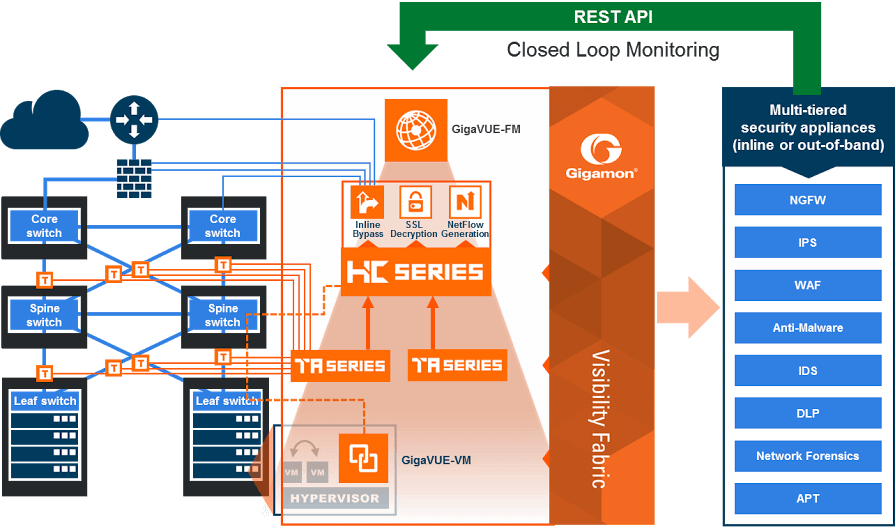
 JDSU is developing closed loop integration plugins that support Gigamon’s Software Defined Visibility, a framework that allows customers, security and network equipment vendors, as well as managed service providers, to control and program Gigamon’s Visibility Fabric via REST-based APIs.
There are several use cases in which JDSU plans to utilize Software Defined Visibility:
- Session-based Filtering – JDSU will take advantage of Gigamon’s Adaptive Packet Filtering capabilities to dynamically drop unwanted ‘streaming’ traffic such as Netflix or YouTube, thereby reducing the demand on monitoring appliance storage capacity.
- IPv4 and IPv6 Traffic Filtering – As more networks begin deployment of IPv6 along with legacy IPv4 infrastructure, JDSU expects customers will need to selectively filter v4 and v6 traffic. Leveraging the intelligent filtering of the Gigamon Visibility Fabric, network administrators can rest assured knowing that they have comprehensive visibility and a future-proof path to simplify IPv6 adoption without creating new blind spots.
- Reduce ‘Mean Time To Resolution’ – To assist with faster diagnosis of traffic anomalies, the ability to enhance captured packets that are subsequently stored on JDSU’s GigaStor appliances will improve diagnosis accuracy and focus. Through the addition of Gigamon’s “Flow Mapping” meta-data and “network neighbor” discovery information, Network Operators will be able to evaluate network incidents more effectively and isolate issues to specific segments of the network infrastructure.
“We are excited to be working with Gigamon to integrate with APIs that support Software Defined Visibility,” said Charles Thompson, senior director, Product Line Management for JDSU. “With this integration, we envision a multitude of possibilities where our customers can automate traffic visibility, so that they can focus their resources on other mission-critical activities.”
“Having partners like JDSU on board and adopting our recently released APIs accelerates our Software Defined Visibility market momentum,” said Ananda Rajagopal, VP of Product Line Management at Gigamon. “Not only is JDSU at the forefront of adoption, they are validating the market need for pervasive and active visibility. Their API-based development demonstrates the true power and flexibility that a programmatic framework can provide to quickly and automatically react to changes in network conditions.”
Gigamon’s GigaVUE-FM 3.0 Fabric Manager offers a single pane-of-glass view of both physical and virtual nodes across the Visibility Fabric, while providing a wizard-based approach for configuring Flow Mapping and GigaSMART traffic policies. A single instance of GigaVUE-FM can manage hundreds of visibility nodes across multiple locations delivering more than a quarter of a million physical and virtual ports. Flow Mapping is a patented technology at the heart of Gigamon’s GigaVUE Visibility Fabric nodes that takes line-rate traffic at 1Gb, 10Gb, 40Gb or 100Gb from a network TAP or a SPAN/mirror port (physical or virtual) and then optimizes flows based on individual traffic profiles of the tools and applications that secure, monitor, and analyze the network infrastructure.