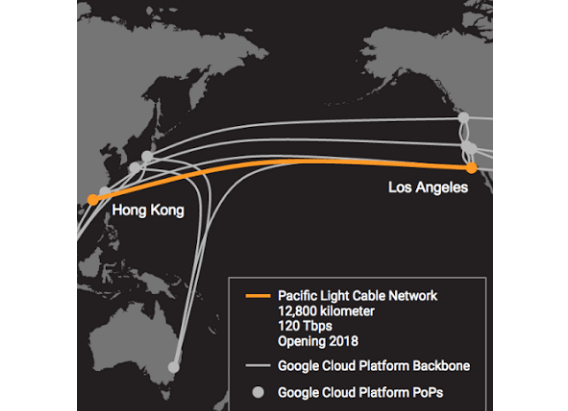
Facebook and Google are teaming up to build the highest capacity, trans-Pacific cable system to date.
The Pacific Light Cable Network (PLCN), which will stretch 12,800 km between Los Angeles and Hong Kong, will have an estimated cable capacity of 120 Tbps. The cable is expected to enter service in the summer of 2018. The project is organized by Pacific Light Data Communication Co. Ltd., a new company based in Hong Kong.
 TE SubCom has been appointed lead contractor. The cable will use TE SubCom’s C+L technology, a major step forward in available cable transmission capacity that effectively doubles the available bandwidth and capacity per fiber pair over a traditional C-band-only designed system.
Google noted that it has now taken an ownership stake in six submarine cables: PLCN, Unity, SJC, FASTER, MONET and Tannat.
http://www.te.com/usa-en/about-te/news-center/subcom-facebook-google-pldc-co-build-plcn-101216.html
Transpacific FASTER Cable Enters Service with 60 Tbps Capacity
The world’s highest capacity undersea cable system has entered commercial service — six fiber pairs capable of delivering 60 Terabits per second (Tbps) of bandwidth across the Pacific.
FASTER is a 9,000km trans-Pacific cable connecting Oregon and two landing sites in Japan (Chiba and Mie prefectures). The system has extended connections to major hubs on the West Coast of the U.S. covering Los Angeles, the San Francisco Bay Area, Portland and Seattle. The design features extremely low-loss fiber, without a dispersion compensation section, and the latest digital signal processing technology.

Google will have sole access to a dedicated fiber pair. This enables Google to carry 10 Tbps of traffic (100 wavelengths at 100 Gbps). In addition to greater capacity, the FASTER Cable System brings much needed diversity to East Asia, writes Alan Chin-Lun Cheung, Google Submarine Networking Infrastructure.
“From the very beginning of the project, we repeatedly said to each other, ‘faster, Faster and FASTER,’ and at one point it became the project name, and today it becomes a reality. This is the outcome of six members’ collaborative contribution and expertise together with NEC’s support,” said Hiromitsu Todokoro, Chairman of the FASTER Management Committee.
“This was the first trans-Pacific submarine cable built solely by NEC Corporation, employing the latest 100Gbps digital coherent optical transmission technology. We are honored that the consortium entrusted us to build FASTER. Although we faced many challenges during the construction, I am truly glad that we were able to overcome these and to welcome this day,” said Kenichi Yoneyama, Project Manager for FASTER at NEC’s Submarine Network Division. “This epoch-making cable will not only bring benefits to the United States and Japan, but to the entire Asia-Pacific region.”
Construction of the system was announced in August 2014 by the FASTER consortium, consisting of China Mobile International, China Telecom Global, Global Transit, Google, KDDI and Singtel.
http://www.nec.com
https://cloudplatform.googleblog.com/2016/06/Google-Cloud-customers-run-at-the-speed-of-light-with-new-FASTER-undersea-pipe.html
- Google previously invested in the 7.68 Tbps Pacific Unity cable system, which came online in 2010.
Microsoft and Facebook to Build 160 Tbps Transatlantic Cable
Microsoft and Facebook will jointly fund a new transatlantic cable system linking Virginia Beach, Virginia to Bilbao, Spain.
The MAREA cable, which will be managed by Telxius, Telefónica’s new infrastructure company, will feature eight fiber pairs and an initial estimated design capacity of 160 Tbps. The new 6,600 km submarine cable system will take a more southern route than other transatlantic cables, which mostly connect northern Europe to the New York/New Jersey region.

Construction is set to begin in August 2016 with completion targeted for October 2017.
“In order to better serve our customers and provide the type of reliable and low-latency connectivity they deserve, we are continuing to invest in new and innovative ways to continuously upgrade both the Microsoft Cloud and the global Internet infrastructure,” said Frank Rey, director, global network acquisition, Microsoft Corp. “This marks an important new step in building the next generation infrastructure of the Internet.”
- Microsoft has previously announced investments with Hibernia and Aqua Comms for fiber connectivity from North America to Ireland and on to the United Kingdom.
- Microsoft is a consortium partner in the New Cross Pacific (NCP) Cable Network. Other partners include China Mobile, China Telecom, China Unicom, Chunghwa Telecom, and KT. TE SubCom its the cable supplier.