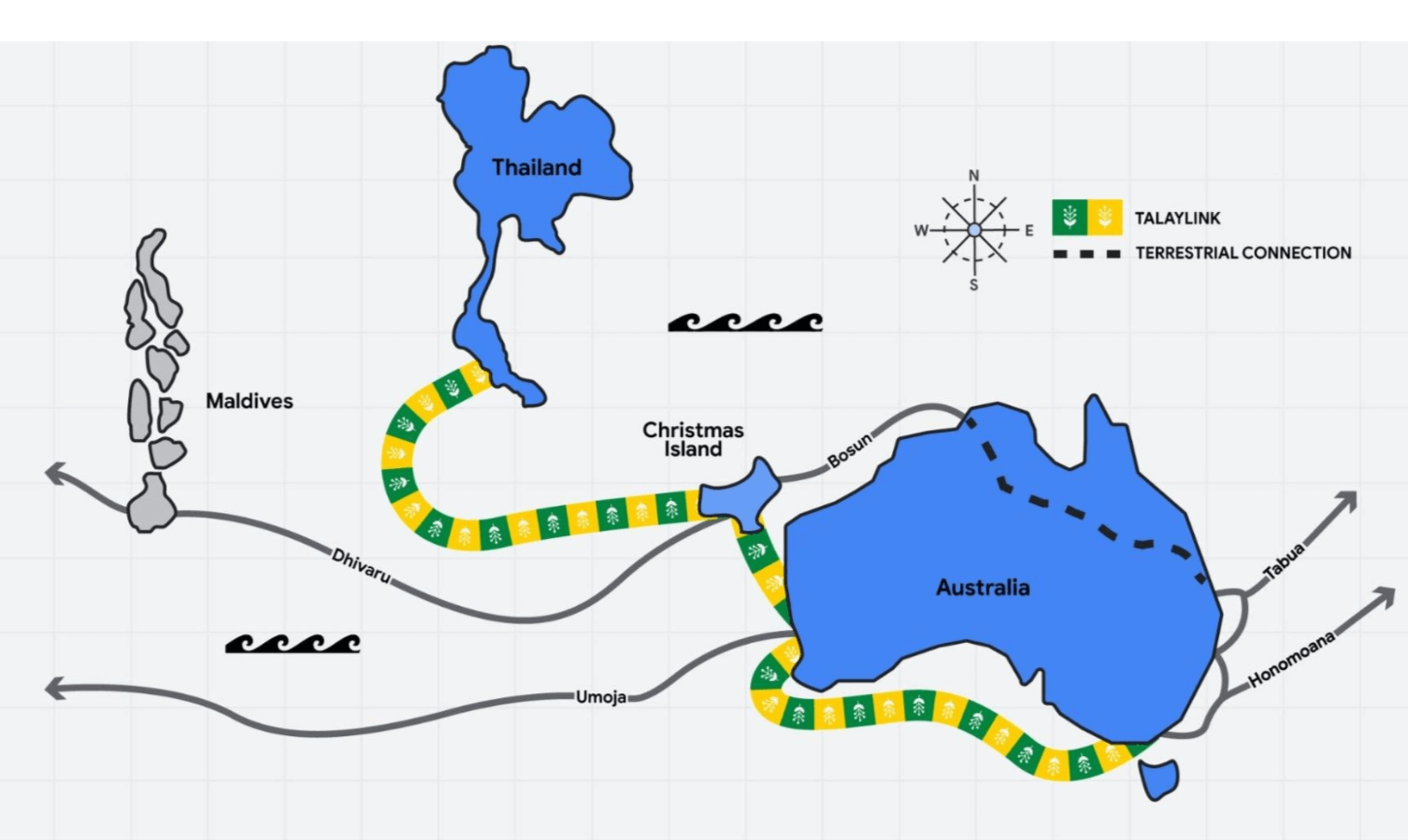
Google has launched TalayLink, a new submarine cable that establishes a direct, diverse corridor between Australia and Thailand to strengthen digital resilience and expand AI-ready infrastructure across the Asia-Pacific region. The system introduces a fresh route across the Indian Ocean, bypassing the congested Sunda Strait where many existing cables cluster. Google is also building new connectivity hubs in Mandurah, Western Australia, and South Thailand, adding to its previously announced hubs in the Maldives and Christmas Island.
TalayLink extends the interlink architecture outlined under Google’s Australia Connect initiative and will directly integrate with Google’s upcoming cloud region and data center in Thailand. The Mandurah hub will offer an alternative landing point to Perth, while the hub in Southern Thailand leverages local partnerships with AIS and ALT Telecom’s International Gateway Company (IGC). Together, these facilities are designed to support cable switching, content caching, and colocation to enable more reliable and lower-latency delivery of cloud and AI services.
Google said that TalayLink and its network of hubs will link into wider routes spanning Australia, Africa, Southeast Asia, and eventually onward to the Middle East. The company positions these builds as foundational for economic modernization, digital inclusion, and next-generation AI workloads in the region.
• New TalayLink cable connects Australia and Thailand via a diverse Indian Ocean path
• Google announces new connectivity hubs in Mandurah (Western Australia) and South Thailand
• Adds to hub investments in Maldives and Christmas Island
• Designed to boost redundancy, reduce latency, and support cloud/AI expansion in Southeast Asia
• Integrates with Google’s upcoming Thailand cloud region and future data center
• Built with partners AIS and ALT Telecom/IGC
“AIS is excited to be extending our relationship with Google as a strategic partner by supporting the connectivity hub in Southern Thailand,” said Pratthana Leelapanang, CEO of AIS. “The combination of Google’s new, diverse submarine cable path and AIS’s high-reliability colocation capabilities will ensure the digital infrastructure in the region is capable of supporting the country’s AI strategy.”
🌐 Analysis
| Cable Name | Route / Landing Points | Type | Partners | Status |
|---|---|---|---|---|
| TalayLink | Australia – Thailand (Indian Ocean, west of Sunda Strait) | Google-owned | AIS, ALT Telecom/IGC | Announced 2025 |
| Interlink / Australia Connect | Australia – Maldives – Christmas Island | Google-owned | Government partners | In development |
| Apricot | Japan – Guam – Philippines – Singapore – Indonesia | Consortium | NTT, Meta, Chunghwa, PLDT, Singtel | 2025–26 |
| Topaz | U.S. (Oregon) – Canada (British Columbia) | Google-owned | None | Live |
| Firmina | U.S. – Brazil – Argentina | Google-owned | None | In deployment |
| Equiano | Portugal – Nigeria – South Africa (+ branches) | Google-owned | Regional telcos | Live |
| Grace Hopper | U.S. – U.K. – Spain | Google-owned | None | Live |
| Dunant | U.S. – France | Google-owned | SubCom | Live |
| Curie | U.S. – Chile – Panama | Google-owned | None | Live |
| PLCN (Pacific Light) | U.S. – Philippines – Taiwan | Partnership | Meta, PLDT | Partially activated |
| Unity / JGA North & South | Japan – Guam – Australia | Consortium | Telstra, NTT, Singtel others | Live |