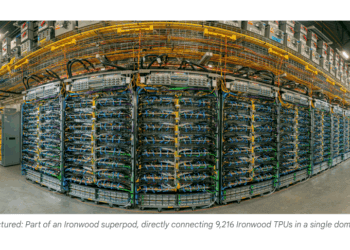
At the 2025 Open Compute Project (OCP) Global Summit, Google showcased several new technology contributions spanning cooling, security, and networking as part of its ongoing effort to modernize data centers for large-scale AI workloads. The company highlighted Project Deschutes, an open-source liquid cooling architecture developed for high-density AI servers, alongside new initiatives in reliability, firmware management, post-quantum security, and open network fabrics.
Project Deschutes introduces a standardized liquid cooling framework that supports both direct-to-chip and rack-level solutions. Google has released the full specification and design collateral to the OCP community, with ecosystem partners including Boyd, CoolerMaster, Delta, Envicool, Nidec, nVent, and Vertiv demonstrating Deschutes-compatible systems at the summit. The goal is to simplify deployment across diverse facilities—hyperscale, colocation, and enterprise—while improving serviceability, efficiency, and interoperability across cooling vendors.
Google also detailed advancements across several OCP technical workstreams:
• Resilience: Expansion of Google’s multi-year reliability initiative to include CPU firmware updates and system-level debuggability, building on earlier GPU serviceability efforts.
• Security: Introduction of Caliptra 2.0, an open-source hardware root of trust now fortified with post-quantum cryptography; and OCP S.A.F.E., a framework to make hardware security audits standardized and cost-effective.
• Storage: Launch of OCP L.O.C.K., a new open-source key management system leveraging Caliptra’s foundation to provide secure data protection for any storage device.
• Networking: Deployment of standardized Congestion Signaling (CSIG) technology for better load balancing, together with continued progress in SONiC and a new effort to standardize Optical Circuit Switching (OCS) for high-throughput AI clusters.
“Our work across cooling, security, and networking reflects Google’s commitment to open standards that enable reliable, sustainable, and interoperable AI data centers,” stated Amin Vahdat, VP/GM of AI & Infrastructure at Google Cloud, in a blog post on the company’s website.
🌐 Analysis: Google’s OCP contributions demonstrate a full-stack approach to open infrastructure—from mechanical and thermal systems to secure compute and optical fabrics. Project Deschutes complements ongoing industry initiatives around 800 VDC power and optical interconnects, while Caliptra 2.0 and OCP L.O.C.K. strengthen the foundation for secure, post-quantum-ready hardware design. These efforts position Google as a central collaborator in shaping AI-era data center standards alongside partners such as NVIDIA, Meta, and Microsoft.