• Home
  • Events Calendar
  • Blueprint Guidelines
  • Privacy Policy
  • Subscribe to Daily Newsletter
  • NextGenInfra.io
No Result
View All Result
Converge Digest
Friday, April 10, 2026
  • Home
  • Events Calendar
  • Blueprint Guidelines
  • Privacy Policy
  • Subscribe to Daily Newsletter
  • NextGenInfra.io
No Result
View All Result
Converge Digest
No Result
View All Result

Home » Google gains partial clearance for Pacific Light subsea cable

Google gains partial clearance for Pacific Light subsea cable

April 9, 2020
in Subsea
A A

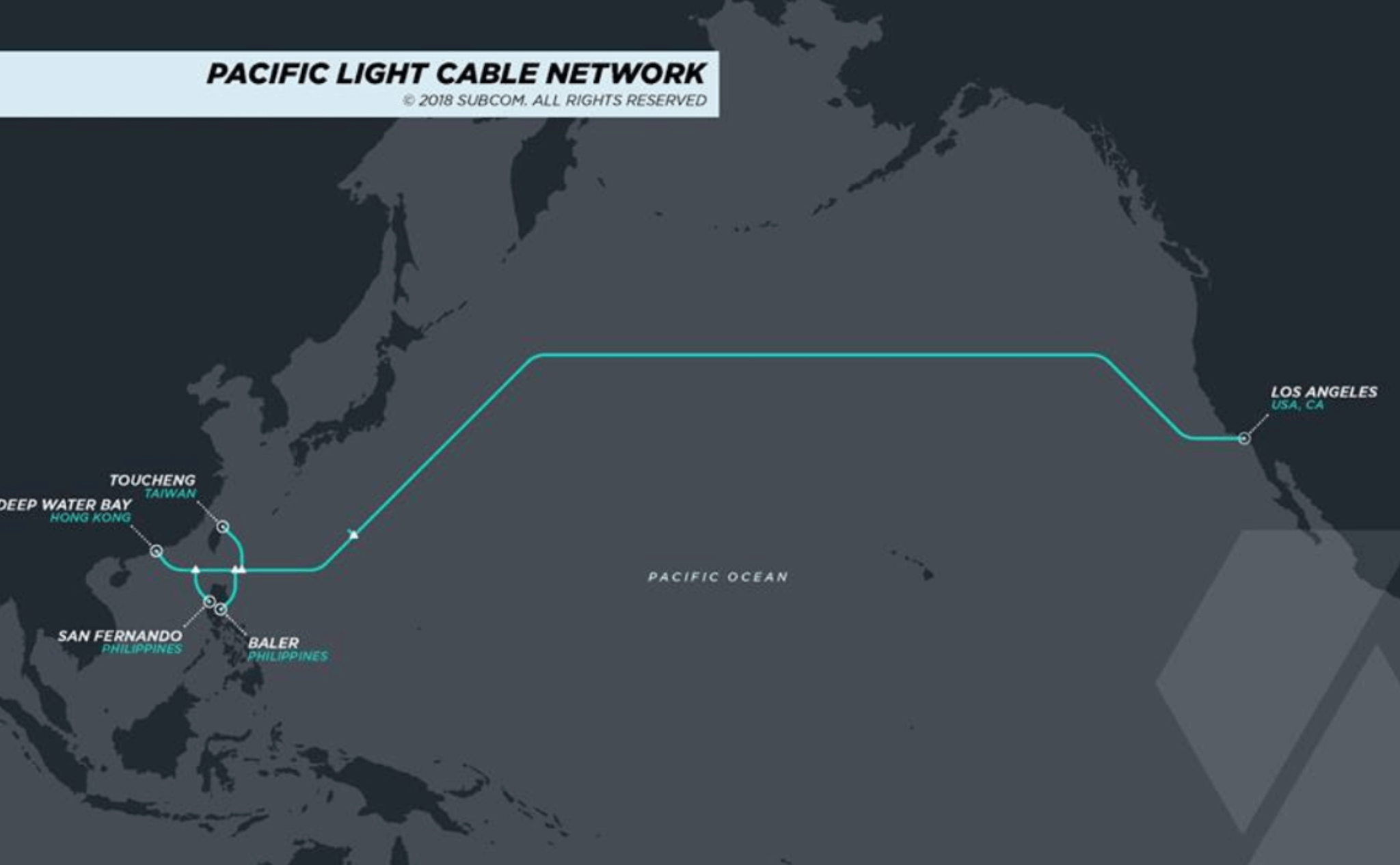
Google was granted clearance by the FCC to operate the segment of the Pacific Light Cable Network System connecting the United States to Taiwan for the next six months, pending a final disposition of the license application. The temporary authorization does not authorize any commercial traffic on the subsea cable segments to/from the Philippines or Hong Kong.

The U.S. Department of Justice, along with the Departments of Homeland Security and Defense, advised the FCC that those agencies do not oppose Google’s request carry traffic over the cable between the U.S. and Taiwan.

In its application for Special Temporary Authority, Google emphasized “an immediate need to meet internal demand for capacity between the U.S. and Taiwan” and that without the sought temporary authority Google would likely have to seek alternative capacity at “significantly higher prices.”

Under the terms of the Provisional National Security Agreement, Google has agreed to a range of operational requirements, notice obligations, access and security guarantees, as well as auditing and reporting duties, among others. The Provisional National Security Agreement also includes a commitment by Google to “pursue diversification of interconnection points in Asia,” as well as to establish network facilities that deliver traffic “as close as practicable” to its ultimate destination.  This term reflects the views of the Executive Branch that a direct cable connection between the United States and Hong Kong would pose an unacceptable risk to the national security and law enforcement interests of the United States.

https://licensing.fcc.gov/cgi-bin/ws.exe/prod/ib/forms/reports/related_filing.hts?f_key=2252704&f_number=SCLSTA2020040200015

Google and Facebook Team Up for Pacific Light Cable Network

Wednesday, October 12, 2016  Facebook, Google, Submarine Cable, Undersea  

Facebook and Google are teaming up to build the highest capacity, trans-Pacific cable system to date.

The Pacific Light Cable Network (PLCN), which will stretch 12,800 km between Los Angeles and Hong Kong, will have an estimated cable capacity of 120 Tbps.  The cable is expected to enter service in the summer of 2018. The project is organized by Pacific Light Data Communication Co. Ltd., a new company based in Hong Kong.

TE SubCom has been appointed lead contractor. The cable will use TE SubCom’s C+L technology, a major step forward in available cable transmission capacity that effectively doubles the available bandwidth and capacity per fiber pair over a traditional C-band-only designed system.

Google noted that it has now taken an ownership stake in six submarine cables: PLCN, Unity, SJC, FASTER, MONET and Tannat.

http://www.te.com/usa-en/about-te/news-center/subcom-facebook-google-pldc-co-build-plcn-101216.html

https://cloudplatform.googleblog.com/2016/10/new-undersea-cable-expands-capacity-for-Google-APAC-customers-and-users.html

Tags: GoogleSubmarine
ShareTweetShare
Previous Post

US Department of Justice recommends banning China Telecom

Next Post

Nokia debuts AirScale All-in-Cloud base station

Staff

Staff

Related Posts

Anthropic Expands Use of Google Cloud TPUs, Targeting One Million Units 
AI Infrastructure

Google Cloud to Build New Türkiye Region as Part of $2B, 10-Year Investment

November 24, 2025
Anthropic Expands Use of Google Cloud TPUs, Targeting One Million Units 
AI Infrastructure

Google Commits $40B for AI Infrastructure in Texas

November 14, 2025
Google Cloud Details Ironwood TPUs and Axion CPUs for AI Inference 
AI Infrastructure

Google Cloud Details Ironwood TPUs and Axion CPUs for AI Inference 

November 9, 2025
Microsoft Cloud and AI Momentum Drive Results, CAPEX Rockets Up
AI Infrastructure

Google Sees Surging AI Infrastructure Expenses

October 29, 2025
Google and NextEra to Restart Iowa’s Duane Arnold Nuclear Plant 
AI Infrastructure

Google and NextEra to Restart Iowa’s Duane Arnold Nuclear Plant 

October 29, 2025
PECC Summit: Google’s Ryohei Urata on Reliability for AI Data Centers
All

PECC Summit: Google’s Ryohei Urata on Reliability for AI Data Centers

October 23, 2025
Next Post
Nokia debuts AirScale All-in-Cloud base station

Nokia debuts AirScale All-in-Cloud base station

Please login to join discussion

Categories

  • 5G / 6G / Wi-Fi
  • AI Infrastructure
  • All
  • Automotive Networking
  • Blueprints
  • Clouds and Carriers
  • Data Centers
  • Enterprise
  • Explainer
  • Feature
  • Financials
  • Last Mile / Middle Mile
  • Legal / Regulatory
  • Optical
  • Quantum
  • Research
  • Security
  • Semiconductors
  • Space
  • Start-ups
  • Subsea
  • Sustainability
  • Video
  • Webinars

Archives

Tags

5G All AT&T Australia AWS Blueprint columns BroadbandWireless Broadcom China Ciena Cisco Data Centers Dell'Oro Ericsson FCC Financial Financials Huawei Infinera Intel Japan Juniper Last Mile Last Mille LTE Mergers and Acquisitions Mobile NFV Nokia Optical Packet Systems PacketVoice People Regulatory Satellite SDN Service Providers Silicon Silicon Valley StandardsWatch Storage TTP UK Verizon Wi-Fi
Converge Digest

A private dossier for networking and telecoms

Follow Us

  • Home
  • Events Calendar
  • Blueprint Guidelines
  • Privacy Policy
  • Subscribe to Daily Newsletter
  • NextGenInfra.io

© 2025 Converge Digest - A private dossier for networking and telecoms.

No Result
View All Result
  • Home
  • Events Calendar
  • Blueprint Guidelines
  • Privacy Policy
  • Subscribe to Daily Newsletter
  • NextGenInfra.io

© 2025 Converge Digest - A private dossier for networking and telecoms.

This website uses cookies. By continuing to use this website you are giving consent to cookies being used. Visit our Privacy and Cookie Policy.
Go to mobile version