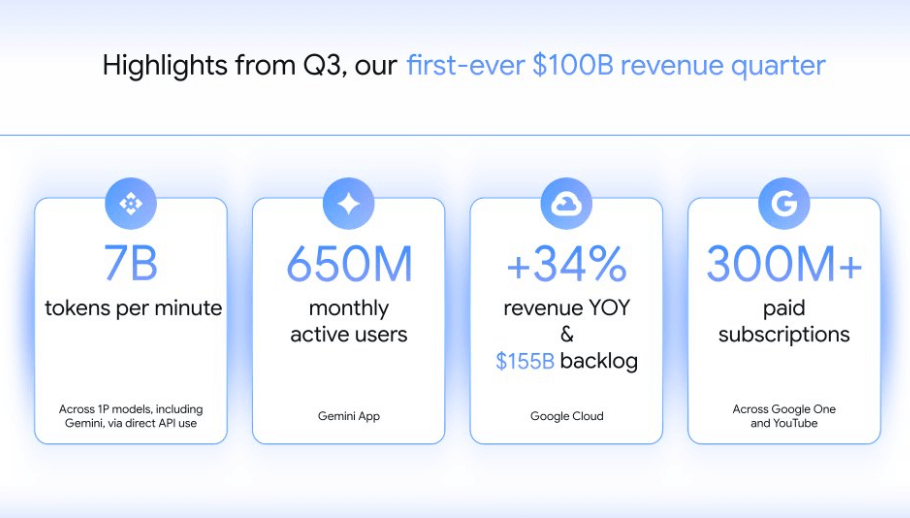
Alphabet reported a strong third quarter for 2025, surpassing $100 billion in quarterly revenue for the first time as it continued to scale its AI infrastructure and cloud operations. Total revenue rose 16% year over year to $102.3 billion, with Google Cloud up 34% to $15.2 billion—driven by demand for AI infrastructure and generative AI services. Operating income increased 22% on a non-GAAP basis to $34.7 billion, excluding a $3.5 billion European Commission fine. Net income jumped 33% to $35 billion, and diluted EPS reached $2.87.
Alphabet’s capital expenditures are now projected between $91 billion and $93 billion for 2025—up sharply from prior guidance—reflecting accelerated investments in data centers, AI compute clusters, and networking infrastructure. Property and equipment rose to $223.8 billion, up from $171 billion at year-end 2024, underscoring Google’s global buildout of AI-ready facilities. The company also benefitted from new U.S. tax incentives for immediate expensing of research and accelerated depreciation for capital investments.
Google Cloud ended the quarter with a record $155 billion backlog, confirming sustained enterprise adoption of its infrastructure and AI solutions. CEO Sundar Pichai highlighted Gemini’s expanding footprint, noting it now processes 7 billion tokens per minute and serves 650 million monthly active users. Alphabet also reported over 300 million paid subscriptions, led by YouTube Premium and Google One, reinforcing the diversification of its revenue base beyond advertising.
• Q3 revenues: $102.3 billion (+16% YoY)
• Google Cloud: $15.2 billion (+34% YoY)
• Net income: $35 billion (+33% YoY)
• CapEx forecast: $91–93 billion for FY2025
• Property and equipment: $223.8 billion (up $52.8 billion since Dec 2024)
• Free cash flow (TTM): $73.6 billion
• Google Cloud backlog: $155 billion
“Alphabet had a terrific quarter, with double-digit growth across every major part of our business,” said Sundar Pichai, CEO. “We are investing to meet customer demand and capitalize on the growing opportunities across the company.”
Infrastructure and AI Investment Trends from Alphabet’s Q3 2025 Earnings Call
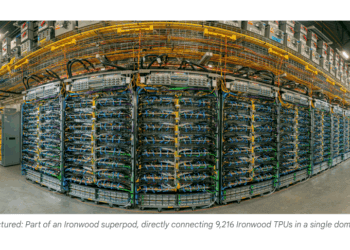
Alphabet executives underscored an unprecedented infrastructure buildout driven by surging AI and cloud demand. CEO Sundar Pichai framed the company’s “full stack” AI approach—spanning chips, models, and products—as its core differentiator, supported by the rapid scaling of both NVIDIA GPUs and Google’s custom Tensor Processing Units (TPUs). The company’s seventh-generation TPU, “Ironwood,” will soon reach general availability, with Anthropic set to access up to one million TPUs. Pichai also confirmed that Google Cloud is now deploying NVIDIA GB300-based A4X Max instances, reflecting a dual-vendor strategy across custom and partner silicon.
CFO Anat Ashkenazi detailed that approximately 60% of Google’s Q3 capital expenditures were devoted to servers and 40% to data centers and networking. Quarterly CapEx reached $24 billion, with full-year guidance raised to $91–93 billion—driven by new AI supercomputing clusters, hyperscale network fabrics, and power-intensive facilities. Property and equipment expanded by over $50 billion since the start of the year. Ashkenazi noted that depreciation grew 41% year-over-year and will accelerate further in Q4, emphasizing that the company remains in a “tight demand-supply environment” for compute and data center capacity through 2026.
Google Cloud remained the centerpiece of infrastructure growth, with revenue up 34% and backlog up 82% year-over-year to $155 billion. Over 70% of existing Cloud customers now use AI products, and nine of the top ten AI labs globally rely on Google Cloud infrastructure. Pichai highlighted that the company signed more billion-dollar cloud deals in the first nine months of 2025 than in the previous two years combined. Cloud operating margins climbed to 23.7%, reflecting improved scale and efficiency.
• CapEx mix: 60% servers / 40% data centers and networking
• Q3 CapEx: $24B; FY2025 forecast: $91–93B
• Depreciation up 41% YoY; expected to rise further in Q4
• Cloud backlog: $155B (+82% YoY)
• 9 of top 10 AI labs use Google Cloud
• Anthropic to access up to 1M TPUs
• A4X Max (NVIDIA GB300) instances now shipping
• Ironwood (7th-gen TPU) entering general availability
Pichai summarized Google’s advantage as the “only hyperscaler providing both custom and partner AI chips at scale,” positioning the company to meet the accelerating enterprise demand for compute and generative AI workloads.
🌐 Analysis: Alphabet’s capital spending trajectory—up more than 40% year over year—signals an aggressive expansion of AI data center capacity, likely centered on its next-generation AI supercomputers, networking fabrics, and custom silicon (TPU v6, Axion CPUs). The company’s $91–93 billion CapEx range now rivals hyperscaler peers like Microsoft and Amazon, reflecting intensifying global competition to build GPU and TPU-rich compute clusters.
Alphabet’s infrastructure expansion ranks among the most aggressive in hyperscale history. The CapEx trajectory—projected to exceed $90 billion this year—places it in direct competition with Microsoft and Amazon in the AI factory race. Google’s balanced strategy between in-house TPUs and NVIDIA GPUs, coupled with early quantum computing breakthroughs, points to an increasingly vertically integrated AI stack from hardware through applications.