• Home
  • Events Calendar
  • Blueprint Guidelines
  • Privacy Policy
  • Subscribe to Daily Newsletter
  • NextGenInfra.io
No Result
View All Result
Converge Digest
Saturday, April 11, 2026
  • Home
  • Events Calendar
  • Blueprint Guidelines
  • Privacy Policy
  • Subscribe to Daily Newsletter
  • NextGenInfra.io
No Result
View All Result
Converge Digest
No Result
View All Result

Home » Google Taps Kairos Power to Develop Advanced Nuclear Reactors

Google Taps Kairos Power to Develop Advanced Nuclear Reactors

October 14, 2024
in Clouds and Carriers
A A

Kairos Power and Google have entered into a Master Plant Development Agreement to build a series of advanced nuclear power plants that will deliver up to 500 MW of clean energy by 2035. The project aims to support Google’s data centers with 24/7 carbon-free electricity, helping the tech giant meet its ambitious net zero goals. The first deployment is planned for 2030, with Kairos Power overseeing the design, construction, and operation of the reactors under Power Purchase Agreements (PPAs).

Each reactor will be part of Kairos Power’s iterative development strategy, allowing the company to optimize its technology and accelerate commercialization. The agreement includes multiple deployment sites across the U.S., designed to generate clean electricity and provide ancillary services. Google’s long-term commitment provides Kairos Power with the opportunity to establish confidence in its ability to deliver on a large scale.

• 500 MW of advanced nuclear power to be deployed by 2035

• First plant operational by 2030, supporting Google’s net zero goals

• Kairos Power to sell energy under long-term Power Purchase Agreements

• Agreement includes milestone-based accountability and multi-plant deployments

• Google has committed to more than 14 GW of clean energy since 2010

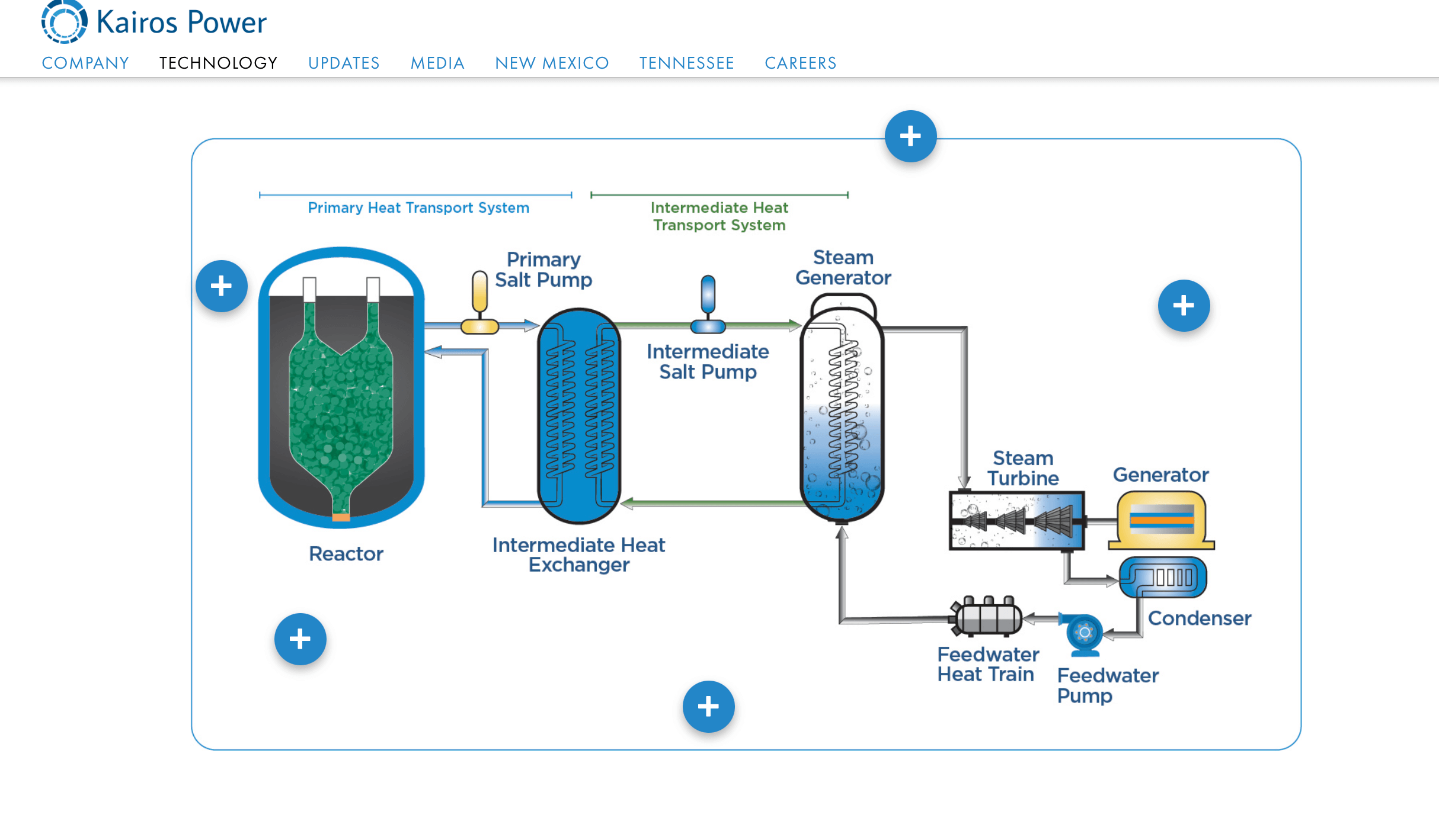
Kairos Power, founded in 2016 and headquartered in Alameda, California, is focused on revolutionizing nuclear energy through its fluoride salt-cooled high-temperature reactor (KP-FHR). This innovative reactor design utilizes molten salt as a coolant and TRISO fuel, which enhances safety and efficiency by allowing the reactor to operate at lower pressures and higher temperatures compared to traditional water-cooled reactors. In December 2023, Kairos Power secured a construction permit for its demonstration reactor, Hermes, in Tennessee, marking the first approval for a non-water-cooled reactor in the U.S. in over 50 years. The company has received significant backing, including up to $303 million from the U.S. Department of Energy under the Advanced Reactor Demonstration Program to support the Hermes project. Kairos Power aims to deliver clean, affordable energy that is competitive with natural gas, contributing to the transition toward sustainable energy solutions.

Since 2010, Google has signed more than 115 agreements, securing over 14 GW of clean energy capacity. The deal with Kairos Power marks Google’s first major foray into nuclear energy, complementing its existing renewable portfolio and driving progress toward decarbonization.

“Our partnership with Google will help Kairos Power quickly advance down the learning curve as we work toward cost and schedule certainty for our commercial product,” said Mike Laufer, CEO of Kairos Power.


Tags: GoogleNuclear
ShareTweetShare
Previous Post

Nokia, Windstream, Colt Complete 800GbE Transatlantic Trial 

Next Post

Nuclear vs Hydrogen for Gigawatt-Scale AI Data Centers

Jim Carroll

Jim Carroll

Editor and Publisher, Converge! Network Digest, Optical Networks Daily - Covering the full stack of network convergence from Silicon Valley

Related Posts

Anthropic Expands Use of Google Cloud TPUs, Targeting One Million Units 
AI Infrastructure

Google Cloud to Build New Türkiye Region as Part of $2B, 10-Year Investment

November 24, 2025
IREN Reports Record Quarter, Expands NVIDIA-Powered AI Cloud Platform
Data Centers

Terra Innovatum and Uvation Advance Nuclear-Powered AI Data Center Pilot

November 20, 2025
Anthropic Expands Use of Google Cloud TPUs, Targeting One Million Units 
AI Infrastructure

Google Commits $40B for AI Infrastructure in Texas

November 14, 2025
Google Cloud Details Ironwood TPUs and Axion CPUs for AI Inference 
AI Infrastructure

Google Cloud Details Ironwood TPUs and Axion CPUs for AI Inference 

November 9, 2025
Microsoft Cloud and AI Momentum Drive Results, CAPEX Rockets Up
AI Infrastructure

Google Sees Surging AI Infrastructure Expenses

October 29, 2025
Google and NextEra to Restart Iowa’s Duane Arnold Nuclear Plant 
AI Infrastructure

Google and NextEra to Restart Iowa’s Duane Arnold Nuclear Plant 

October 29, 2025
Next Post
Nuclear vs Hydrogen for Gigawatt-Scale AI Data Centers

Nuclear vs Hydrogen for Gigawatt-Scale AI Data Centers

Categories

  • 5G / 6G / Wi-Fi
  • AI Infrastructure
  • All
  • Automotive Networking
  • Blueprints
  • Clouds and Carriers
  • Data Centers
  • Enterprise
  • Explainer
  • Feature
  • Financials
  • Last Mile / Middle Mile
  • Legal / Regulatory
  • Optical
  • Quantum
  • Research
  • Security
  • Semiconductors
  • Space
  • Start-ups
  • Subsea
  • Sustainability
  • Video
  • Webinars

Archives

Tags

5G All AT&T Australia AWS Blueprint columns BroadbandWireless Broadcom China Ciena Cisco Data Centers Dell'Oro Ericsson FCC Financial Financials Huawei Infinera Intel Japan Juniper Last Mile Last Mille LTE Mergers and Acquisitions Mobile NFV Nokia Optical Packet Systems PacketVoice People Regulatory Satellite SDN Service Providers Silicon Silicon Valley StandardsWatch Storage TTP UK Verizon Wi-Fi
Converge Digest

A private dossier for networking and telecoms

Follow Us

  • Home
  • Events Calendar
  • Blueprint Guidelines
  • Privacy Policy
  • Subscribe to Daily Newsletter
  • NextGenInfra.io

© 2025 Converge Digest - A private dossier for networking and telecoms.

No Result
View All Result
  • Home
  • Events Calendar
  • Blueprint Guidelines
  • Privacy Policy
  • Subscribe to Daily Newsletter
  • NextGenInfra.io

© 2025 Converge Digest - A private dossier for networking and telecoms.

This website uses cookies. By continuing to use this website you are giving consent to cookies being used. Visit our Privacy and Cookie Policy.
Go to mobile version