• Home
  • Events Calendar
  • Blueprint Guidelines
  • Privacy Policy
  • Subscribe to Daily Newsletter
  • NextGenInfra.io
No Result
View All Result
Converge Digest
Wednesday, April 15, 2026
  • Home
  • Events Calendar
  • Blueprint Guidelines
  • Privacy Policy
  • Subscribe to Daily Newsletter
  • NextGenInfra.io
No Result
View All Result
Converge Digest
No Result
View All Result

Home » HOTI25:  Lightmatter’s Roadmap to 100x AI Bandwidth

HOTI25:  Lightmatter’s Roadmap to 100x AI Bandwidth

August 20, 2025
in AI Infrastructure, All
A A

AI supercomputers are hitting a wall—not in compute, but in moving data fast enough. At today’s Hot Interconnects online event, Lightmatter CEO Nick Harris argued that scaling AI clusters into “million-XPU brains” requires a radical new interconnect architecture. Copper and pluggables are running out of headroom, leaving photonics as the only path forward.

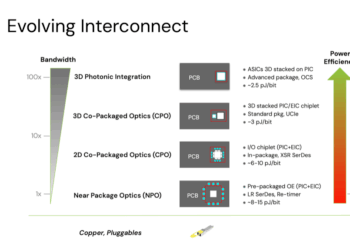
Harris outlined the limits of today’s approaches: copper ties together only about 100 chips, Gen 1 pluggables consume 17–20 pJ/bit, and near-package optics (Gen 2) lower that to 8–15 pJ/bit. Gen 3 2D CPO pushes further to 6–10 pJ/bit but still contends with shoreline limits around the chip perimeter. Lightmatter’s Gen 4 architecture replaces the shoreline with a 3D photonic interposer—stacking ASICs, switches, and GPUs directly on photonics. Demonstrations have already reached as low as 3 pJ/bit, below the long-standing 5 pJ/bit industry target.

Lightmatter presented new results showing the first 16-wavelength bi-directional optical link delivering 800 Gbps per fiber with error rates below 10^-10 without forward error correction. The system remained stable over a kilometer of fiber, six connectors, and polarization scrambling. At the core are microring modulators only 15µm in diameter, delivering extreme density and power efficiency compared to Mach-Zehnder and electro-absorption designs. Lightmatter claims these rings can operate stably from 0°C to 105°C while supporting both O- and C-band transmission.

  • Copper-based scale-up hits ~100 chips; photonics needed for million-XPU clusters
  • Gen 4 3D photonic interposer achieves <5 pJ/bit; roadmap to 3 pJ/bit
  • Demonstrated: 800 Gbps per fiber, 16λ bi-directional, BER <10^-10, 1 km reach
  • Microring modulators: 10–1000x smaller than rivals, ultra-low drive power
  • Standards support up to 224 Gbps per lane; 800 Gbps and 1.6 Tbps per fiber shipping today

“We’re already showing stable operation at less than 5 pJ/bit across kilometers of fiber, which is a dream target for the industry,” said Nick Harris, CEO of Lightmatter.

https://hoti.org

🌐 Analysis: Lightmatter’s 3D stacking approach bypasses the shoreline bottleneck that constrains 2D CPO. By embedding optics beneath compute, the company addresses both bandwidth and radix scaling simultaneously—critical for trillion-parameter AI workloads. Competitors such as Ayar Labs and OpenLight are pursuing different paths in optical I/O, but Lightmatter’s microring-based density and 3D photonic interposer integration give it a distinctive position. With hyperscalers rushing to deploy AI factories at gigawatt scale, adoption of ultra-efficient photonic fabrics could determine which architectures dominate in the late 2020s.

Tags: HOTILightmatter
ShareTweetShare
Previous Post

HOTI25: Cornelis Presents its 576-Port Director Switch and Sub-µs Latency

Next Post

Hot Interconnects: Google Unveils Falcon, Swift, and Firefly for AI Data Centers

Jim Carroll

Jim Carroll

Editor and Publisher, Converge! Network Digest, Optical Networks Daily - Covering the full stack of network convergence from Silicon Valley

Related Posts

Lightmatter’s 3D Photonic Integration for AI Interconnects
Optical

Lightmatter’s 3D Photonic Integration for AI Interconnects

October 27, 2025
AI Infrastructure Summit: Lightmatter’s Photonic Roadmap 
AI Infrastructure

AI Infrastructure Summit: Lightmatter’s Photonic Roadmap 

September 10, 2025
Video: Network Slicing over Fiber
Optical

Video: Lightmatter’s 3D Photonic Interposer

August 26, 2025
Hot Interconnects: UALink for Rack-Scale AI Interconnects
All

Hot Interconnects: UALink for Rack-Scale AI Interconnects

August 25, 2025
Hot Interconnects: Avicena’s MicroLED Links Promise Sub-1 pJ/bit Energy Efficiency
AI Infrastructure

Hot Interconnects: Avicena’s MicroLED Links Promise Sub-1 pJ/bit Energy Efficiency

August 25, 2025
Hot Interconnects: Celestial AI’s Photonic Fabric
AI Infrastructure

Hot Interconnects: Celestial AI’s Photonic Fabric

August 25, 2025
Next Post
Hot Interconnects: Google Unveils Falcon, Swift, and Firefly for AI Data Centers

Hot Interconnects: Google Unveils Falcon, Swift, and Firefly for AI Data Centers

Categories

  • 5G / 6G / Wi-Fi
  • AI Infrastructure
  • All
  • Automotive Networking
  • Blueprints
  • Clouds and Carriers
  • Data Centers
  • Enterprise
  • Explainer
  • Feature
  • Financials
  • Last Mile / Middle Mile
  • Legal / Regulatory
  • Optical
  • Quantum
  • Research
  • Security
  • Semiconductors
  • Space
  • Start-ups
  • Subsea
  • Sustainability
  • Video
  • Webinars

Archives

Tags

5G All AT&T Australia AWS Blueprint columns BroadbandWireless Broadcom China Ciena Cisco Data Centers Dell'Oro Ericsson FCC Financial Financials Huawei Infinera Intel Japan Juniper Last Mile Last Mille LTE Mergers and Acquisitions Mobile NFV Nokia Optical Packet Systems PacketVoice People Regulatory Satellite SDN Service Providers Silicon Silicon Valley StandardsWatch Storage TTP UK Verizon Wi-Fi
Converge Digest

A private dossier for networking and telecoms

Follow Us

  • Home
  • Events Calendar
  • Blueprint Guidelines
  • Privacy Policy
  • Subscribe to Daily Newsletter
  • NextGenInfra.io

© 2025 Converge Digest - A private dossier for networking and telecoms.

No Result
View All Result
  • Home
  • Events Calendar
  • Blueprint Guidelines
  • Privacy Policy
  • Subscribe to Daily Newsletter
  • NextGenInfra.io

© 2025 Converge Digest - A private dossier for networking and telecoms.

This website uses cookies. By continuing to use this website you are giving consent to cookies being used. Visit our Privacy and Cookie Policy.
Go to mobile version