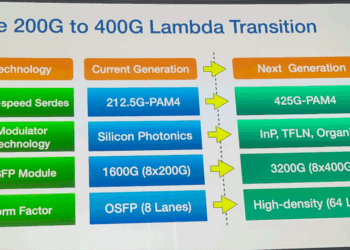
Arista Networks co-founder Andreas Bechtolsheim used his keynote at IEEE Hot Interconnects 2025 to highlight how Linear Pluggable Optics (LPO) and new rack designs can dramatically cut power consumption in AI-scale networks. LPO modules reduce per-pluggable power from ~30W with DSP-based optics to ~10W, enabling up to 50% system-level savings. Early tests show good receiver performance even under degraded conditions, though transmit paths remain sensitive to reflections and crosstalk at the connector level.
Bechtolsheim outlined additional optical approaches under development, including “slow-and-wide” 50G/lane solutions, tunable VCSELs, RF/microwave links for short reach, and advanced silicon photonics. Normalized efficiency comparisons show that linear optics halve optical engine power relative to DSP-based modules. Still, manufacturability remains the gating factor. “The path to energy-efficient optics is constrained by high-volume manufacturing,” Bechtolsheim noted, stressing that advanced optics packaging remains difficult and risky without proven production scale.
Looking beyond optics, Bechtolsheim focused on the need for liquid-cooled switches in next-generation AI data centers. Standard ORv3 racks lack fiber channel space for 1,000–2,000 fiber cables, leading Arista to propose an ORv3W wide-rack design with 800–900mm width and 120kW capacity. The design accommodates up to 16 × 2U switch blades with tool-less installation, tightly located liquid quick disconnects, and generous space for cable management. Removing fans in liquid-cooled switches saves 5–10% of power, reduces vibration, and improves optics reliability.
- LPO modules can reduce pluggable optics power to ~10W, versus 25–30W for DSP-based optics.
- Early 200G/lane LPO results show strong receiver direction performance; transmit paths require connector and packaging improvements.
- Alternative approaches include slow-and-wide 50G lanes, VCSELs, and RF/microwave links for sub-20m reach.
- High-volume manufacturing is critical to making advanced optics commercially viable.
- Arista’s ORv3W wide-rack design supports 120kW, 32OU payload, and 2,000 fiber cables, with tool-less switch installation and standardized liquid cooling.
“In conclusion, AI data centers need liquid-cooled switches,” Bechtolsheim said. “This reduces power consumption and failure rates, while enabling scale-out networking.”
| Technology | Typical Power (per module) | Reach Capability | Advantages | Challenges / Limitations |
|---|---|---|---|---|
| DSP-based Pluggables | ~25–30W | 500 m–10 km | Mature ecosystem; robust performance and reach | Higher power; scaling limits as densities rise |
| Linear Pluggable Optics (LPO) | ~10W | ~500 m–2 km (projected) | Large power reduction; simplified datapath | TX sensitivity to reflections/crosstalk; packaging still maturing |
| Slow‑and‑Wide (50G/lane) | ~6–8W (projected) | <1 km | Lowest power per bit in concept | Requires substrate‑level integration with GPU/switch ASIC; high manufacturing risk |
| VCSEL‑based Solutions | ~5–7W | Up to ~500 m | Very efficient and cost‑effective for short reach | Limited reach; not suitable for longer interconnects |
| RF / Microwave Links | <10W | ~1–20 m | Excellent efficiency and simplicity at very short reach | Distance‑limited; specialized packaging/cabling |
Notes: Power numbers are indicative and normalized as described in the talk (e.g., 50V bus bar; efficiency on actual port data rate). Reach/power are subject to implementation.
Source: Arista Networks presentation by Andreas Bechtolsheim at Hot Interconnects 2025; table compiled by Converge Digest based on the talk and slides.
🌐 Analysis: Arista’s emphasis on LPO echoes broader industry momentum toward power-efficient optics as AI networking scales to terabit-class links. A key point is that high-volume manufacturability remains the central challenge for integrated optics. On the infrastructure side, Arista’s ORv3W rack proposal aligns with parallel initiatives in OCP to standardize liquid-cooled systems for high-density GPUs and switches—an urgent requirement as AI clusters push racks beyond 100kW.