• Home
  • Events Calendar
  • Blueprint Guidelines
  • Privacy Policy
  • Subscribe to Daily Newsletter
  • NextGenInfra.io
No Result
View All Result
Converge Digest
Saturday, April 11, 2026
  • Home
  • Events Calendar
  • Blueprint Guidelines
  • Privacy Policy
  • Subscribe to Daily Newsletter
  • NextGenInfra.io
No Result
View All Result
Converge Digest
No Result
View All Result

Home » Hot Interconnects: Avicena’s MicroLED Links Promise Sub-1 pJ/bit Energy Efficiency

Hot Interconnects: Avicena’s MicroLED Links Promise Sub-1 pJ/bit Energy Efficiency

August 25, 2025
in AI Infrastructure, All
A A

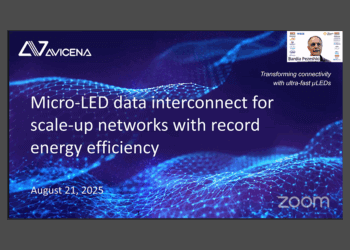
Avicena sees a huge opportunity to reshape AI cluster design with its microLED-based interconnects, a technology it says could slash energy use while breaking through the short-reach limits of copper. Speaking at this week’s IEEE Hot Interconnects online conference, Chris Pfistner, head of sales and marketing, described how the company’s “LightBundle” approach targets the dense, power-hungry connections inside scale-up networks—an area projected to become a major choke point as GPU clusters expand.

Pfistner warned that without more efficient interconnects, AI infrastructure could consume up to 20% of global energy by 2030. Today’s leading systems, such as Nvidia’s DGX, still rely on thousands of short copper cables, capped at about one meter. Avicena’s solution promises sub-1 pJ/bit energy efficiency, shoreline density above 1 Tbps/mm, and reach extended to 20 meters—all while maintaining reliability at operating temperatures up to 125°C. By leveraging GaN microLEDs from the display industry, the company also aims to drive costs well below those of laser-based silicon photonics.

The roadmap begins with a demo kit in 2025, followed by a 1.6 Tbps active optical cable in 2026 and high-density pluggables scaling up to 12.8 Tbps by 2027–28. Co-packaged optics and optical memory interconnects are planned by 2030, with test results already showing up to 20x better energy efficiency than silicon photonics.

• Energy efficiency: <1 pJ/bit (NRZ)

• Shoreline density: >1 Tbps/mm (2D arrays)

• Reach: 10–20m, up to 30m with lower efficiency

• Reliability: 10 FIT

• Operating temperature: –55°C to 125°C; tested up to 400°C

• Roadmap: Demo kit (2025), 1.6T AOC (2026), 12.8T HD pluggables (2027–28), CPO and optical memory interconnects (2030)

“Avicena’s microLED-based interconnects provide the energy efficiency and reach that AI scale-up networks urgently need,” Pfistner said.

🌐 Analysis: Avicena is adapting microLEDs, proven in the display sector, into a new class of data center interconnects. Positioned between copper and conventional optics, the approach offers low energy, low cost, and scalable reach, making it especially relevant as GPUs trend toward 2000 W+ power envelopes. Early deployments will likely come as active optical cables and high-density pluggables, but the long-term play is in co-packaged optics and optical memory links. Based in Sunnyvale, California and founded in 2019, Avicena has secured backing from Samsung Catalyst, Micron Ventures, and others. If its technology scales, it could provide a disruptive alternative to silicon photonics in hyperscale AI data centers.

🌐 We’re tracking the latest developments in networking silicon. Follow our ongoing coverage at: https://convergedigest.com/category/semiconductors/

Tags: AvicenaHOTI
ShareTweetShare
Previous Post

Hot Interconnects: Celestial AI’s Photonic Fabric

Next Post

Hot Interconnects: UALink for Rack-Scale AI Interconnects

Jim Carroll

Jim Carroll

Editor and Publisher, Converge! Network Digest, Optical Networks Daily - Covering the full stack of network convergence from Silicon Valley

Related Posts

ECOC25: Avicena Demonstrates 200 fJ/bit MicroLED Optical Link 
Optical

Avicena Pushes microLED Interconnects to 4Gbps at 80fJ/bit

November 17, 2025
ECOC25: Avicena Demonstrates 200 fJ/bit MicroLED Optical Link 
Optical

ECOC25: Avicena Demonstrates 200 fJ/bit MicroLED Optical Link 

September 29, 2025
Avicena Appoints Former Samsung EVP Marco Chisari as CEO
Semiconductors

Avicena Appoints Former Samsung EVP Marco Chisari as CEO

September 3, 2025
Hot Interconnects: UALink for Rack-Scale AI Interconnects
All

Hot Interconnects: UALink for Rack-Scale AI Interconnects

August 25, 2025
Hot Interconnects: Celestial AI’s Photonic Fabric
AI Infrastructure

Hot Interconnects: Celestial AI’s Photonic Fabric

August 25, 2025
Hot Interconnects: Avicena’s High-Yield MicroLED Arrays for Scale-Up AI Clusters
AI Infrastructure

Hot Interconnects: Avicena’s High-Yield MicroLED Arrays for Scale-Up AI Clusters

August 22, 2025
Next Post
Hot Interconnects: UALink for Rack-Scale AI Interconnects

Hot Interconnects: UALink for Rack-Scale AI Interconnects

Categories

  • 5G / 6G / Wi-Fi
  • AI Infrastructure
  • All
  • Automotive Networking
  • Blueprints
  • Clouds and Carriers
  • Data Centers
  • Enterprise
  • Explainer
  • Feature
  • Financials
  • Last Mile / Middle Mile
  • Legal / Regulatory
  • Optical
  • Quantum
  • Research
  • Security
  • Semiconductors
  • Space
  • Start-ups
  • Subsea
  • Sustainability
  • Video
  • Webinars

Archives

Tags

5G All AT&T Australia AWS Blueprint columns BroadbandWireless Broadcom China Ciena Cisco Data Centers Dell'Oro Ericsson FCC Financial Financials Huawei Infinera Intel Japan Juniper Last Mile Last Mille LTE Mergers and Acquisitions Mobile NFV Nokia Optical Packet Systems PacketVoice People Regulatory Satellite SDN Service Providers Silicon Silicon Valley StandardsWatch Storage TTP UK Verizon Wi-Fi
Converge Digest

A private dossier for networking and telecoms

Follow Us

  • Home
  • Events Calendar
  • Blueprint Guidelines
  • Privacy Policy
  • Subscribe to Daily Newsletter
  • NextGenInfra.io

© 2025 Converge Digest - A private dossier for networking and telecoms.

No Result
View All Result
  • Home
  • Events Calendar
  • Blueprint Guidelines
  • Privacy Policy
  • Subscribe to Daily Newsletter
  • NextGenInfra.io

© 2025 Converge Digest - A private dossier for networking and telecoms.

This website uses cookies. By continuing to use this website you are giving consent to cookies being used. Visit our Privacy and Cookie Policy.
Go to mobile version