• Home
  • Events Calendar
  • Blueprint Guidelines
  • Privacy Policy
  • Subscribe to Daily Newsletter
  • NextGenInfra.io
No Result
View All Result
Converge Digest
Friday, April 10, 2026
  • Home
  • Events Calendar
  • Blueprint Guidelines
  • Privacy Policy
  • Subscribe to Daily Newsletter
  • NextGenInfra.io
No Result
View All Result
Converge Digest
No Result
View All Result

Home » HOTI25: Cisco on Managing AI Networking Complexity

HOTI25: Cisco on Managing AI Networking Complexity

August 20, 2025
in AI Infrastructure, Clouds and Carriers
A A

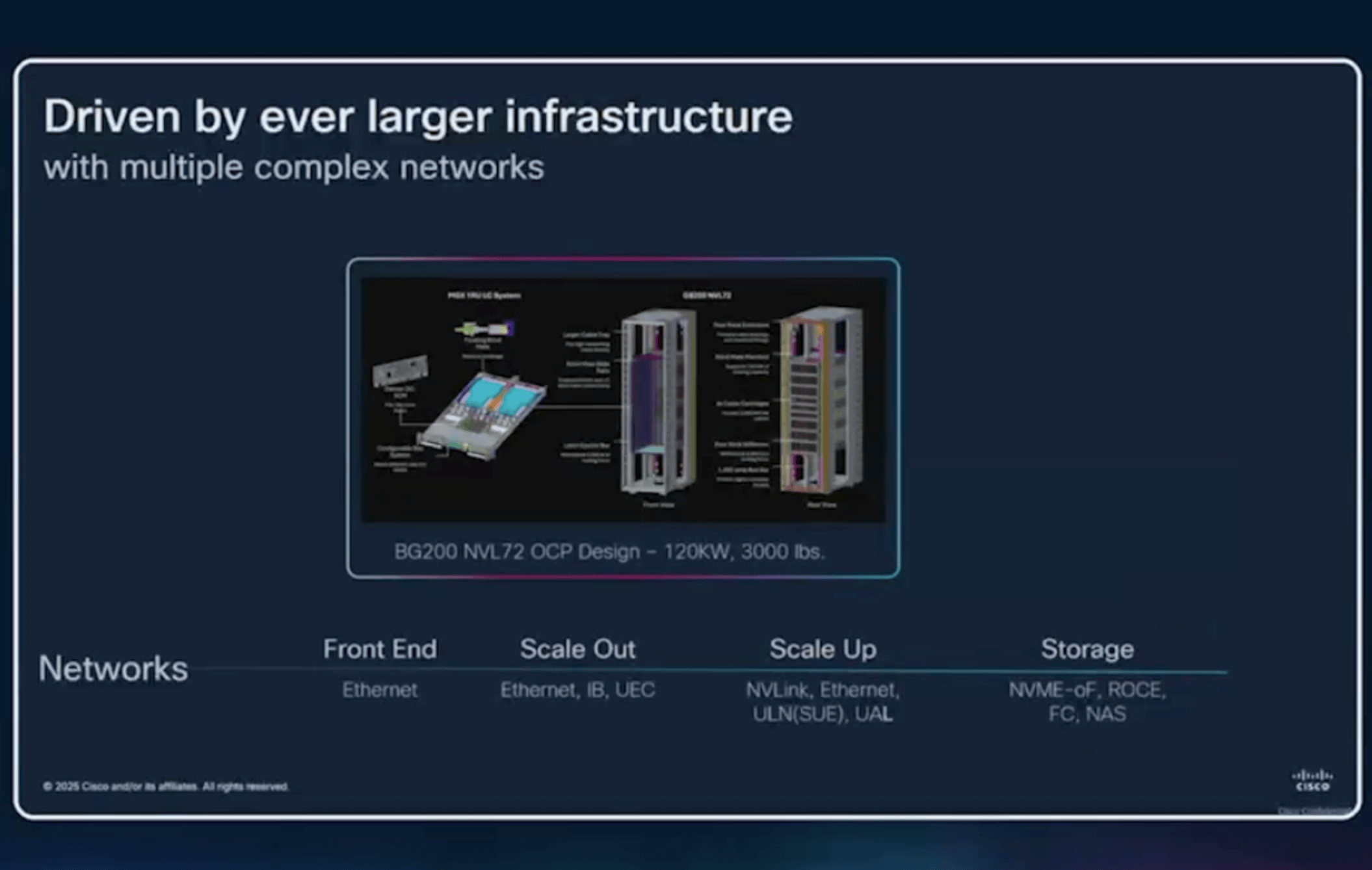
At HOTI25, Will Eatherton, VP at Cisco, highlighted the mounting complexity of networking in large-scale AI clusters and Cisco’s vision for simplifying operations. Much of the discussion in the industry, he noted, has focused on the extraordinary size and power requirements of today’s AI systems, with racks like NVIDIA’s NVL72 design drawing up to 120 kW and weighing over 3,000 pounds. But Eatherton argued that the more pressing challenge lies in coordinating the many overlapping network fabrics that must come together to make these clusters function reliably.

Eatherton described the proliferation of network domains that serve different roles in AI infrastructure. Front-end networks, traditionally Ethernet-based, are now carrying growing amounts of east-west traffic as AI agents and scale-out applications expand. Scale-out fabrics link GPUs across nodes using Ethernet, InfiniBand, and UEC. Scale-up networks, employing NVLink, Ethernet, ULN (SUE), and UAL, provide ultra-high-bandwidth connections within a rack. Storage networking, once a separate domain, is converging with compute fabrics as NVMe-oF, RoCE, Fibre Channel, and NAS are pressed into higher-performance AI-driven roles.

  • Front End: Ethernet
  • Scale Out: Ethernet, InfiniBand, UEC
  • Scale Up: NVLink, Ethernet, ULN (SUE), UAL
  • Storage: NVMe-oF, RoCE, Fibre Channel, NAS

The convergence of these domains increases operational risk. Eatherton warned that a single interface failure or miswired connection can ripple across an entire cluster, leading to costly downtime. Compounding this, AI clusters operate on much shorter lifecycles than traditional data center infrastructure. Whereas enterprise networks have typically refreshed every seven to ten years, the expectation now is that clusters will turn over in three years or less, raising the stakes for multi-generational compatibility across fabrics, power, and cooling.

Cisco’s strategy for addressing these challenges is to unify network operations through a common operating system and controller framework. The company is extending NX-OS and IOS-XR across domains, while also investing heavily in SONiC for hyperscale, new cloud, and select enterprise customers. A unified controller is envisioned to span front-end, scale-out, and scale-up networks, while enhanced functions in the Nexus Dashboard will deliver cluster-level troubleshooting and analytics. Cisco is also developing Nexus HyperFabric AI, a full-lifecycle management system for AI clusters, encompassing design, deployment, cabling, and ongoing operations.

Eatherton closed by stressing that networking is what transforms a GPU or server into a usable cluster, and that manageability must be engineered into these systems from the start.

🌐 Analysis

Cisco’s presentation underscores a broader theme at HOTI25: the move from focusing solely on raw performance to addressing operational complexity. AI clusters are no longer just about compute density or power draw—they are multi-layered ecosystems of interconnected fabrics. Cisco is betting that customers will value integrated management that reduces risk and accelerates deployment. With its deep enterprise footprint and investment in SONiC for hyperscalers, Cisco is positioning itself as the vendor that can bridge both worlds: traditional enterprise networks and the emerging fabric complexity of AI.

Tags: CiscoHOTI
ShareTweetShare
Previous Post

HOTI25: Nubis Sees Linear Optics and CPX Critical for AI Cluster Scaling

Next Post

HOTI25: Cornelis Presents its 576-Port Director Switch and Sub-µs Latency

Jim Carroll

Jim Carroll

Editor and Publisher, Converge! Network Digest, Optical Networks Daily - Covering the full stack of network convergence from Silicon Valley

Related Posts

IBM and Cisco Aim for Networked, Fault-Tolerant Quantum by Early 2030s
Quantum

IBM and Cisco Aim for Networked, Fault-Tolerant Quantum by Early 2030s

November 20, 2025
AMD, Cisco and HUMAIN Form Joint Venture to Build 1 GW of AI Infrastructure by 2030
AI Infrastructure

AMD, Cisco and HUMAIN Form Joint Venture to Build 1 GW of AI Infrastructure by 2030

November 19, 2025
Cisco posts 7% YoY growth, increases dividend and stock buyback
All

Cisco Sees Surge in AI Networking as Refresh Cycles Accelerate

November 12, 2025
Telia Carrier launches SD-WAN leveraging its cloud-scale backbone
Enterprise

Cisco Launches Unified Edge Platform for Distributed Agentic AI

November 3, 2025
Cisco, G42, and AMD to Build AI Infrastructure in the UAE
AI Infrastructure

Cisco, G42, and AMD to Build AI Infrastructure in the UAE

October 29, 2025
NVIDIA, Cisco, T-Mobile Launch AI-RAN Stack to Accelerate 6G
5G / 6G / Wi-Fi

NVIDIA, Cisco, T-Mobile Launch AI-RAN Stack to Accelerate 6G

October 28, 2025
Next Post
HOTI25: Cornelis Presents its 576-Port Director Switch and Sub-µs Latency

HOTI25: Cornelis Presents its 576-Port Director Switch and Sub-µs Latency

Categories

  • 5G / 6G / Wi-Fi
  • AI Infrastructure
  • All
  • Automotive Networking
  • Blueprints
  • Clouds and Carriers
  • Data Centers
  • Enterprise
  • Explainer
  • Feature
  • Financials
  • Last Mile / Middle Mile
  • Legal / Regulatory
  • Optical
  • Quantum
  • Research
  • Security
  • Semiconductors
  • Space
  • Start-ups
  • Subsea
  • Sustainability
  • Video
  • Webinars

Archives

Tags

5G All AT&T Australia AWS Blueprint columns BroadbandWireless Broadcom China Ciena Cisco Data Centers Dell'Oro Ericsson FCC Financial Financials Huawei Infinera Intel Japan Juniper Last Mile Last Mille LTE Mergers and Acquisitions Mobile NFV Nokia Optical Packet Systems PacketVoice People Regulatory Satellite SDN Service Providers Silicon Silicon Valley StandardsWatch Storage TTP UK Verizon Wi-Fi
Converge Digest

A private dossier for networking and telecoms

Follow Us

  • Home
  • Events Calendar
  • Blueprint Guidelines
  • Privacy Policy
  • Subscribe to Daily Newsletter
  • NextGenInfra.io

© 2025 Converge Digest - A private dossier for networking and telecoms.

No Result
View All Result
  • Home
  • Events Calendar
  • Blueprint Guidelines
  • Privacy Policy
  • Subscribe to Daily Newsletter
  • NextGenInfra.io

© 2025 Converge Digest - A private dossier for networking and telecoms.

This website uses cookies. By continuing to use this website you are giving consent to cookies being used. Visit our Privacy and Cookie Policy.
Go to mobile version