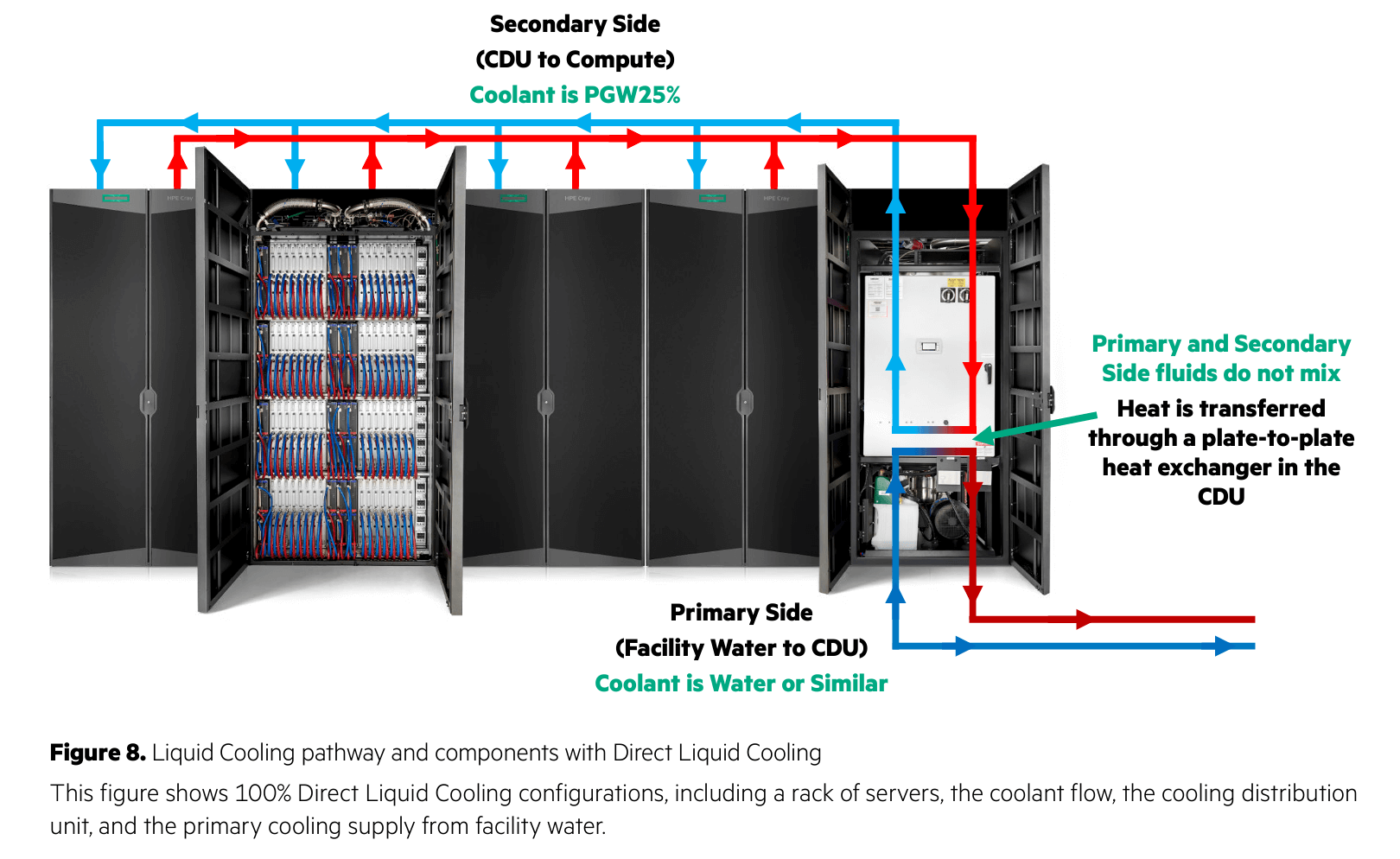
Hewlett Packard Enterprise (HPE) introduced the first 100% fanless direct liquid cooling system for large-scale AI deployments at its AI Day event in Houston. This new cooling architecture addresses the growing power demands of AI systems, which are outpacing the efficiency of traditional cooling methods. By eliminating fans and relying entirely on liquid cooling, HPE aims to significantly reduce power consumption and operational costs for AI workloads. The system, which has already contributed to seven of the top ten most energy-efficient supercomputers on the Green500 list, targets organizations looking to scale their AI operations while maintaining sustainability goals.
HPE’s fanless liquid cooling system cuts cooling power requirements by 37% per server blade compared to hybrid liquid-air solutions. The architecture uses an 8-element cooling design to cover all key hardware components, including GPUs, CPUs, server blades, and network fabrics. Additionally, the system enables greater server density, which reduces data center floor space usage by 50%. These efficiency gains also lower utility costs and carbon emissions, while eliminating the noise associated with fan-cooled systems.
The new cooling technology provides flexibility for users, supporting a range of accelerators and integrating a lower-cost network fabric for large-scale AI environments. HPE leaders, including CEO Antonio Neri, emphasized that the system meets the growing demand for AI infrastructure while supporting sustainability. “This direct liquid cooling architecture yields a 90% reduction in cooling power consumption compared to traditional air-cooled systems,” Neri said.
Key Points:
• HPE launches the first 100% fanless direct liquid cooling system for AI workloads.
• Reduces cooling power by 37% per server blade compared to hybrid cooling.
• Uses 8-element design to cool GPU, CPU, server blades, and network fabric.
• Enables higher server density, saving 50% of floor space.
• Supports multiple accelerators and integrates low-power network fabric.
“This direct liquid cooling architecture yields a 90% reduction in cooling power consumption compared to traditional air-cooled systems.” — Antonio Neri, President and CEO, HPE