• Home
  • Events Calendar
  • Blueprint Guidelines
  • Privacy Policy
  • Subscribe to Daily Newsletter
  • NextGenInfra.io
No Result
View All Result
Converge Digest
Friday, April 10, 2026
  • Home
  • Events Calendar
  • Blueprint Guidelines
  • Privacy Policy
  • Subscribe to Daily Newsletter
  • NextGenInfra.io
No Result
View All Result
Converge Digest
No Result
View All Result

Home » HyperLight advances its thin-film lithium niobate PICs

HyperLight advances its thin-film lithium niobate PICs

September 9, 2021
in All, Start-ups
A A

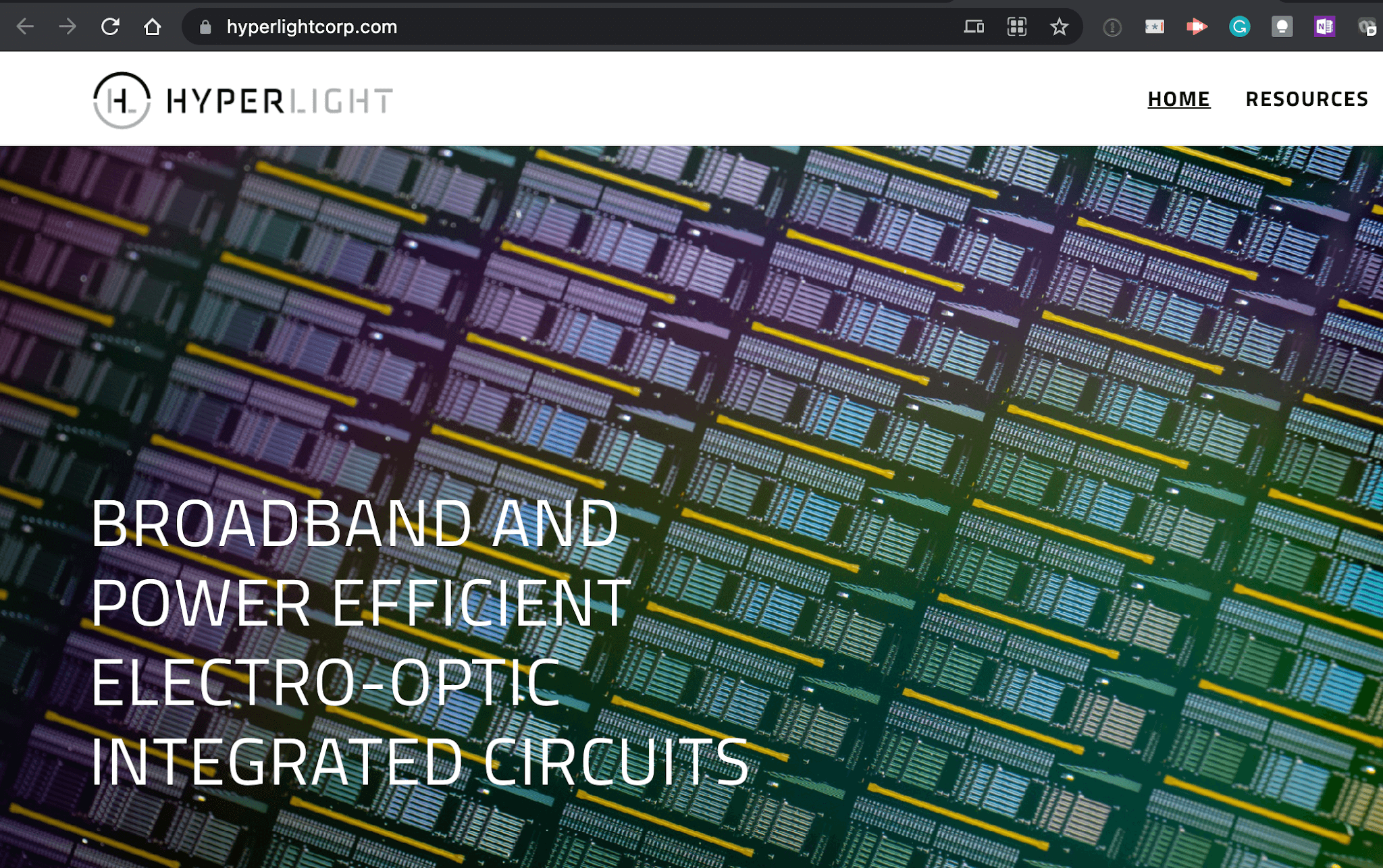
HyperLight, a start-up based in Cambridge, Mass., cited progress in its development of thin-film lithium niobate photonic integrated circuits for next-generation 800 Gbps and beyond 1.6 Tbps optical networking systems.

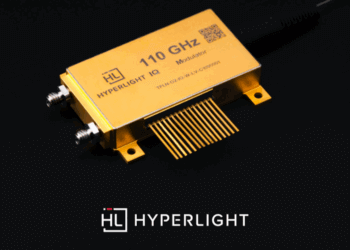
HyperLight claims its thin-film lithium niobate integrated photonics solution combines the proven superior material property of lithium niobate with an established and scalable integration process. The company has developed a thin-film lithium niobate modulator that reaches sub-volt driving voltages while maintaining >100 GHz bandwidth. Earlier generation of the devices achieved 700.5 Gbps line rate and 538.8 Gbps net rate over 10.2 km of single-mode fiber of intensity-modulated and direct detected (IM-DD) signals in a demonstration conducted with Nokia Bell Labs. 

Dr. Mian Zhang, CEO and co-founder of HyperLight, will present the company at the upcoming 2021 European Conference on Optical Communications (ECOC) next week in France.

https://hyperlightcorp.com/

HyperLight claims breakthrough with its lithium niobate optical modulator

Sunday, March 14, 2021  HyperLight, Optical, Start-Up  

HyperLight, a start-up based in Cambridge, MA developing thin-film lithium niobate (LN) photonic integrated circuits (PICs), announced breakthrough voltage-bandwidth performances in integrated electro-optic modulators. 

HyperLight says its electro-optic PIC could lead to orders of magnitude energy consumption reduction for next generation optical networking.

Current electro-optic modulators require extremely high radio-frequency (RF) driving voltages (> 5 V) as the analog bandwidth in ethernet ports approaches 100 GHz for future terabits per sec capacity transceivers. In comparison, a typical CMOS RF modulator driver delivers less than 0.5 V at such frequencies. Compound semiconductor modulator drivers can deliver voltage > 1 V at significantly increased cost and energy consumption but still fall short to meet the optimum driving voltage. The limited voltage-bandwidth performance in electro-optic modulators poses a serious challenge for meeting tight power consumption requirements from network builders.

HyperLight’s integrated electro-optic modulator is capable of 3-dB bandwidth > 100 GHz, a previously impossible voltage-bandwidth achievement. The results are described in a manuscript entitled “Breaking voltage-bandwidth limits in integrated lithium niobate modulators using micro-structured electrodes,” published in Optica on March 8th, 2021.

“We believe the significantly improved electro-optic modulation performance in our integrated LN platform will lead to a paradigm shift for both analog and digital ultra-high speed RF links,” said Mian Zhang, author, CEO of HyperLight. “For example, using sub-volt modulators for digital applications, high speed electronic drivers may have largely reduced gain-bandwidth requirements or possibly be completely bypassed with modulators directly driven from electronic processors. This would save building and running costs for network operators. For RF links, the low-voltage, high bandwidth and excellent optical power handling ability could enable sensitive and low noise millimeter wave (mmWave) photonic links in ultrahigh-frequency bands.”

http://www.hyperlightcorp.com

Tags: Blueprint columnsHyperLightNew England
ShareTweetShare
Previous Post

Databricks closes whopping $1.6 billion for data lakehouse

Next Post

T-Systems teams with Google Cloud on sovereign cloud for Germany

Staff

Staff

Related Posts

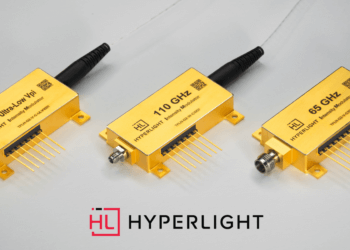
HyperLight Debuts 110 GHz IQ Modulators to Enable 240 GBaud
Optical

HyperLight Debuts 110 GHz IQ Modulators to Enable 240 GBaud

September 30, 2025
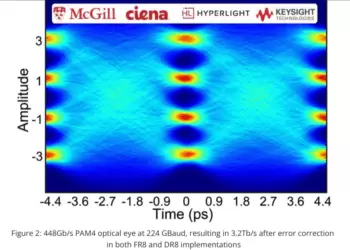
Ciena, HyperLight, McGill Demo 3.2Tbps IMDD using 448G/Lane
Optical

Ciena, HyperLight, McGill Demo 3.2Tbps IMDD using 448G/Lane

April 1, 2025
HyperLight expands electro-optical modulator line
Optical

HyperLight Raises $37M for Thin Film Lithium Niobate

September 24, 2024
HyperLight expands electro-optical modulator line
Optical

HyperLight expands electro-optical modulator line

March 20, 2024
Blueprint: Brazil looks to municipal Wi-Fi 6E
Blueprints

Blueprint: Brazil looks to municipal Wi-Fi 6E

February 21, 2023
Blueprint: Building wholesale networks with OTN
All

Blueprint: Building wholesale networks with OTN

December 20, 2022
Next Post
T-Systems teams with Google Cloud on sovereign cloud for Germany

T-Systems teams with Google Cloud on sovereign cloud for Germany

Please login to join discussion

Categories

  • 5G / 6G / Wi-Fi
  • AI Infrastructure
  • All
  • Automotive Networking
  • Blueprints
  • Clouds and Carriers
  • Data Centers
  • Enterprise
  • Explainer
  • Feature
  • Financials
  • Last Mile / Middle Mile
  • Legal / Regulatory
  • Optical
  • Quantum
  • Research
  • Security
  • Semiconductors
  • Space
  • Start-ups
  • Subsea
  • Sustainability
  • Video
  • Webinars

Archives

Tags

5G All AT&T Australia AWS Blueprint columns BroadbandWireless Broadcom China Ciena Cisco Data Centers Dell'Oro Ericsson FCC Financial Financials Huawei Infinera Intel Japan Juniper Last Mile Last Mille LTE Mergers and Acquisitions Mobile NFV Nokia Optical Packet Systems PacketVoice People Regulatory Satellite SDN Service Providers Silicon Silicon Valley StandardsWatch Storage TTP UK Verizon Wi-Fi
Converge Digest

A private dossier for networking and telecoms

Follow Us

  • Home
  • Events Calendar
  • Blueprint Guidelines
  • Privacy Policy
  • Subscribe to Daily Newsletter
  • NextGenInfra.io

© 2025 Converge Digest - A private dossier for networking and telecoms.

No Result
View All Result
  • Home
  • Events Calendar
  • Blueprint Guidelines
  • Privacy Policy
  • Subscribe to Daily Newsletter
  • NextGenInfra.io

© 2025 Converge Digest - A private dossier for networking and telecoms.

This website uses cookies. By continuing to use this website you are giving consent to cookies being used. Visit our Privacy and Cookie Policy.
Go to mobile version