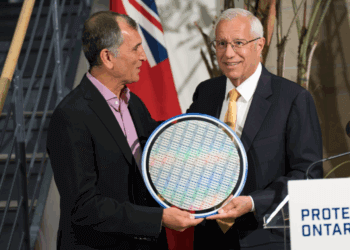
Hyperlume, a start-up based in Ottawa, has secured a US$12.5 million seed funding round to advance its high-bandwidth, low-latency, and energy-efficient interconnect solutions for AI data centers and high-performance computing systems. The round was led by BDC’s Deep Tech Venture Fund and ArcTern Ventures, with participation from MUUS Climate Partners, SOSV, Intel Capital, and a strategic investment from LG Technology Ventures.
Founded in 2022 by Mohsen Asad and Hossein Fariborzi, Hyperlume is pioneering optical interconnect technology using ultra-fast microLEDs and ultra-low power circuitry to address connectivity bottlenecks in accelerated computing and AI infrastructure. The company’s technology provides pluggable, mid-board, and co-packaged optical solutions to replace traditional copper interconnects, significantly improving performance, reducing power consumption, and lowering costs.
The funding will be used to:
- Accelerate the development of optical interconnect technologies.
- Expand Hyperlume’s product, engineering, and R&D teams.
- Strengthen partnerships with hyperscalers, chip manufacturers, and AI infrastructure providers.
- Prepare for the production of 800G and 1.6T optical interconnects to meet industry demand.
“This funding represents a significant step in Hyperlume’s journey as we continue to push the boundaries of optical communication and deliver transformative solutions for the AI and semiconductor industries,” said Mohsen Asad, Co-founder and CEO of Hyperlume.
- Founded in 2022 by Mohsen Asad and Hossein Fariborzi, Hyperlume’s core technology centers on the development of ultra-fast microLED-based optical interconnects designed to overcome the limitations of traditional copper and laser-based connections. By integrating novel microLEDs with ultra-low power consumption and high bandwidth capabilities, Hyperlume aims to provide scalable solutions that offer 1.6 terabits per second (Tbps) bandwidth—scalable to 3.2 Tbps—with latency as low as 4 nanoseconds and energy efficiency below 1 picojoule per bit, according to the company’s website.