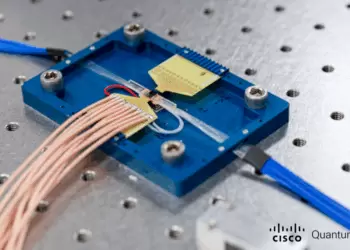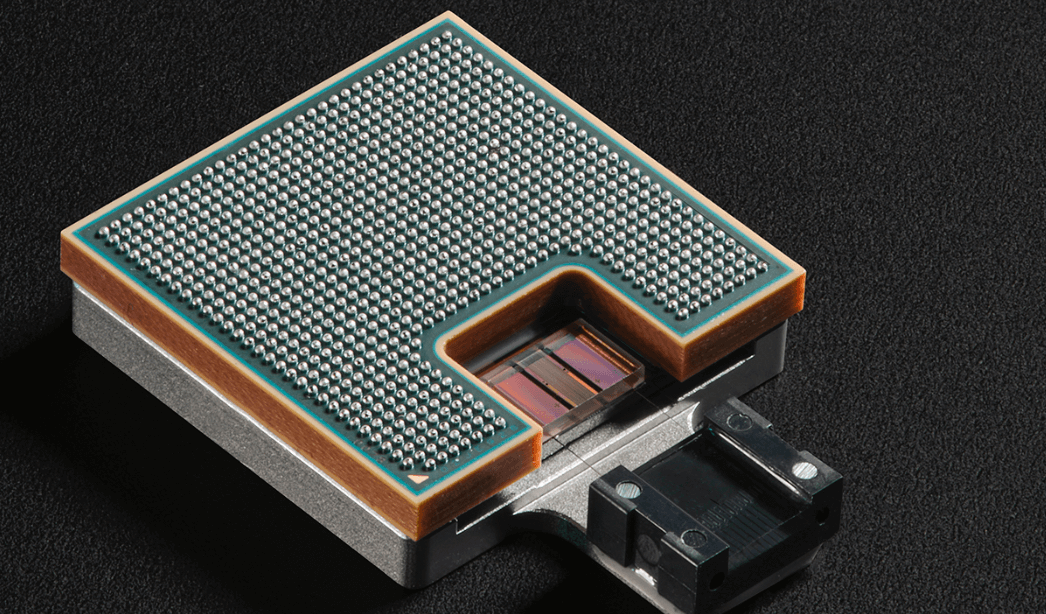
IBM has introduced a new co-packaged optics (CPO) technology that integrates polymer optical waveguides (PWG) to replace electrical interconnects inside data centers. Designed to support the growing demands of generative AI, this innovation enables chip-to-chip and board-to-board communication using optical signals, offering significant improvements in bandwidth density, energy efficiency, and scalability. The prototype achieves an 80-fold increase in bandwidth compared to traditional electrical pathways while drastically reducing energy consumption.
The system leverages 50-micrometer-pitch PWGs, which are adiabatically coupled to silicon photonics waveguides using standard assembly processes. These optical connections transmit terabits of data per second across distances ranging from a few centimeters to hundreds of meters, eliminating the bottlenecks of copper wiring. IBM’s CPO module supports six times the beachfront density (optical fibers at a chip’s edge) compared to existing solutions. The company has also demonstrated scalability to 18-micrometer-pitch PWGs, enabling up to 128 optical channels on a single module.
Key Points:
• Bandwidth Increase: Offers up to 80x the bandwidth of electrical interconnects, transmitting data at 10 Tbps/mm.
• Energy Efficiency: Reduces power consumption by over five times, saving energy equivalent to powering 5,000 U.S. homes annually during AI training.
• Faster AI Model Training: Reduces training time for Large Language Models from three months to three weeks.
• Extended Reach: Enables interconnect lengths of hundreds of meters, surpassing electrical wire limitations.
• Durability: Components pass JEDEC reliability tests, including operation in -40°C to 125°C environments and high-humidity conditions.
Researchers developed and tested the modules at IBM’s facilities in Albany, New York, and Bromont, Quebec, part of the Northeast Semiconductor Corridor. These efforts highlight IBM’s focus on advancing semiconductor manufacturing and packaging technologies to address emerging computing challenges.
“As generative AI demands more energy and processing power, the data center must evolve—and co-packaged optics can make these data centers future-proof,” said Dario Gil, SVP and Director of Research at IBM. “This innovation enables chips to communicate optically, paving the way for faster, more efficient AI systems.”