
by James E. Carroll
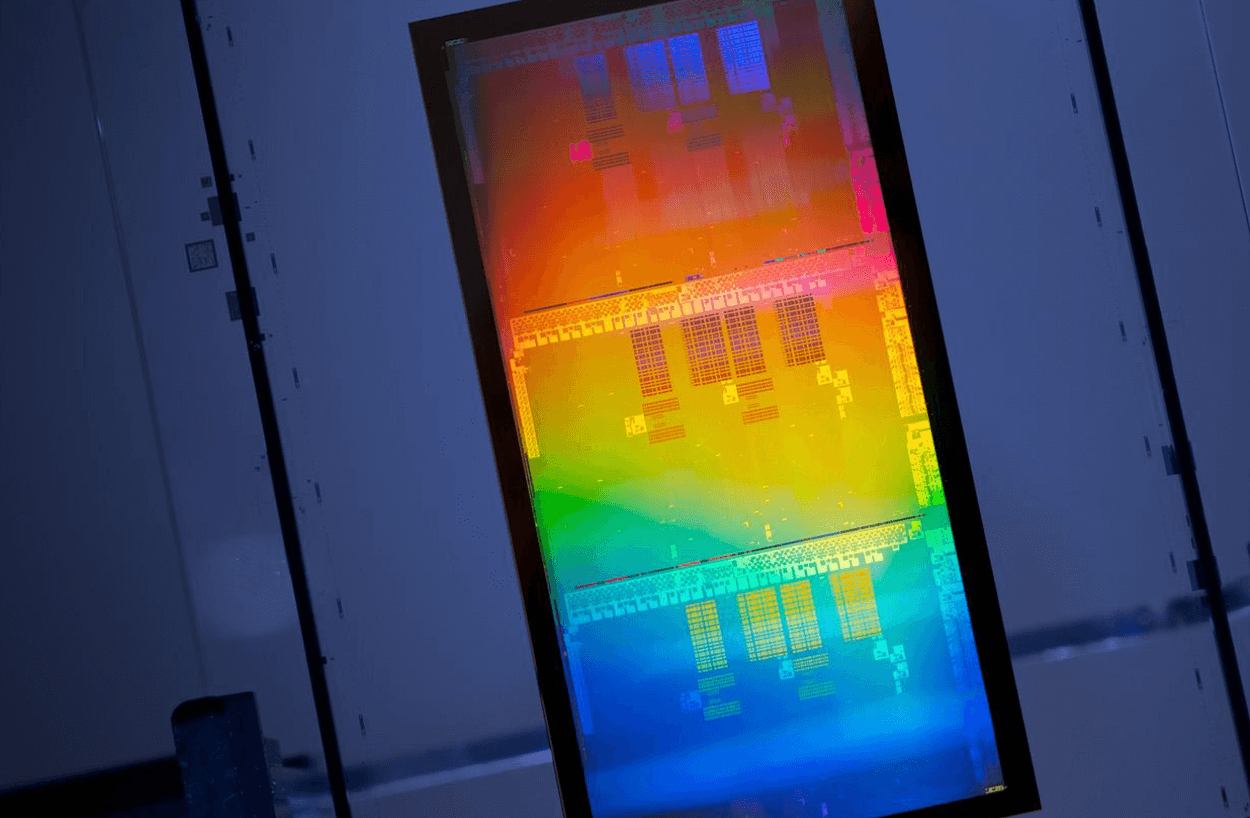
Intel introduced its Xeon Processor E5-2600 v2 product family (Ivy Bridge-EP) for powering servers, storage and networking infrastructure in data centers. The announcement at this week’s Intel Developer Forum (IDF13) in San Francisco highlights a major push by the company to “re-architect the data center” by combining energy-efficient, multicore silicon, the open architecture of software-defined networking (SDN), and network functions virtualisation (NFV).
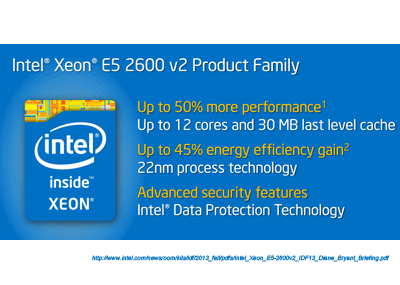
The new Xeon processors leverage Intel’s 22-nanometer process technology to deliver energy efficiency improvements of up to 451 percent when compared to the previous generation. The processor family also features up to 12 cores and delivers up to 50 percent more performance across variety of compute intensive workloads.
 Significantly, Intel is positioning the Xeon E5-2600 v2 product family for processing network workloads commonly handled by proprietary offload engines and accelerators found in networking appliances. The idea is to use Intel’s Open Network Platform (ONP) server reference design, high-volume Xeon-based servers, and open standards to consolidate virtualized networking applications.
Intel believes the next generation of data centers will need to evolve to a “software defined infrastructure” where many of the functions are managed in software. The Xeon E5-2600 v2 processors are designed to deliver the throughput performance and latency for Software Defined Networking (SDN) and Network Function Virtualization (NFV) workloads.
Intel’s ONP server reference design is based on the Wind River Open Virtualization Profile and the Intel Data Plane Development Kit Accelerated Open vSwitch.

Intel also announced a Network Builders ecosystem to help partners accelerate SDN and NFV deployments. With more than 20 leading technology companies contributing, Intel’s partners will be able to access a comprehensive reference architecture library of proven solutions to build and optimize software-defined infrastructure based on today’s telecommunications, cloud, and enterprise datacenter requirements.
The Intel Xeon processor E5-2600 v2 product family is also designed to power cost efficient scale-out, distributed, and software defined storage.
Some additional notes:
- The Intel Xeon processors E5-2600 v2 product family will power the IBM’s new NeXtScale System, a high-density, flexible computing platform designed for high-demand workloads such as analytics, technical computing and cloud delivery.
- Intel’s newest processor family also will be used in IBM’s new x3650 M4 HD high-density storage server, ideal for managing big data and business-critical workloads, as well as all of IBM’s two-socket systems including System x racks and towers, Flex System, iDataPlex, and BladeCenter offerings.
- HP is an ecosystem partner for Intel’s ONP server and switch reference design.
- Dell has selected the new processors for its upcoming storage solution.
- System manufacturers from around the world are expected to announce hundreds of Intel Xeon processor E5 family-based platforms. These manufacturers include Acer, Apple, Asus, Bull, Cray Cisco, Dell, Fujitsu, HP, Hitachi, Huawei, IBM, Inspur, Lenovo, NEC, Oracle, Quanta, SGI, Sugon, Supermicro, TYAN, Wiwynn and Unisys.
Last week, ntel launched its second generation, 64-bit Intel Atom C2000 product family aimed at lightweight workloads in hyperscale data centers.

The new Intel Atom C2000, which are the first products based on the company’s Silvermont micro-architecture and 22nm Tri-Gate SoC process technology, deliver significant increases in performance and energy efficiency over the previous Atom generation introduced only nine months ago. They also maintain compatibility with the existing software ecosystems.
The Atom C2000 features up to eight cores, a range of 6 to 20 Watts TDP, integrated Ethernet and support for up to 64 GB of memory. Intel is delivering 13 specific models with customized features and accelerators that are optimized for particular lightweight workloads such as entry dedicated hosting, distributed memory caching, static web serving and content delivery. The company said this level of silicon customization enables it to expand into new markets like cold storage and entry-level networking.