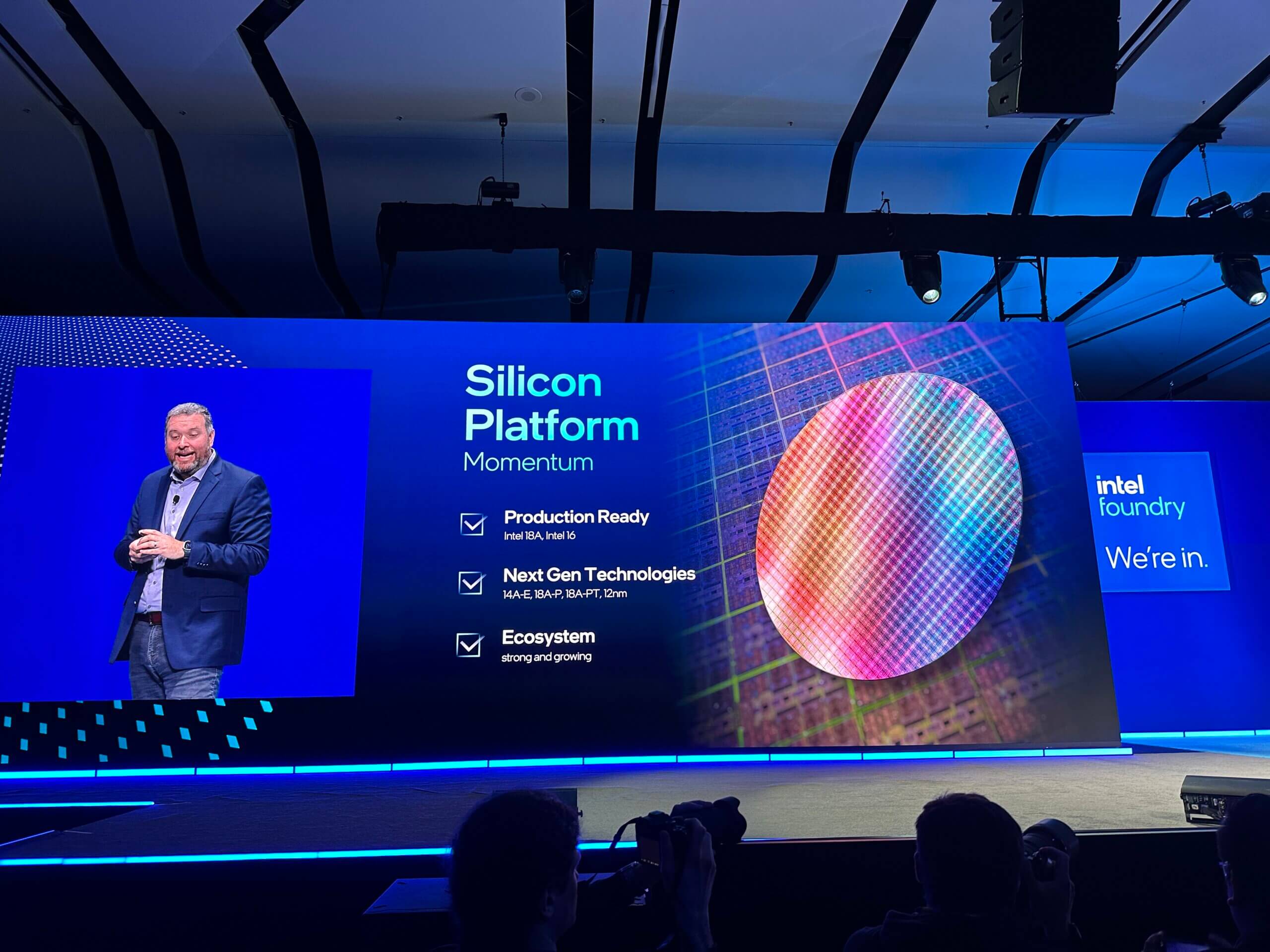
At the Intel Direct event in San Jose, Kevin O’Buckley, SVP and GM of Intel Foundry Services, delivered a candid address focused on aligning Intel’s foundry roadmap with the fast-evolving needs of AI-era customers. Rather than rehashing process node specs, O’Buckley emphasized the “why” behind Intel’s strategy—explaining how customer demands are driving the company’s push toward massive chiplet-based architectures, supply chain diversification, and ecosystem collaboration. He spotlighted a shift toward service-first execution and predictability, rooted in trust, flexibility, and support for highly heterogeneous systems with radical die sizes, stacked memory, and ultra-high bandwidth electrical and optical interconnects.
O’Buckley confirmed that Intel 18A remains the cornerstone of Intel’s advanced foundry offerings, now supported by new variants like 18A-P and 18A-BT to address broader performance and packaging requirements. He also detailed progress on Intel 14A, the company’s second-generation node with backside power and ribbonFET, and confirmed active customer tape-outs on mature nodes like Intel 16 and Intel 12. To enhance customer enablement, Intel announced two new initiatives: the Intel Foundry Design Chain Alliance for turnkey design and manufacturing services, and the Chiplet Alliance to promote secure, interoperable chiplet standards.
In a key move to expand packaging capacity and geographic flexibility, Intel announced a partnership with Amkor Technology to qualify EMIB assembly at Amkor facilities starting in Korea by the end of 2026. Amkor COO Kevin Engel said the collaboration will offer customers consistent quality and reliability across regions, with future plans for U.S.-based EMIB packaging. O’Buckley also reiterated Intel’s openness to advanced package assembly for chips fabbed elsewhere—further signaling the company’s transformation into a full-spectrum systems foundry.
- Intel Foundry is evolving into a service-first, customer-centric business, guided by customer roadmaps and AI-driven architectures.
- Intel 18A is now in risk production, with new derivatives 18A-P (performance) and 18A-BT (TSV-enabled base die) in development.
- Intel 14A will deliver second-generation ribbonFET and backside power, with enhanced PPA targets based on learnings from 18A.
- MediaTek’s first product on Intel 16 has reached successful silicon, validating Intel’s mature node foundry capabilities.
- Intel announced two new alliances: Foundry Design Chain Alliance (turnkey design) and Chiplet Alliance (interoperability).
- Intel is expanding packaging services to include 3rd-party wafer bumping and test services with partners like Teradyne and Advantest.
- Intel and Amkor will jointly qualify EMIB advanced packaging, with production in Korea by late 2026 and future expansion in Arizona.
- EMIB, Foveros Direct, and UCIe-based platforms are optimized for AI-scale packaging, including massive HBM4 memory stacks.
- Intel’s foundry ecosystem now includes broader IP, EDA, substrate, and ATE partners to support secure, multi-vendor manufacturing.
“We’re not just building silicon—we’re building trust. We’re delivering roadmaps, accelerating ecosystem partnerships, and doing it all with intentionality to serve our customers,” said Kevin O’Buckley, SVP of Intel Foundry Services.