• Home
  • Events Calendar
  • Blueprint Guidelines
  • Privacy Policy
  • Subscribe to Daily Newsletter
  • NextGenInfra.io
No Result
View All Result
Converge Digest
Tuesday, April 14, 2026
  • Home
  • Events Calendar
  • Blueprint Guidelines
  • Privacy Policy
  • Subscribe to Daily Newsletter
  • NextGenInfra.io
No Result
View All Result
Converge Digest
No Result
View All Result

Home » Intel’s Future of the Enterprise looks to cloud repatriation

Intel’s Future of the Enterprise looks to cloud repatriation

August 14, 2018
in All
A A

A fundamental question regarding the astonishing rise of public cloud companies is how far will they go in capturing the enterprise networking and IT services businesses? 

Nearly every week, this journal tracks another “all-in” customer migration story to AWS, Azure, Google Cloud, Alicloud, etc. However, in reading the press announcements in detail, we often find caveats. Sometimes it is only one division of a corporation that is fully migrating to the cloud, or maybe it is a next-gen application that is all-in, or maybe the news is only the expression of an intent to go all-in to cloud but no timeline is given.

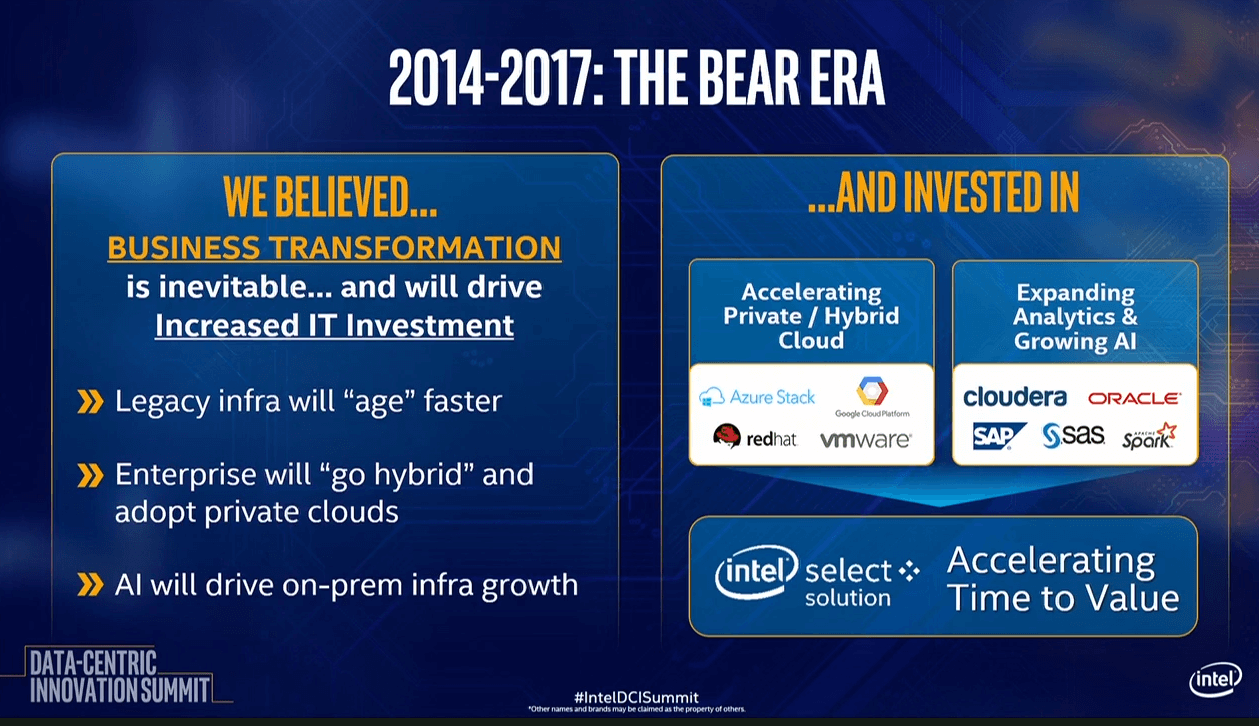
This topic was the subject of a  presentation given last week at the Intel Data Centric Innovation Summit by Rajeeb Hazra, Corporate Vice Presiden of Intel’s Data Center Group. Earlier in the day, Intel had spoken quite enthusiastically about partnerships with the big cloud providers to build custom silicon for their pressing scalability challenges. It is clear that Intel is benefitting from the explosive growth of hyperscale data centers from these guys. The forthcoming Intel Xeon processors with integrated persistent memory is an effort to accelerate this fire even faster.

The afternoon talk by Hazra tackled the “Future of the Enterprise” from the Intel perspective. Plenty of Xeon chips have shipped to enterprise customers of the past two decades and the company is determined that this party won’t end for any reason, even to be cannibalized by Xeon sales to the public cloud.

The key takeaway from Hazra’s presentation is a data point cited from IDC: that 80% of enterprises are considering re-patriating workloads from public clouds to their on-premise infrastructure.

One argument for this trend is that biggest enterprise applications require many clusters of high-performance systems, which currently are best procured in a public cloud. However, if we think about the mid to long-term future of computing, we should question whether this assumption will always hold true. How big are the largest corporate applications? What would it take to run them in-memory?  Hundreds of cores and thousands of threads? Terabytes of persistent memory? 

The development of persistent memory technologies, such as Intel’s Optane, promises to redraw the boundaries between computing and storage. In the microservices and containerization, could very efficient on-premise infrastructure do the job better than an all-in public cloud solution or hybrid cloud solution. Ten years from now or maybe sooner, the amount of compute and storage resources and AI resources that can be packed in one standard rack of equipment, may have caught up to the big data needs of most enterprise applications. In some sense, this is the same old question of whether it is better to rent or own. The answer depends on many factors, which may well shift away from public clouds when resources are cheap and powerful enough.

A video of Rajeeb Hazra’s “Future of the Enterprise” is archived here:  http://intelstudios.edgesuite.net/180808_dcis/archive/rh.html

Tags: Blueprint columns
ShareTweetShare
Previous Post

IETF completes Transport Layer Security 1.3

Next Post

Ixia brings visibility into east-west flows without hypervisor access

Staff

Staff

Related Posts

Blueprint: Brazil looks to municipal Wi-Fi 6E
Blueprints

Blueprint: Brazil looks to municipal Wi-Fi 6E

February 21, 2023
Blueprint: Building wholesale networks with OTN
All

Blueprint: Building wholesale networks with OTN

December 20, 2022
Oracle opens cloud region in Chicago
All

Oracle opens cloud region in Chicago

December 20, 2022
BT trials C-RAN in Leeds
All

BT trials C-RAN in Leeds

December 19, 2022
T-Mobile builds cloud native 5G converged core with Cisco
All

T-Mobile builds cloud native 5G converged core with Cisco

December 15, 2022
Meta halts data center expansion construction in Denmark
All

Meta halts data center expansion construction in Denmark

December 15, 2022
Next Post
Ixia brings visibility into east-west flows without hypervisor access

Ixia brings visibility into east-west flows without hypervisor access

Please login to join discussion

Categories

  • 5G / 6G / Wi-Fi
  • AI Infrastructure
  • All
  • Automotive Networking
  • Blueprints
  • Clouds and Carriers
  • Data Centers
  • Enterprise
  • Explainer
  • Feature
  • Financials
  • Last Mile / Middle Mile
  • Legal / Regulatory
  • Optical
  • Quantum
  • Research
  • Security
  • Semiconductors
  • Space
  • Start-ups
  • Subsea
  • Sustainability
  • Video
  • Webinars

Archives

Tags

5G All AT&T Australia AWS Blueprint columns BroadbandWireless Broadcom China Ciena Cisco Data Centers Dell'Oro Ericsson FCC Financial Financials Huawei Infinera Intel Japan Juniper Last Mile Last Mille LTE Mergers and Acquisitions Mobile NFV Nokia Optical Packet Systems PacketVoice People Regulatory Satellite SDN Service Providers Silicon Silicon Valley StandardsWatch Storage TTP UK Verizon Wi-Fi
Converge Digest

A private dossier for networking and telecoms

Follow Us

  • Home
  • Events Calendar
  • Blueprint Guidelines
  • Privacy Policy
  • Subscribe to Daily Newsletter
  • NextGenInfra.io

© 2025 Converge Digest - A private dossier for networking and telecoms.

No Result
View All Result
  • Home
  • Events Calendar
  • Blueprint Guidelines
  • Privacy Policy
  • Subscribe to Daily Newsletter
  • NextGenInfra.io

© 2025 Converge Digest - A private dossier for networking and telecoms.

This website uses cookies. By continuing to use this website you are giving consent to cookies being used. Visit our Privacy and Cookie Policy.
Go to mobile version